
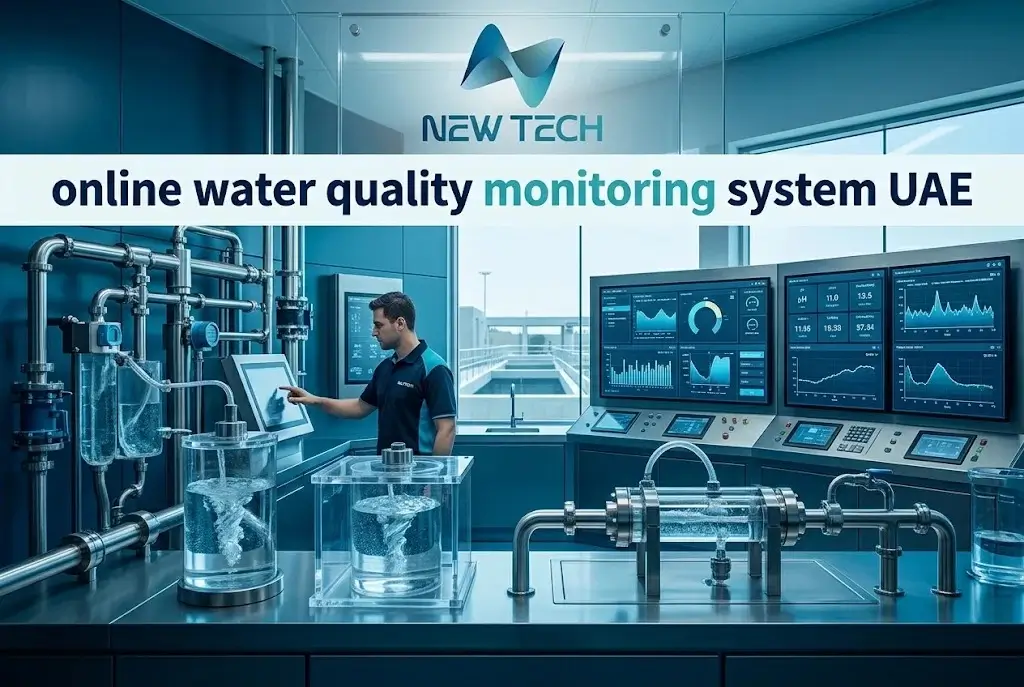
Are you looking for an online water quality monitoring system UAE industrial facilities can use to detect changes in critical water parameters before they disrupt operations? Continuous monitoring helps plant operators track selected measurements, identify abnormal trends and make more informed decisions.
From reverse osmosis systems to industrial process water, choosing the right sensors and monitoring points is essential. This guide explains the technologies, practical applications, costs and selection criteria to consider with New Tech Water.
Online Water Quality Monitoring System UAE: How Does It Work?
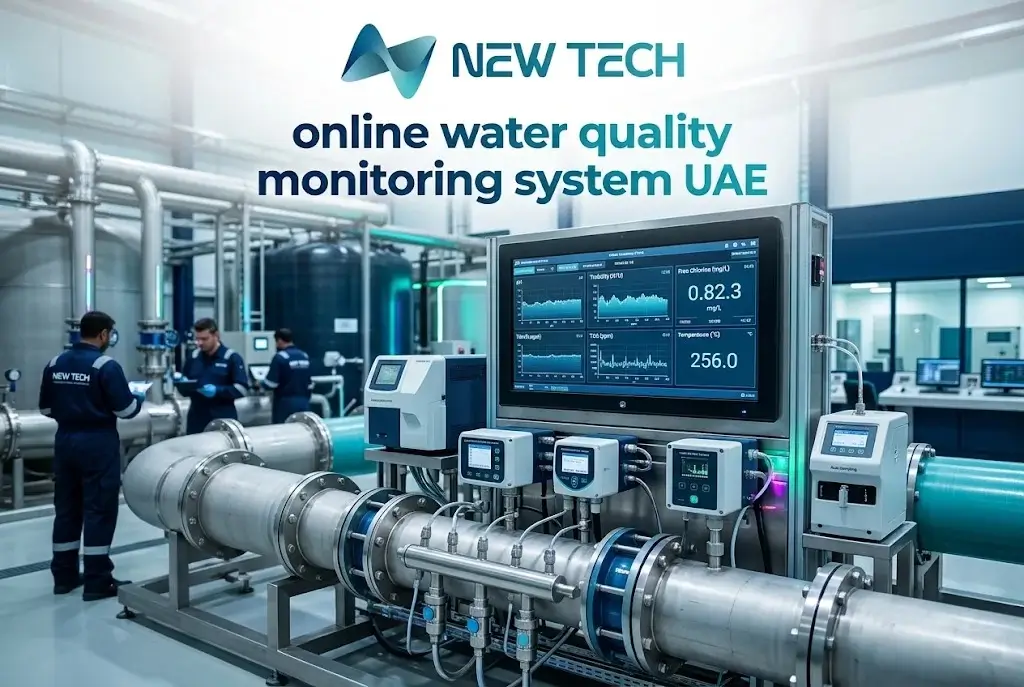
An online water quality monitoring system UAE facilities use measures selected water parameters continuously or at defined intervals through installed instruments. Unlike occasional manual sampling, an online configuration can provide frequent readings that help operators observe changes as they occur. The measurement equipment may include sensors, analyzers, transmitters, displays and data recording devices. The exact arrangement depends on the treatment process, sampling conditions and required parameters.
For example, a reverse osmosis plant may use conductivity sensors to monitor changes in dissolved-ion content before and after membrane treatment. These instruments send signals to a local display or another compatible monitoring device. If the system includes alarm functionality, abnormal readings may trigger notifications for operator investigation. However, an alarm does not automatically identify the underlying cause or prove that water is safe for every intended use.
Continuous water quality monitoring should therefore support an established water management program rather than replace laboratory testing, routine maintenance or technical supervision.
How Water Quality Data Moves Through the System
- Water reaches the selected measurement point or sample line.
- A suitable sensor measures the intended physical or chemical parameter.
- A transmitter or analyzer processes the instrument signal.
- The reading appears on an approved display or monitoring interface.
- Compatible equipment may record measurements for trend analysis.
- Configured alarms notify operators when specified limits are exceeded.
- Operators investigate changes and follow approved response procedures.
Some systems provide only local measurement, while others can support centralized monitoring. A water treatment monitoring system should be designed around actual operating needs instead of assuming every facility requires advanced connectivity.
Want better visibility into your treatment process? Contact New Tech Water to discuss the monitoring requirements of your industrial water treatment plant.
Request a Free Consultation Now
Get in touch with our experts to help you choose the right water treatment plant for your needs with maximum efficiency and minimum cost.
Why Continuous Water Quality Monitoring Matters for Industrial Facilities
Water treatment performance can change because of fluctuations in feedwater composition, equipment condition, chemical treatment or operating parameters. Periodic laboratory samples remain essential for many applications, but they may not show every variation that occurs between sampling events. Online monitoring can help bridge this information gap by providing measurements at selected points during operation.
For industrial facilities, the main objective is not simply collecting more data. Monitoring should provide information that operators can act on. A conductivity trend, for example, may indicate a change in reverse osmosis performance that requires investigation. A turbidity measurement may help operators assess selected filtration processes. A pH reading can provide useful information for chemical treatment where pH control is required.
The monitoring approach should reflect the water source, treatment technology, operational risks and required product-water quality. Sensors must also be maintained and verified to prevent misleading readings. When configured appropriately, continuous monitoring supports more consistent process supervision and can contribute to better-informed maintenance decisions.
Benefits of Selecting the Right Monitoring Parameters
- Earlier identification of abnormal trends in selected measurements.
- More consistent visibility into treatment process conditions.
- Improved documentation of measured operating parameters.
- Better information for troubleshooting and maintenance planning.
- Support for defined process-control and alarm requirements.
- Reduced dependence on manual readings for parameters that can be measured online.
These potential benefits depend on sensor accuracy, appropriate sampling locations, reliable communications and trained operators. An instrument cannot measure contaminants or conditions outside its specified capabilities.
Improve the information available to your operators. Discuss your water quality and monitoring objectives with New Tech Water.
Request a Free Consultation Now
Get in touch with our experts to help you choose the right water treatment plant for your needs with maximum efficiency and minimum cost.
Which Water Quality Parameters Should You Monitor Online?
Choosing a water quality monitoring system starts with deciding what must be measured. Different treatment processes require different parameters, and not every sensor is suitable for every application. A monitoring package that works well for industrial RO permeate may not provide the measurements required for wastewater treatment or a disinfection process.
An online water quality monitoring system UAE specification should identify each parameter, its operating range, measurement accuracy, installation conditions and required maintenance. This makes it easier to compare instruments and avoid purchasing unnecessary components.
| Parameter | Measurement Purpose | Typical Application |
|---|---|---|
| pH | Measures acidity or alkalinity. | Chemical treatment and process monitoring. |
| Conductivity | Indicates the water’s electrical conductivity, influenced by dissolved ions. | RO feedwater and permeate monitoring. |
| TDS | Estimates dissolved solids when derived from conductivity using an appropriate factor. | Selected water-quality trending applications. |
| Turbidity | Measures light scattering associated with suspended particles. | Filtration and selected pretreatment processes. |
| ORP | Measures oxidation-reduction potential. | Selected chemical treatment and disinfection applications. |
| Residual Chlorine | Measures remaining chlorine concentration. | Applicable chlorination and disinfection systems. |
| Dissolved Oxygen | Measures oxygen dissolved in water. | Wastewater and selected industrial processes. |
Conductivity and TDS Monitoring for RO Plants
Conductivity is one of the most useful measurements for monitoring dissolved-ion trends in reverse osmosis systems. Changes in feedwater or permeate conductivity can provide operators with information about operating conditions and potential performance changes. However, conductivity is not a direct measurement of every dissolved contaminant.
Some instruments display estimated TDS based on conductivity and an assumed conversion factor. The estimate depends on the dissolved-ion composition, temperature compensation and selected conversion method. It should not be treated as a complete chemical analysis.
pH Monitoring for Chemical Treatment
Online pH measurement can support processes where acidity or alkalinity affects treatment performance. Sensor selection depends on the chemical characteristics of the water, temperature, pressure and required measurement range. Proper calibration and electrode maintenance are especially important because inaccurate pH readings can affect operating decisions.
Turbidity Monitoring for Filtration Performance
Turbidity instruments can help observe changes in suspended-particle conditions at selected process stages. They are useful where clarification or filtration performance needs to be monitored. However, low turbidity does not demonstrate the absence of dissolved contaminants or microorganisms, and additional testing may be required.
ORP, Chlorine and Dissolved Oxygen Monitoring
Other parameters may be relevant to particular treatment processes. ORP can provide information about oxidation-reduction conditions, while suitable chlorine analyzers can measure residual disinfectant concentrations. Dissolved oxygen measurement may be important in biological treatment and other process applications.
These instruments should only be specified where the process requires them. A multiparameter system is not automatically more effective than a carefully selected set of individual sensors.
Not sure which parameters your facility should monitor? Share your water analysis and treatment objectives with New Tech Water.
Request a Free Consultation Now
Get in touch with our experts to help you choose the right water treatment plant for your needs with maximum efficiency and minimum cost.
Online Water Quality Monitoring vs Laboratory Testing
Online monitoring and laboratory analysis serve different purposes. Continuous instruments are particularly useful for observing trends and identifying changes in selected parameters. Laboratory testing can evaluate additional substances or characteristics that cannot be established using the installed online instruments.
An online water quality monitoring system UAE facilities rely on should complement the required sampling and verification program. The appropriate combination depends on the water application, applicable standards and the technical limitations of the measurement equipment.
| Comparison | Online Monitoring | Laboratory Testing |
|---|---|---|
| Measurement Frequency | Continuous or scheduled automatic readings. | Samples tested according to an established schedule. |
| Result Availability | Frequent process measurements. | Depends on analytical method and laboratory turnaround. |
| Parameter Coverage | Limited to installed sensor capabilities. | Broader analyses where suitable methods are available. |
| Primary Purpose | Process trends and operational monitoring. | Detailed testing and specified verification. |
| Maintenance | Calibration, cleaning and instrument checks. | Sampling controls and laboratory quality procedures. |
For example, a conductivity sensor can detect changes in a selected RO water stream, but it cannot independently confirm that all chemical and microbiological requirements have been satisfied. A facility may therefore need both continuous process measurements and laboratory testing.
Sampling procedures also matter. Poor sample handling can affect laboratory results, while unsuitable sensor placement can compromise online measurements. Both approaches need documented quality controls.
Build a monitoring strategy around your actual water-quality requirements. Contact New Tech Water to discuss your industrial treatment application.
Request a Free Consultation Now
Get in touch with our experts to help you choose the right water treatment plant for your needs with maximum efficiency and minimum cost.
Where Should Water Quality Sensors Be Installed in an Industrial RO Plant?
Sensor placement is one of the most important decisions in a water quality monitoring project. Installing a suitable analyzer at the wrong location may produce accurate measurements that provide little useful information about the process. Monitoring points must be selected according to the water treatment stages and the decisions operators need to make.
For an industrial RO plant, a monitoring plan may include feedwater, selected pretreatment stages and permeate water. The exact configuration depends on the equipment, membrane requirements and product-water specification.
Feedwater Monitoring Points
Feedwater measurement helps establish the water conditions entering the treatment system. Conductivity, pH and other parameters may be relevant depending on the source and treatment design. Measurements at this stage can provide context when operators compare downstream performance.
Pretreatment Monitoring Points
Pretreatment monitoring should focus on parameters relevant to the selected filtration and chemical treatment processes. For example, turbidity measurements may be useful in certain filtration arrangements, while other installations need specific water-quality checks before membrane treatment.
Instrumentation should reflect the actual protection requirements of the installed membranes. Sensors cannot replace the need to verify parameters that are not measured by the online system.
Permeate Monitoring Points
Permeate conductivity can help operators observe changes in dissolved-ion rejection over time. The readings should be interpreted alongside feedwater conditions, flow, pressure and temperature. A change in conductivity alone does not prove the cause of a performance problem.
For more information about industrial RO configurations and treatment requirements, explore New Tech Water’s industrial RO plant UAE guide.
Sampling Lines and Flow Cells
Some instruments require a controlled sample flow through an appropriate measurement chamber or flow cell. The sample arrangement should consider pressure, temperature, flow conditions, maintenance access and instrument manufacturer recommendations.
Long or poorly designed sample lines may introduce delays or affect the representativeness of the measurement. Sensor locations should therefore be reviewed during engineering rather than selected solely for installation convenience.
Planning monitoring points for an RO plant? Share your process layout and treatment requirements with New Tech Water.
Request a Free Consultation Now
Get in touch with our experts to help you choose the right water treatment plant for your needs with maximum efficiency and minimum cost.
Practical Example: Detecting Changes in RO Permeate Quality
Consider a manufacturing facility using reverse osmosis to produce process water. The plant normally operates within established conductivity and flow ranges, and its operators monitor permeate quality during production.
If the permeate conductivity begins increasing, an online analyzer may identify the trend before the next scheduled manual sample. The operator can review the associated process readings and determine whether further investigation is necessary.
A suitable response may include the following steps:
- Verify the conductivity reading and instrument status.
- Compare current measurements with recent operating trends.
- Review feedwater conductivity and relevant temperature conditions.
- Check available flow and pressure information.
- Collect a confirmatory sample when appropriate.
- Investigate potential process or equipment causes.
- Document findings and corrective actions.
This example shows the difference between detecting a change and diagnosing its cause. Increasing permeate conductivity might relate to changing feedwater composition, membrane performance, operating conditions or an instrument issue. The correct conclusion requires additional evidence.
Configured alarms can support the investigation, but thresholds should reflect the approved water-quality specification and control philosophy. They should not be based on arbitrary values copied from another installation.
A well-planned monitoring arrangement makes relevant information easier to access, helping operators respond systematically rather than relying on assumptions.
Need better insight into your RO plant’s water-quality performance? Discuss your monitoring objectives with New Tech Water.
Request a Free Consultation Now
Get in touch with our experts to help you choose the right water treatment plant for your needs with maximum efficiency and minimum cost.
Single-Parameter vs Multiparameter Monitoring Systems
A water quality monitoring system may use individual analyzers or a coordinated multiparameter arrangement. The choice depends on how many measurements are required, where they are taken and how the information will be used.
| Selection Factor | Single-Parameter | Multiparameter |
|---|---|---|
| Measurement Scope | One selected parameter per instrument. | Several supported parameters. |
| Configuration | Individual instrument installation. | Integrated or modular instrument arrangement. |
| Suitable Use | Focused monitoring at specific points. | Applications requiring several related measurements. |
| Maintenance | Depends on each instrument. | Depends on sensor types and system architecture. |
| Cost | Depends on instrument and installation scope. | Depends on modules, functions and integration requirements. |
A facility that only needs permeate conductivity monitoring may not benefit from purchasing a comprehensive multiparameter analyzer. Conversely, a process that requires several measurements at the same sampling point may benefit from an integrated solution.
For technical background on modular continuous water analysis and sensor integration, see Bürkert’s continuous online water quality monitoring overview.
The final selection should account for measurement accuracy, sensor compatibility, maintenance requirements, sample conditions and the total installed scope.
Avoid unnecessary monitoring equipment. Discuss the parameters your plant actually needs with New Tech Water.
Request a Free Consultation Now
Get in touch with our experts to help you choose the right water treatment plant for your needs with maximum efficiency and minimum cost.
Remote Monitoring, Data Logging and Alarm Integration
Some industrial facilities need more than local instrument displays. They may require historical data, centralized visualization or notifications when selected measurements exceed approved limits. These functions can be incorporated into a monitoring architecture when supported by the installed equipment.
Data Logging and Trend Analysis
Data logging allows operators to review changes over time instead of relying only on current readings. Historical measurements can support maintenance investigations and process performance reviews, provided the data is accurate and recorded with appropriate timestamps.
The system specification should define which values need recording, how frequently measurements should be stored and how long records must be retained.
Integration with Plant Control Systems
Compatible instruments may provide signals to a PLC, HMI or SCADA system. However, measuring a parameter and automatically controlling equipment are separate functions. Any automatic response requires approved control logic, equipment compatibility and suitable testing.
A monitoring system should not be assumed to include automatic chemical dosing or protective shutdowns unless those functions are explicitly specified.
Remote Access and Cybersecurity
Remote monitoring may help authorized personnel review available readings without being physically present at the plant. Where network connectivity is included, access permissions, communication security and responsibility for system administration should be clearly defined.
Essential local equipment protection should not rely entirely on an internet connection. Remote access should support the approved operational arrangement without creating unnecessary cybersecurity risks.
Need clearer reporting and visibility across your water treatment process? Discuss your monitoring and data requirements with New Tech Water.
Request a Free Consultation Now
Get in touch with our experts to help you choose the right water treatment plant for your needs with maximum efficiency and minimum cost.
Online Water Quality Monitoring Requirements for UAE Facilities
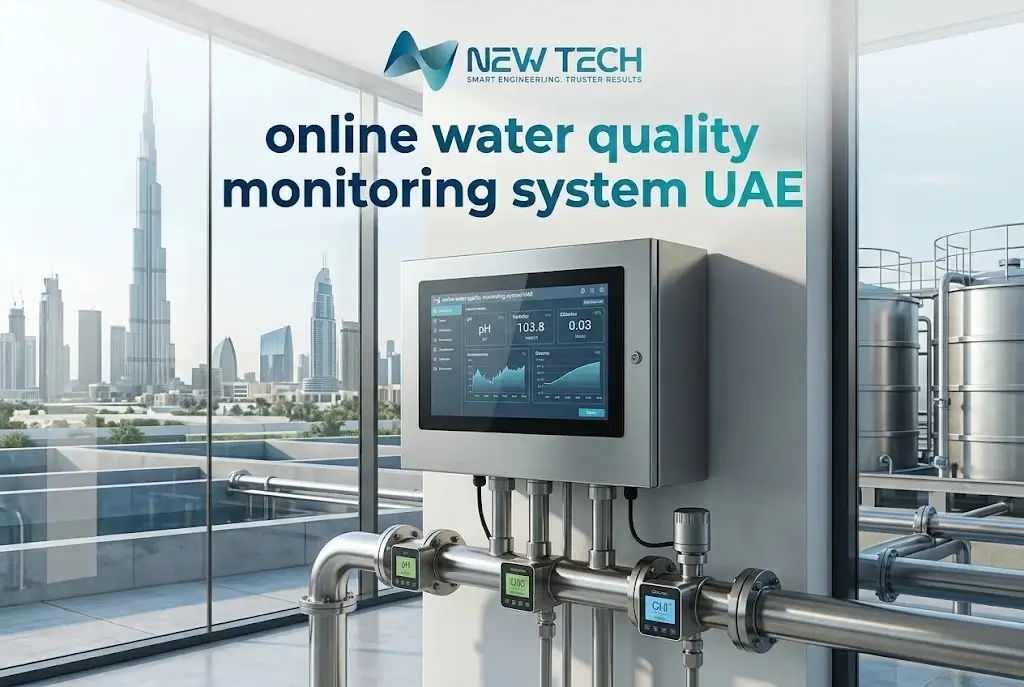
An online water quality monitoring system UAE industrial projects consider should be specified for the actual operating environment and application. Facilities in Dubai, Abu Dhabi, Sharjah and other emirates may have different treatment needs, installation conditions and site requirements.
A manufacturing facility monitoring RO permeate for production may require different parameters from a facility assessing water for another use. The intended application should determine measurement targets and verification methods.
Environmental Conditions and Instrument Protection
High ambient temperatures, humidity, dust and outdoor exposure can affect electronic instruments and control equipment. Specifications should consider the environmental ratings of sensors, analyzers, enclosures and communication devices.
Where instruments are installed outdoors or in demanding industrial areas, additional protection or suitable installation arrangements may be necessary. The requirements should follow actual site conditions and equipment manufacturer instructions.
Industrial Monitoring Needs in Dubai and Abu Dhabi
Industrial plants may require monitoring at different treatment stages depending on the water source and production requirements. For example, an RO installation serving a manufacturing process may prioritize conductivity trends, while another industrial treatment system may require pH or turbidity measurements.
The monitoring design should not assume that a specific instrument package applies equally to every facility or emirate.
For related engineering considerations, review New Tech Water’s industrial RO plant Dubai guide.
Water Quality Standards and Verification
Applicable water-quality requirements depend on the intended use, facility type and responsible authority. Online instrument readings do not automatically demonstrate legal or contractual compliance.
Project owners should identify the relevant standards, required laboratory testing, reporting obligations and acceptance criteria before selecting equipment. Where the application involves drinking water or another regulated use, the appropriate requirements must be confirmed with the responsible authorities and qualified professionals.
Planning a monitoring system for a UAE facility? Contact New Tech Water with your application, water specification and site requirements.
Request a Free Consultation Now
Get in touch with our experts to help you choose the right water treatment plant for your needs with maximum efficiency and minimum cost.
How Much Does an Online Water Quality Monitoring System Cost in UAE?
The cost of an online water quality monitoring system UAE project depends on the required measurements, selected instrument specifications, installation conditions and additional monitoring functions. A single conductivity analyzer can have a very different installed cost from a multiparameter system with several sampling points and centralized data recording.
Providing one general price without reviewing the technical requirements would be misleading. Procurement teams should compare quotations against a defined measurement and installation scope.
Main Factors Affecting Monitoring System Cost
- Number and type of required water-quality parameters.
- Sensor accuracy and measurement range.
- Number and location of sampling points.
- Sample lines, flow cells and associated equipment.
- Displays, transmitters and data logging requirements.
- Communication interfaces and integration scope.
- Environmental protection and installation conditions.
- Calibration, verification and commissioning requirements.
- Maintenance materials and replacement components.
What Should Be Included in a Technical RFQ?
| RFQ Item | Information to Provide |
|---|---|
| Application | Water source, treatment process and intended use. |
| Parameters | Required measurements and applicable operating ranges. |
| Sampling Points | Locations and available process conditions. |
| Monitoring | Local display, logging or remote access requirements. |
| Interfaces | Connections to existing control or monitoring equipment. |
| Installation | Site conditions and relevant mechanical or electrical requirements. |
| Verification | Calibration, functional checks and acceptance criteria. |
| Maintenance | Required service arrangements and replacement components. |
When comparing offers, confirm whether sensors, transmitters, sampling accessories, software, installation and commissioning are included. A lower headline price may reflect a narrower scope rather than a better-value solution.
Preparing an industrial water monitoring RFQ? Share your water analysis, measurement requirements and project scope with New Tech Water.
Request a Free Consultation Now
Get in touch with our experts to help you choose the right water treatment plant for your needs with maximum efficiency and minimum cost.
Common Water Quality Monitoring Problems and Maintenance Requirements
Online monitoring equipment requires regular attention to maintain dependable measurements. Even technically suitable instruments can produce misleading information when installed incorrectly, affected by deposits or operated without the required calibration procedures.
Sensor Drift and Calibration Errors
Sensor drift can cause measurements to change gradually even when the actual water conditions remain relatively stable. Calibration and verification intervals should reflect the instrument technology, manufacturer guidance, operating conditions and measurement importance.
If a reading appears abnormal, operators should investigate instrument condition and compare results with appropriate reference measurements before making significant process adjustments.
Sensor Fouling and Sample Line Problems
Deposits, suspended particles or biological growth can affect certain sensor surfaces and sample arrangements. Maintenance procedures may include appropriate cleaning, inspection and replacement of consumable parts.
Sample lines should also be checked for restrictions, leaks, insufficient flow or other conditions that could compromise measurement quality. Cleaning procedures must remain compatible with the installed sensor materials.
Temperature and Measurement Interpretation
Some water-quality measurements are affected by temperature. Conductivity readings, for example, may require appropriate temperature compensation when comparing results collected under different conditions.
Operators should understand whether an analyzer displays actual or temperature-compensated measurements and whether historical values were recorded using comparable settings.
False Alarms and Unreliable Data
Incorrect sensor configuration, unstable signals or unsuitable alarm thresholds can generate misleading notifications. Alarm settings should be established according to the process requirements and checked during commissioning.
For additional context on instrument verification and plant startup, read New Tech Water’s water treatment plant commissioning UAE guide.
Experiencing inconsistent water-quality readings? Discuss your instruments, process conditions and monitoring challenges with New Tech Water.
Request a Free Consultation Now
Get in touch with our experts to help you choose the right water treatment plant for your needs with maximum efficiency and minimum cost.
How to Choose the Right Water Quality Monitoring Solution
Selecting monitoring equipment should begin with the information that the facility needs, not with a list of available sensors. The best configuration is one that provides relevant measurements with suitable accuracy and maintainable installation arrangements.
Before requesting a proposal, use the following checklist:
- Define the intended water use and required quality.
- Identify the treatment stages that require monitoring.
- Confirm which parameters can be measured online.
- Determine whether laboratory verification is also required.
- Select representative and accessible measurement points.
- Review sensor ranges, accuracy and process compatibility.
- Specify data recording and alarm requirements.
- Check instrument maintenance and calibration needs.
- Confirm site conditions and integration requirements.
- Establish the technical quotation and acceptance criteria.
The goal is to avoid both insufficient monitoring and unnecessary equipment. A single properly located instrument may provide more useful information than several poorly selected sensors.
For existing facilities, the assessment should also consider whether the current water treatment process is performing as intended. Adding monitoring equipment cannot correct an unsuitable treatment design or unresolved mechanical problem.
Choose instruments based on your actual process needs. Contact New Tech Water to discuss your water treatment and monitoring requirements.
Request a Free Consultation Now
Get in touch with our experts to help you choose the right water treatment plant for your needs with maximum efficiency and minimum cost.
Why Consider New Tech Water for Your Water Treatment Project?
Reliable monitoring starts with understanding the treatment process, required water quality and operating conditions. New Tech Water works with industrial water treatment solutions, including engineering considerations related to system design, equipment selection, installation, commissioning and maintenance.
When evaluating an online water quality monitoring system UAE project, this process-focused approach can help facility owners identify which measurements are relevant to their treatment objectives. Rather than beginning with an assumed instrument package, project discussions can address the water source, treatment stages, required quality and available operating data.
Important technical considerations include:
- Understanding feedwater and treated-water requirements.
- Reviewing the relevant treatment process.
- Identifying suitable monitoring parameters.
- Defining instrumentation and sampling requirements.
- Considering equipment integration and operating conditions.
- Reviewing installation and commissioning requirements.
- Planning for calibration and routine maintenance.
The availability and scope of any standalone online analyzer supply, specialist integration or remote monitoring service should be confirmed within the project proposal. This ensures that the selected equipment and technical responsibilities match the actual requirements.
Discuss your industrial water treatment project with New Tech Water and request a technical consultation based on your facility’s needs.
Request a Free Consultation Now
Get in touch with our experts to help you choose the right water treatment plant for your needs with maximum efficiency and minimum cost.
Frequently Asked Questions About Online Water Quality Monitoring System UAE
What is an online water quality monitoring system?
It uses installed instruments to measure selected water parameters continuously or at defined intervals, providing operating data and optional alarm information.
Which water parameters can be monitored online?
Common examples include pH, conductivity, turbidity, ORP, residual chlorine and dissolved oxygen. The required parameters depend on the treatment application.
Can an online monitoring system measure TDS?
Some systems estimate TDS from conductivity using a selected conversion factor. This estimate is not equivalent to a complete laboratory analysis.
Is online monitoring suitable for industrial RO plants?
Yes. Suitable instruments can monitor selected RO parameters, particularly conductivity trends in feedwater and permeate streams.
Does continuous monitoring replace laboratory testing?
No. Laboratory analysis may still be needed for parameters that online sensors do not measure and for applicable verification or compliance requirements.
How much does online water quality monitoring cost in the UAE?
Cost depends on sensor specifications, monitoring points, displays, data systems, installation and commissioning requirements. A defined technical scope is needed for pricing.
Where should water quality sensors be installed?
Measurement points should be selected according to the treatment stages and operating decisions, ensuring representative samples and suitable installation conditions.
Can water quality measurements be monitored remotely?
Yes, when compatible communication and monitoring functions are included. Remote access requires appropriate security and operational arrangements.
How often should monitoring sensors be calibrated?
Calibration intervals depend on the sensor technology, manufacturer instructions, operating conditions and required measurement accuracy.
What information is needed to request a monitoring system quotation?
Provide the water source, intended use, treatment process, required parameters, measurement points, site conditions and monitoring or integration requirements.
Have questions about selecting water-quality instruments? Contact New Tech Water with your project details.
Request a Free Consultation Now
Get in touch with our experts to help you choose the right water treatment plant for your needs with maximum efficiency and minimum cost.
Stay Ahead of Water Quality Changes with Smarter Monitoring
Choosing an online water quality monitoring system UAE facilities can rely on starts with selecting the right parameters, sensors and measurement points. Continuous monitoring can help operators identify changes, review process trends and make better-informed decisions when supported by reliable instruments and maintenance.
New Tech Water can discuss your industrial water treatment requirements and the monitoring considerations relevant to your project. Share your water analysis, plant capacity and required measurements to begin a technical discussion.
Contact New Tech Water today to discuss your water treatment project and take the next step toward more informed water-quality monitoring.
Request a Free Consultation Now
Get in touch with our experts to help you choose the right water treatment plant for your needs with maximum efficiency and minimum cost.

 English
 Arabic