
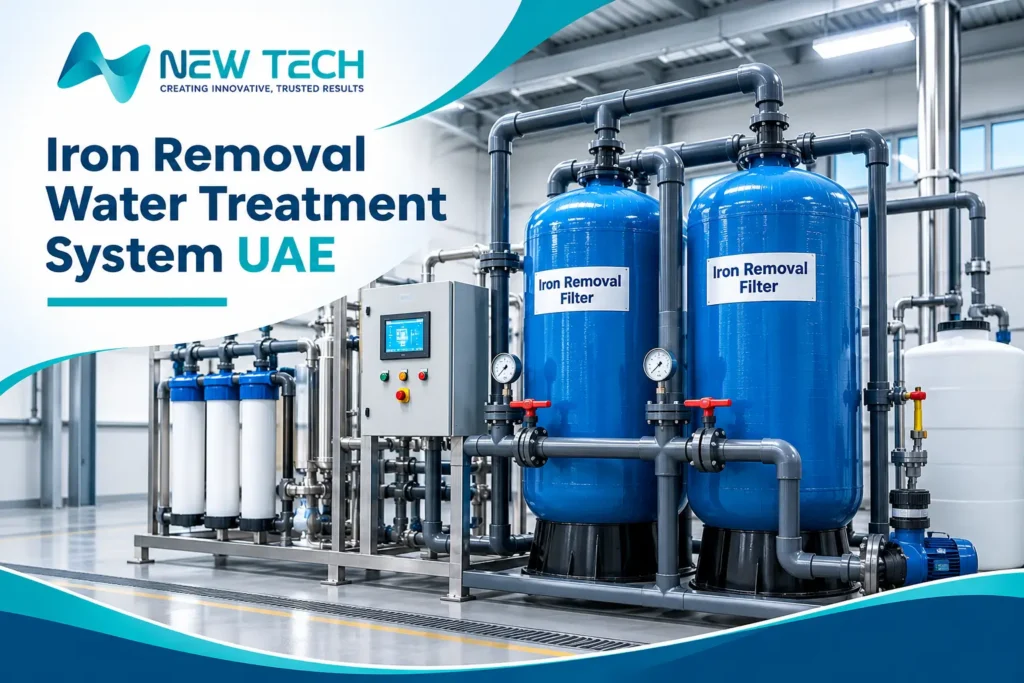
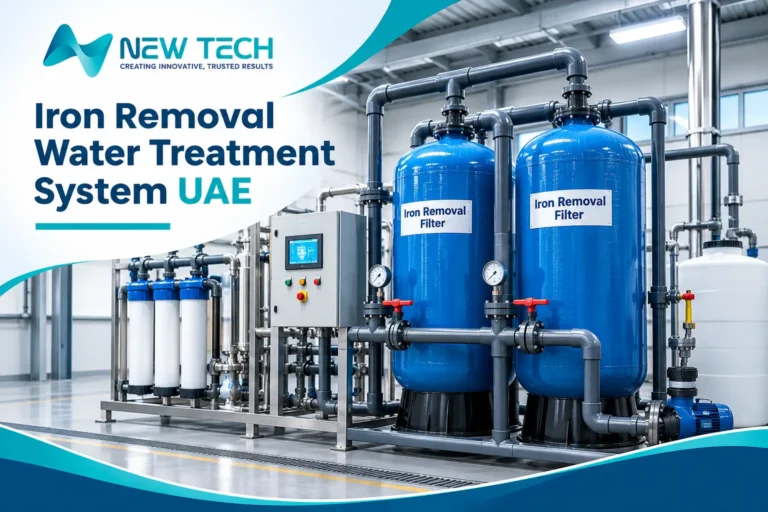
Does your groundwater cause brown deposits, staining or recurring filtration problems? An Iron Removal Water Treatment System UAE project should begin with accurate water testing, not an assumption about the source of discoloration. Dissolved iron, particulate iron and manganese can require different treatment conditions.
Whether you manage a factory, groundwater well or industrial RO plant, this guide explains oxidation, filtration, sizing, troubleshooting and procurement requirements to help you discuss a suitable solution with New Tech Water.
Iron Removal Water Treatment System UAE: Start with the Right Water Analysis
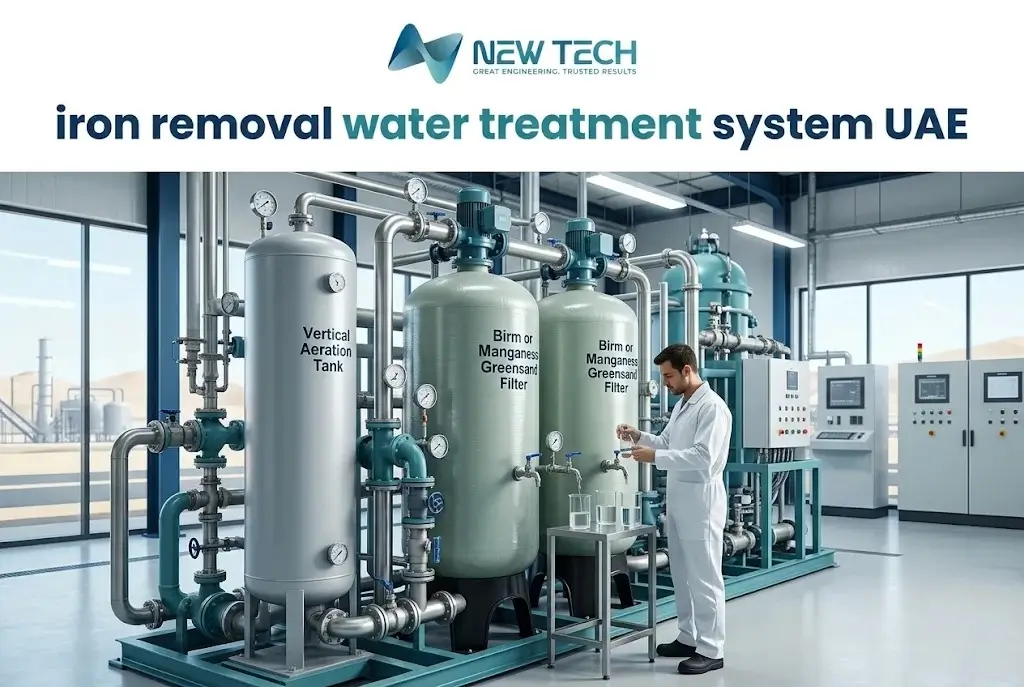
The first step in selecting an industrial iron removal system is identifying the actual forms and concentrations of iron in the source water. Groundwater can contain dissolved ferrous iron that initially appears clear, suspended iron particles or mixtures of both. These forms behave differently during treatment, so equipment selection should follow appropriate laboratory analysis.
Buyers evaluating an Iron Removal Water Treatment System UAE should establish the required treated-water quality alongside the source-water conditions. Water intended for a manufacturing process, agricultural use or reverse osmosis pretreatment may have different specifications. A system that reduces visible staining may not necessarily provide the water quality required by downstream membranes.
The water analysis should also identify manganese and other constituents that may affect oxidation or filtration. Where the feedwater changes over time, the design may need to account for variations in concentration, flow and operating conditions.
Essential Water Testing Parameters
| Parameter | Why It Matters |
|---|---|
| Total Iron | Measures the overall iron concentration in the sample. |
| Dissolved Iron | Helps distinguish the dissolved fraction from suspended iron. |
| Ferrous Iron, Fe(II) | Helps assess oxidation requirements where appropriately measured. |
| Manganese | Identifies whether additional treatment conditions are necessary. |
| pH | Influences oxidation kinetics and media performance. |
| Dissolved Oxygen | Supports evaluation of oxygen-based oxidation. |
| Alkalinity | Helps assess pH stability during treatment. |
| Turbidity | Indicates the presence of suspended particles. |
| TDS and Conductivity | Help characterize the source water and downstream treatment needs. |
| Organic Matter and Other Constituents | May interfere with oxidation or affect process selection. |
Understanding Total Iron vs Dissolved Iron
Total iron includes the dissolved and particulate iron fractions measured by the applicable analytical method. Dissolved iron is determined using a suitable sample filtration and preservation procedure. These measurements can help engineers understand whether particulate separation alone is likely to be sufficient.
For example, suppose a properly collected groundwater sample contains 3.0 mg/L of total iron and 2.4 mg/L of dissolved iron. The difference of approximately 0.6 mg/L represents the operationally determined non-dissolved fraction under the analytical methods used.
This suggests that a substantial proportion of the iron is present in dissolved form. However, dissolved iron is not necessarily all Fe(II), and the difference between the two measurements does not independently establish the best treatment process.
Why Sampling Procedures Matter
Ferrous iron may oxidize after a groundwater sample is exposed to air. As a result, the measured distribution between dissolved and particulate iron can change during sample transport.
Field measurement of Fe(II), appropriate sample filtration and preservation, and suitable laboratory methods should be considered according to the analytical objective. Incorrect sample handling can lead to treatment decisions based on misleading results.
Turn Your Water Analysis into a Treatment Plan. Share your iron, manganese, pH and required flow data with New Tech Water to discuss your groundwater treatment requirements.
Request a Free Consultation Now
Get in touch with our experts to help you choose the right water treatment plant for your needs with maximum efficiency and minimum cost.
Why Groundwater Contains Iron and Manganese
Iron and manganese can enter groundwater through natural interactions between water, soil and geological formations. Their concentrations and chemical forms depend on the local environment and conditions such as dissolved oxygen, pH and oxidation-reduction potential.
Under certain low-oxygen conditions, iron may remain dissolved as Fe(II). When water is pumped, aerated or exposed to different chemical conditions, the iron may oxidize and form particles that produce yellow, orange or brown deposits.
Dissolved Iron and Visible Deposits
Groundwater containing dissolved iron may initially appear clear. After exposure to oxygen, some of the iron may oxidize to Fe(III), forming insoluble iron-containing particles.
These deposits can affect filters, valves, tanks and industrial equipment. However, the amount and rate of precipitation depend on the actual water chemistry.
Does Brown Water Always Indicate Iron?
No. Discoloration can also arise from suspended sediment, corrosion products or other materials. Visual inspection alone cannot establish the cause or determine the required treatment.
Laboratory testing is necessary when diagnosing recurring staining or changes in water quality.
Why Manganese Needs Separate Attention
Manganese can occur alongside iron, but its oxidation and removal requirements are not necessarily identical. Some processes that effectively remove iron may leave dissolved manganese in the treated water.
Where both metals occur, engineers should establish separate treatment objectives and verify whether one combined process can achieve them.
Identify the Cause Before Choosing a Filter. Discuss your groundwater analysis and operating conditions with New Tech Water.
Request a Free Consultation Now
Get in touch with our experts to help you choose the right water treatment plant for your needs with maximum efficiency and minimum cost.
How Industrial Iron Removal Systems Work
Many industrial iron removal systems combine chemical transformation and physical separation. The process may convert dissolved iron into filterable particles and then remove those particles through suitable filtration or clarification equipment.
The required sequence depends on the forms of iron present, pH, oxidant demand, manganese concentration, organic matter and the expected solids loading.
Step 1: Determine the Treatment Objective
The engineer reviews source-water analysis and the required outlet quality. The assessment should identify whether the primary issue is dissolved iron, particulate iron, combined iron and manganese, or a more complex mixture.
Step 2: Select an Appropriate Oxidation Method
Where oxidation is required, the process must provide suitable conditions to convert dissolved iron into a removable form. Aeration or appropriately designed chemical oxidation may be considered depending on the source-water characteristics.
Step 3: Allow Sufficient Reaction and Particle Formation
Oxidation and precipitation may require mixing and contact time. The required conditions should be established from the treatment design and supported by testing where necessary.
Step 4: Separate the Resulting Particles
Pressure filtration, granular media systems or other suitable separation methods may remove oxidized iron particles. Where the solids load is high, clarification can be considered before filtration to reduce the burden on the filter beds.
Step 5: Verify Treatment Performance
Testing after the treatment stages helps confirm whether the required outlet-water quality is being achieved. Depending on the application, monitoring may include total iron, dissolved iron, manganese, turbidity and filter differential pressure.
New Tech Water provides information about integrated water treatment plants incorporating filtration and reverse osmosis technologies.
Choose the Right Oxidation and Filtration Process. Share your treatment targets and water analysis with New Tech Water to discuss an appropriate system configuration.
Request a Free Consultation Now
Get in touch with our experts to help you choose the right water treatment plant for your needs with maximum efficiency and minimum cost.
Aeration vs Chemical Oxidation for Iron Removal
Aeration and chemical oxidation are common approaches for converting dissolved iron into removable forms. Their performance depends on the water chemistry, oxidation conditions and effectiveness of the downstream separation process.
Iron Removal by Aeration
Aeration increases contact between water and air, allowing oxygen to enter the water. Under suitable pH and reaction conditions, dissolved Fe(II) can oxidize and form ferric particles that can subsequently be removed.
Simple aeration may be effective for selected groundwater sources. However, relatively low pH, unfavorable reaction conditions or organically complexed iron can make the process less effective.
Aeration equipment must also be designed to provide suitable oxygen transfer and contact conditions for the required treatment duty.
Iron Removal by Chemical Oxidation
Chemical oxidation uses a suitable oxidant to convert dissolved iron into removable particles. Depending on the application, selected oxidants may include chlorine, potassium permanganate or other agents.
Oxidant selection must consider the actual chemical demand, required contact time, reaction products and downstream equipment. Chemical dosing must be designed with appropriate monitoring and safety measures.
Comparing Available Treatment Methods
| Method | Potential Application | Key Limitation |
|---|---|---|
| Aeration + Filtration | Groundwater suitable for oxygen-based iron oxidation. | Influenced by pH, oxygen transfer and contact time. |
| Chemical Oxidation + Filtration | Applications requiring a selected chemical oxidant. | Requires controlled dosing and residual management. |
| Catalytic Media Filtration | Compatible iron or manganese treatment duties. | Depends on media-specific chemistry and operating conditions. |
| Clarification + Filtration | Processes with substantial particulate loading. | Requires additional equipment and residuals handling. |
| Biological Filtration | Selected systems with suitable biological conditions. | Requires specialized process design and stable operation. |
When Are Jar Tests or Pilot Tests Necessary?
For challenging source water, bench-scale tests or pilot studies can help verify treatment feasibility and optimize operating conditions before full-scale equipment is selected.
These investigations are especially useful where iron and manganese occur together, organic matter interferes with oxidation, oxidant demand is uncertain or the required treated-water specification is demanding.
Depending on the proposed process, testing may assess oxidation response, contact time, particle formation, chemical demand and filterability. The specific protocol should be designed by qualified water treatment professionals.
Health Canada’s technical guideline on iron in drinking water explains iron speciation, oxidation, filtration and the role of bench-scale and pilot testing.
This reference provides technical background and should not be interpreted as establishing regulatory requirements for industrial facilities in the UAE.
Test the Process Before Investing in Full-Scale Equipment. Contact New Tech Water with your water analysis and required treatment performance.
Request a Free Consultation Now
Get in touch with our experts to help you choose the right water treatment plant for your needs with maximum efficiency and minimum cost.
Choosing Filter Media for Iron and Manganese Removal
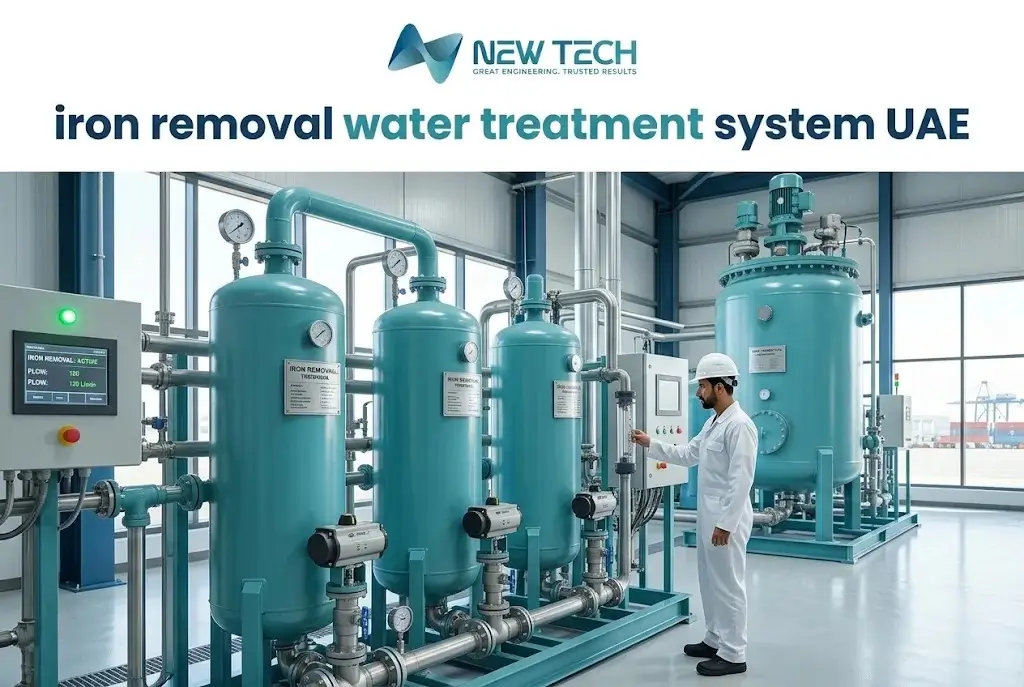
Filter media selection depends on whether the system must retain already-formed particles, support oxidation reactions or perform another specified treatment function.
Different media have different requirements for pH, dissolved oxygen, oxidant use, filtration velocity and backwashing. Therefore, the correct product cannot be selected from its name alone.
Silica Sand and Granular Filtration
Silica sand may remove suspended iron particles after suitable oxidation. It can be appropriate for selected filtration arrangements where the particles are sufficiently large and the system is correctly designed.
Conventional sand filtration should not automatically be expected to remove dissolved iron that has not undergone an appropriate treatment process.
Manganese Dioxide-Based Media
Selected manganese dioxide-based media may support iron or manganese removal through surface-related processes under defined operating conditions.
However, different media products have different requirements. Some systems rely on dissolved oxygen, while others need suitable oxidant addition or specific regeneration procedures.
Manganese Greensand
Greensand-type media may be used in suitable iron and manganese removal systems. Performance depends on the actual media product, water characteristics and maintenance arrangement.
Backwashing and the appropriate oxidation or regeneration strategy must follow the manufacturer’s requirements.
Birm and Other Specialized Media
Birm-type media can be considered for applications that meet the manufacturer’s conditions. Water pH, dissolved oxygen and interfering constituents are relevant selection factors.
A product suitable for one groundwater source may perform poorly with another, particularly where manganese, organics or other contaminants are present.
What Should Be Included in a Media Specification?
- Media product and exact grade.
- Required treatment function.
- Feedwater pH and dissolved oxygen conditions.
- Iron and manganese concentrations.
- Relevant oxidant or regeneration requirements.
- Design filtration rate and bed depth.
- Backwash flow and cleaning arrangements.
- Technical documentation and performance limits.
Select Filter Media Based on Your Actual Water Chemistry. Share your treatment parameters with New Tech Water before specifying a media grade.
Request a Free Consultation Now
Get in touch with our experts to help you choose the right water treatment plant for your needs with maximum efficiency and minimum cost.
Iron Removal and Manganese Removal: Why One Process May Not Be Enough
Iron and manganese frequently occur together in groundwater, but their chemical behavior can differ. Treating both effectively requires evaluating each metal’s dissolved and particulate forms and the process conditions needed for removal.
| Factor | Iron | Manganese |
|---|---|---|
| Common Dissolved Form | Fe(II). | Mn(II). |
| Oxygen-Based Oxidation | Often feasible under suitable conditions. | May require more demanding conditions. |
| pH Dependence | Important to oxidation kinetics. | Particularly important for many oxidation processes. |
| Media Selection | Suitable granular or catalytic media. | Suitable catalytic or specialized media. |
| Performance Monitoring | Iron species and total iron, as appropriate. | Manganese and relevant operating parameters. |
Why Treatment Sequence Matters
Iron can contribute to oxidant demand and solids loading in a treatment system. Where both iron and manganese are present, the sequence of oxidation and filtration may affect the removal performance of each metal.
Some projects may use a combined treatment stage, while others may benefit from separate treatment conditions. The appropriate design depends on the water analysis and verified process performance.
Successful iron removal does not automatically confirm manganese compliance with the required outlet-water specification. Both should be monitored where relevant.
Address Iron and Manganese as Separate Treatment Targets. Discuss your laboratory results with New Tech Water to evaluate the appropriate process sequence.
Request a Free Consultation Now
Get in touch with our experts to help you choose the right water treatment plant for your needs with maximum efficiency and minimum cost.
Protecting Industrial RO Membranes from Iron Fouling
Iron in feedwater can create problems for reverse osmosis systems when dissolved iron oxidizes or iron-containing particles accumulate on membrane surfaces.
The actual fouling risk depends on water chemistry, iron speciation, oxidation conditions and other constituents in the feedwater.
How Iron Deposits Affect RO Operation
Iron-containing deposits may contribute to reduced membrane performance, changes in differential pressure and additional cleaning requirements.
Such symptoms are not exclusive to iron fouling. Other particulate, organic or inorganic contaminants may produce similar operational changes.
Why Pretreatment Must Address the Iron Form
Where dissolved iron is present, a suitable pretreatment strategy may require oxidation and removal before the water enters the RO system.
A cartridge filter alone should not be assumed sufficient where the main problem involves dissolved iron that can oxidize downstream.
Monitoring Before the Membranes
Depending on the process design, monitoring may include total iron, dissolved iron, manganese, turbidity and other indicators relevant to membrane operation.
Oxidant residuals also require attention because many RO membranes have restrictions on exposure to particular oxidizing chemicals.
For related system design information, see New Tech Water’s industrial RO plant UAE guide.
Reduce Iron Fouling Risks Before RO. Share your feedwater analysis, membrane requirements and pretreatment data with New Tech Water.
Request a Free Consultation Now
Get in touch with our experts to help you choose the right water treatment plant for your needs with maximum efficiency and minimum cost.
How to Size an Industrial Iron Removal Filter
Filter sizing requires an evaluation of operating flow, suitable filtration velocity, media characteristics, solids loading and cleaning requirements.
For an Iron Removal Water Treatment System UAE project, the design should also consider water demand, available space, required operating hours and the possibility of changes in feedwater quality.
Calculating the Theoretical Filtration Area
The theoretical filter area can be estimated using the required flow and the selected filtration velocity.
Filtration Area (m²) = Flow Rate (m³/h) / Filtration Velocity (m/h)
Practical Calculation Example
Consider a hypothetical system with a required flow of 15 m³/h. Assume a preliminary filtration velocity of 10 m/h for this illustration.
| Parameter | Example Value |
|---|---|
| Operating Flow | 15 m³/h |
| Assumed Filtration Velocity | 10 m/h |
| Theoretical Filter Area | 1.5 m² |
Filter Area = 15 / 10 = 1.5 m²
For a circular filter:
Internal Diameter = √(4 × Filter Area / π)
Internal Diameter = √(6 / 3.1416) ≈ 1.38 m
The result is a theoretical single-filter diameter of approximately 1.38 meters under the stated assumptions.
Why Final Equipment Selection Requires More Data
The calculation does not establish the final vessel size, number of filters or media configuration. Actual design must account for iron and manganese loading, required bed depth, media specifications, backwashing and expected operating cycles.
For facilities that require continuous production, multiple filters or suitable standby arrangements may be considered to accommodate cleaning and maintenance.
The selected filtration velocity must be appropriate for the actual media and treatment process rather than adopted directly from this illustrative example.
Get a Filter Design Based on Your Actual Flow. Share your capacity requirements, water analysis and operating schedule with New Tech Water.
Request a Free Consultation Now
Get in touch with our experts to help you choose the right water treatment plant for your needs with maximum efficiency and minimum cost.
Backwashing and Maintenance of Iron Removal Filters
Iron removal systems can accumulate substantial solids as dissolved iron is oxidized and captured. Maintaining the required filtration performance therefore depends on suitable backwashing and consistent operating checks.
How Backwashing Helps
During a backwash cycle, the filter is cleaned according to its specified hydraulic arrangement. The process removes accumulated particles and helps restore suitable flow conditions.
Insufficient cleaning can lead to increased pressure differential and shorter filtration cycles. Excessive cleaning flow may cause media loss, depending on the filter configuration.
Automatic Backwash Controls
Selected filters use automatic control valves to initiate cleaning based on time, flow volume, pressure differential or another approved control strategy.
However, automatic valves cannot compensate for insufficient backwash supply, unsuitable drain arrangements or incorrect filter design.
Routine Operating Checks
- Monitor inlet and outlet iron concentrations.
- Review manganese measurements where applicable.
- Record pressure differential and filtration flow.
- Check the backwash sequence and available flow.
- Inspect media depth and condition when required.
- Verify oxidation and dosing equipment performance.
- Review the management of backwash water and collected solids.
Backwash frequency should follow the approved filter design and actual operating conditions, rather than a universal daily or weekly schedule.
Maintain Reliable Iron Removal Performance. Discuss your filter operating records and backwash requirements with New Tech Water.
Request a Free Consultation Now
Get in touch with our experts to help you choose the right water treatment plant for your needs with maximum efficiency and minimum cost.
Why Is Your Iron Removal Filter Underperforming?
Unexpectedly high iron levels after treatment do not always mean that the filter media must be replaced. Poor performance can result from incomplete oxidation, hydraulic overloading, changing source-water conditions or unsuitable cleaning.
| Problem | Possible Cause | Recommended Investigation |
|---|---|---|
| High Iron After Filtration | Incomplete oxidation or unsuitable particle separation. | Review iron speciation, pH, oxidation and filter operation. |
| High Manganese After Treatment | Insufficient manganese-removal conditions. | Evaluate pH, oxidant, media and contact requirements. |
| Rapid Pressure Increase | Excessive particle loading or inadequate backwash. | Check solids loading, filtration rate and cleaning performance. |
| Short Filter Runs | High solids burden or insufficient filter capacity. | Review pretreatment and filter sizing. |
| Media Loss | Excessive bed expansion or internal equipment problems. | Inspect backwash conditions and filter internals. |
| Unstable Outlet Quality | Changes in groundwater or operating conditions. | Compare source-water trends and process measurements. |
| Brown Deposits Downstream | Iron breakthrough, subsequent precipitation or corrosion products. | Test water at relevant points and inspect the piping system. |
Incomplete Oxidation
Where dissolved iron has not been converted into a removable form, a conventional granular filter may allow a significant fraction to pass through.
The required investigation may involve evaluating pH, oxidant availability, contact time and any interfering substances.
Unsuitable Media or Operating Conditions
A filter medium may underperform when the actual water chemistry falls outside its specified operating range. This is particularly relevant to catalytic media and combined iron and manganese treatment.
Inadequate Backwashing
If accumulated particles remain in the media bed after cleaning, the filter may experience high differential pressure and reduced operating cycles.
Backwash flow, water temperature, media grading and the condition of internal components should be reviewed before selecting corrective measures.
Identify Why Your Iron Filter Is Underperforming. Share inlet and outlet test results with New Tech Water to discuss the underlying treatment problem.
Request a Free Consultation Now
Get in touch with our experts to help you choose the right water treatment plant for your needs with maximum efficiency and minimum cost.
Iron Removal Water Treatment System Price UAE: What Affects Cost?
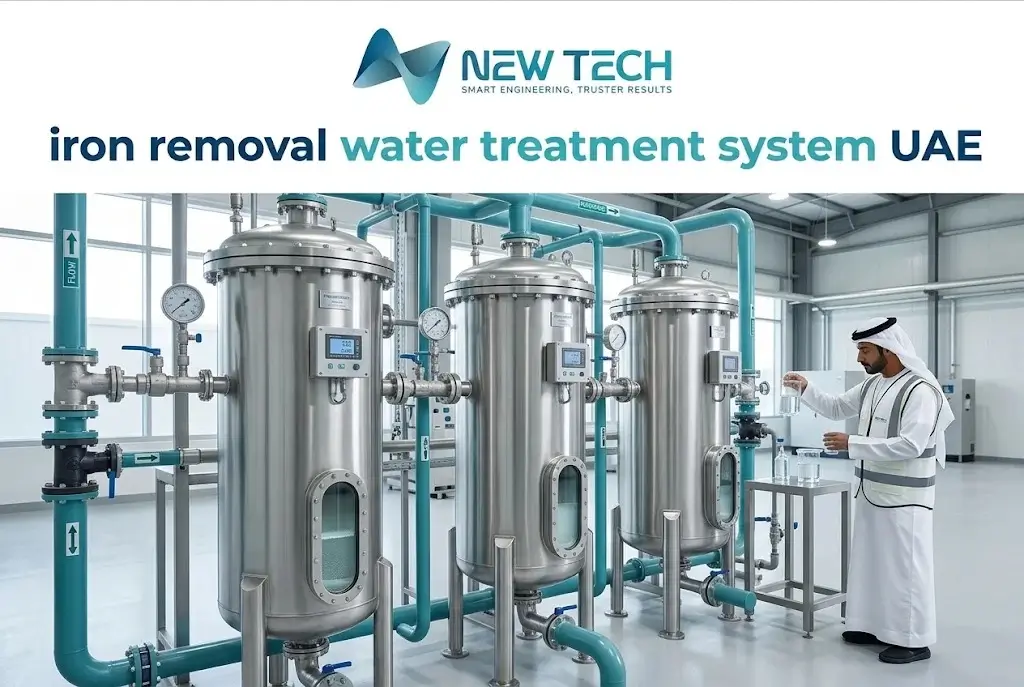
The cost of an industrial iron removal plant depends on the required process, system capacity, water chemistry, equipment selection and project scope.
A Water Treatment System designed for particulate iron removal may require a different configuration from a plant treating dissolved iron, manganese and substantial solids loading.
Factors That Influence the Quotation
| Cost Factor | What Buyers Should Verify |
|---|---|
| Feedwater Analysis | Iron species, concentrations and interfering constituents. |
| Required Capacity | Operating flow and daily water demand. |
| Oxidation Equipment | Aeration, chemical dosing or other specified methods. |
| Filter Media | Type, quantity and operating requirements. |
| Vessels | Number, dimensions, materials and pressure ratings. |
| Automation | Backwash controls, instrumentation and monitoring. |
| Additional Processes | Contact tanks, clarification or other required treatment. |
| Operating Costs | Energy, chemicals, cleaning water and maintenance. |
| Project Services | Design, installation, commissioning and support scope. |
Technical RFQ Checklist
To request a meaningful quotation, provide the following information:
- Available groundwater laboratory analysis.
- Total and dissolved iron concentrations.
- Manganese and relevant pH results.
- Required operating flow and daily water consumption.
- Required outlet-water quality.
- Intended industrial or agricultural application.
- Operating hours and available utilities.
- Downstream equipment, including RO if applicable.
- Site location and installation constraints.
- Required documentation and project services.
Where source-water chemistry is complex, the quotation process may require additional testing to establish a reliable treatment basis.
Request a Technical Quote Based on Your Water Analysis. Contact New Tech Water with your required capacity and treatment specifications.
Request a Free Consultation Now
Get in touch with our experts to help you choose the right water treatment plant for your needs with maximum efficiency and minimum cost.
Industrial Iron Removal Applications in the UAE
Groundwater treatment requirements vary across Dubai, Sharjah, Abu Dhabi and other emirates. The suitability of an iron removal system depends on the actual water source, intended use and required outlet quality rather than location alone.
Groundwater Treatment in Dubai
Industrial facilities using groundwater or another specified source may need iron treatment to reduce deposits and support downstream process requirements.
The design should reflect current water analysis, operating flow and any required pretreatment stages. Different facilities can require different treatment arrangements even when their production capacities are similar.
Iron and Manganese Treatment in Sharjah
Where well water contains both iron and manganese, engineers should evaluate whether the selected treatment can reliably address both contaminants.
Suitable oxidation, filtration and monitoring conditions should be established from the actual water chemistry rather than assuming a standard filter package is sufficient.
Industrial Pretreatment in Abu Dhabi
Industrial projects may require iron removal before RO, process-water equipment or other sensitive treatment stages.
Water-quality variations, utility availability, site conditions and operating schedules should be considered during project planning.
Local Project Requirements
Groundwater abstraction permissions, treated-water specifications, residuals handling and discharge obligations may differ between facilities and jurisdictions.
Applicable requirements must be verified for the particular UAE project. Foreign drinking-water guidelines should not be substituted for local industrial or regulatory specifications.
Discuss Your Groundwater Treatment Project in the UAE. Share your location, source-water analysis and production requirements with New Tech Water.
Request a Free Consultation Now
Get in touch with our experts to help you choose the right water treatment plant for your needs with maximum efficiency and minimum cost.
Why Consider New Tech Water for Iron and Manganese Treatment?
Effective groundwater treatment begins with understanding the source-water chemistry and defining the required outlet quality. New Tech Water publishes industrial treatment services that include iron and manganese removal filters, filtration systems and reverse osmosis solutions.
Considering the treatment process as a whole helps project owners evaluate oxidation, filtration, operating flow and maintenance requirements rather than purchasing equipment solely by nominal capacity.
Technical Considerations for a Suitable Project
- Reviewing iron and manganese test results.
- Identifying dissolved and particulate iron fractions.
- Evaluating suitable oxidation conditions.
- Choosing compatible filtration methods and media.
- Assessing filter sizing and hydraulic requirements.
- Considering backwash and maintenance demands.
- Planning monitoring and outlet-water verification.
- Evaluating RO pretreatment requirements where relevant.
- Clarifying engineering and supply responsibilities.
New Tech Water’s published treatment services include iron and manganese removal filters and industrial water treatment solutions.
The exact system configuration, equipment availability and project services should be confirmed through the technical and commercial proposal.
Choose an Iron Removal Process Based on Reliable Water Data. Contact New Tech Water to discuss your treatment objectives and available project options.
Request a Free Consultation Now
Get in touch with our experts to help you choose the right water treatment plant for your needs with maximum efficiency and minimum cost.
Frequently Asked Questions About Iron Removal Systems in UAE
How do I remove iron from groundwater in UAE?
The method depends on iron concentration and chemical form. Dissolved iron is commonly treated using suitable oxidation followed by filtration or another appropriate separation process.
How much does an iron removal filter cost in Dubai?
Cost depends on the water analysis, required flow, treatment stages, media, equipment and project scope. A reliable quotation requires technical specifications.
What is the best media for removing iron from water?
The suitable medium depends on iron form, pH, dissolved oxygen, other contaminants and the required treatment process. Different granular and catalytic media have different operating requirements.
Can an RO membrane remove iron without pretreatment?
RO membranes can reject certain iron species, but iron precipitation and deposition may cause fouling. Pretreatment requirements should follow the feedwater conditions and membrane specifications.
What causes brown stains in industrial water?
Possible causes include oxidized iron, corrosion products or other suspended materials. Laboratory testing helps establish the cause.
What is the difference between iron and manganese removal?
Iron often oxidizes under conditions where manganese removal remains difficult. Manganese may require a different oxidation method, pH or suitable catalytic media.
How do iron oxidation filters work?
Suitable systems use oxidation, surface reactions and/or particle separation to remove iron under defined water-quality and operating conditions.
What iron concentration requires water treatment?
There is no single limit applicable to every industrial use. The decision depends on outlet-water requirements, equipment restrictions and applicable specifications.
How often should an iron removal filter backwash?
Backwash frequency depends on iron loading, filter size, media, available cleaning flow and observed performance. It should follow the approved treatment design.
Who supplies industrial iron removal systems in UAE?
Industrial treatment requirements should be discussed with providers whose equipment and project scope match the application. New Tech Water publishes iron and manganese removal filters among its services and can be contacted to confirm project options.
Need Help with Iron or Manganese in Groundwater? Share your laboratory results with New Tech Water to discuss the treatment requirements.
Request a Free Consultation Now
Get in touch with our experts to help you choose the right water treatment plant for your needs with maximum efficiency and minimum cost.
Get a Reliable Iron Removal Solution for Your Water
Choosing an Iron Removal Water Treatment System UAE starts with accurate testing and the right process design. Dissolved iron, particulate iron and manganese may require different oxidation, filtration and monitoring conditions.
New Tech Water can discuss industrial groundwater treatment, filtration equipment and RO pretreatment requirements. Share your source-water analysis, required flow and project details to begin a technical consultation focused on achieving the appropriate treated-water quality.
Contact New Tech Water Today to Discuss Your Industrial Iron Removal Project and Request a Technical Quote.
Request a Free Consultation Now
Get in touch with our experts to help you choose the right water treatment plant for your needs with maximum efficiency and minimum cost.

 English
 Arabic