
Struggling with ammonia buildup, poor water quality or rising operating costs at your fish farm? Choosing an aquaculture water treatment system UAE requires more than installing a filter. The right solution depends on fish species, feeding rates, oxygen demand and water chemistry.
Explore RAS filtration, ammonia control, source-water treatment, capacity calculations and equipment costs to make informed purchasing decisions and discuss suitable water treatment equipment with New Tech Water.
Aquaculture Water Treatment System UAE: What Does Your Fish Farm Need?
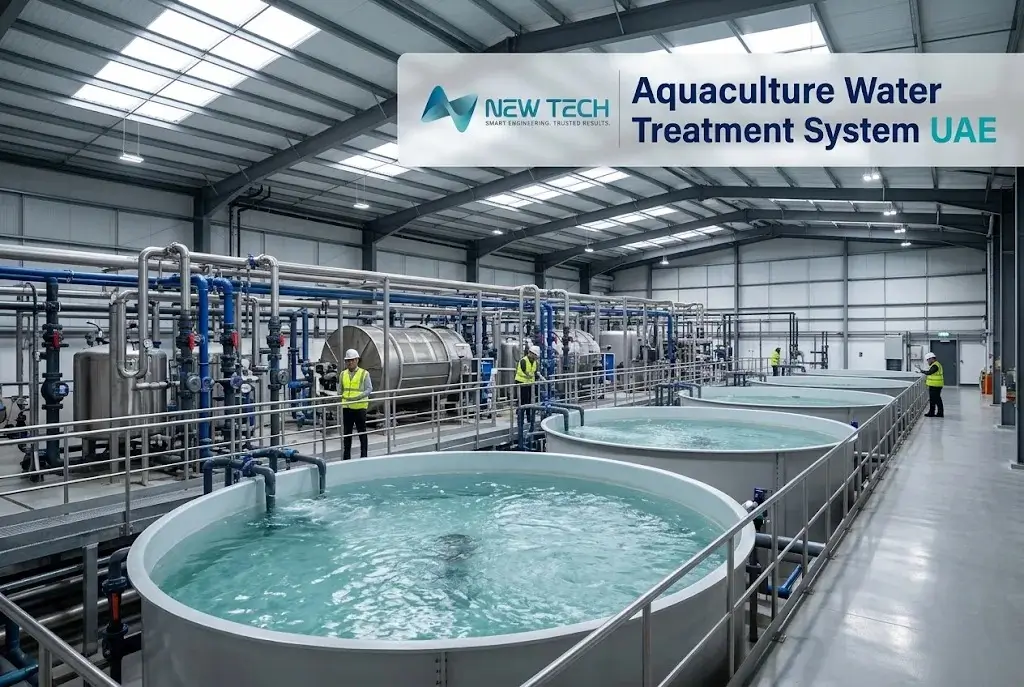
Selecting an aquaculture water treatment system UAE starts with the biological requirements of the cultured species and the farm’s production method. Fish produce waste through respiration, feeding and metabolism, while uneaten feed and faeces contribute suspended solids and dissolved contaminants. Without appropriate treatment, these substances may accumulate and affect fish health and system performance.
Recirculating aquaculture systems, commonly known as RAS, use different treatment technologies to manage these challenges. Mechanical filtration removes selected solids, biological filtration converts ammonia and nitrite, and gas-management equipment supports oxygen supply and carbon dioxide removal. Source-water conditioning and effluent treatment may also be necessary, depending on the site.
However, a freshwater fish farm, marine aquaculture facility and hatchery may require different water quality conditions. Equipment specifications should therefore be based on species, water chemistry, biomass, feeding load, circulation and operational reliability rather than nominal tank volume alone.
Technical Information to Prepare Before Buying Equipment
- Cultured species and production stage.
- Freshwater, brackish or marine operation.
- Total culture tank volume and arrangement.
- Maximum planned fish biomass.
- Daily and peak feeding rates.
- Source-water analysis and target water quality.
- Required recirculation and make-up flows.
- Existing mechanical and biological filtration.
- Electricity, pumping pressure and available space.
- Wastewater, sludge and concentrate disposal requirements.
- Monitoring, alarm and backup-system needs.
- Equipment specifications and quotation scope.
Find Suitable Water Treatment Equipment for Your Fish Farm. Share your project specifications and water analysis with New Tech Water.
Request a Free Consultation Now
Get in touch with our experts to help you choose the right water treatment plant for your needs with maximum efficiency and minimum cost.
Why Water Quality Is Critical for Aquaculture Operations
Water quality affects fish respiration, metabolism, growth and overall production performance. In intensive aquaculture, the quality of water may change rapidly as fish consume oxygen and release metabolic waste. Feeding intensity, temperature, biological treatment capacity and circulation all influence the conditions inside culture tanks.
Dissolved Oxygen and Fish Health
Dissolved oxygen supports fish respiration and the microorganisms responsible for nitrification. Insufficient oxygen supply may occur when biological demand increases, aeration becomes inadequate or circulation equipment fails. Required oxygen concentrations depend on species, temperature, biomass and production conditions.
Ammonia and Nitrite Toxicity
Fish release ammonia primarily through metabolism. Organic waste decomposition can contribute additional nitrogen loading. In water, ammonia occurs in ionized and un-ionized forms, and the un-ionized form is particularly toxic to many aquatic species.
Nitrite is produced during nitrification and can also harm fish when it accumulates. Therefore, monitoring must consider both ammonia and nitrite instead of assuming that biological treatment automatically controls every nitrogen-related risk.
Temperature, pH and Salinity
Temperature influences fish metabolism, oxygen solubility and biological treatment activity. pH affects ammonia chemistry, while salinity requirements vary between freshwater, marine and brackish species. One universal water quality specification is not suitable for every fish farming operation.
Why Stable Conditions Matter
Rapid changes in oxygen, pH or other parameters can be dangerous even when routine average measurements appear acceptable. Reliable monitoring and a suitable emergency response plan are important elements of intensive aquaculture management.
Identify Your Fish Farm Water Quality Challenges. Establish the requirements of your cultured species before selecting treatment equipment.
Request a Free Consultation Now
Get in touch with our experts to help you choose the right water treatment plant for your needs with maximum efficiency and minimum cost.
Water Quality Parameters Every Aquaculture Farm Should Monitor
Water quality monitoring helps operators identify whether the treatment process meets the requirements of the culture system. The appropriate parameters, acceptable concentrations and testing frequency depend on the species, life stage, operating conditions and local requirements.
| Parameter | Why It Matters | Management Consideration |
|---|---|---|
| Dissolved Oxygen (DO) | Supports fish respiration and biological treatment. | Aeration, oxygenation and appropriate alarms. |
| Total Ammonia Nitrogen (TAN) | Indicates combined ammonia and ammonium nitrogen loading. | Biofiltration and feeding-load management. |
| Un-ionized Ammonia (NH3) | Can be particularly toxic to aquatic organisms. | Evaluate TAN with pH, temperature and salinity. |
| Nitrite (NO2) | Potentially harmful nitrogen intermediate. | Maintain suitable nitrifying biofilter performance. |
| Nitrate (NO3) | May accumulate as nitrification continues. | Water exchange or suitable nitrate management. |
| pH | Affects fish health and ammonia chemistry. | Monitoring and species-appropriate conditioning. |
| Alkalinity | Supports buffering and nitrification. | Controlled alkalinity management. |
| Total Suspended Solids | Indicates particulate waste accumulation. | Mechanical filtration and solids management. |
| Carbon Dioxide | Can accumulate through respiration. | Gas exchange and degassing. |
| Temperature and Salinity | Influence species physiology and system chemistry. | Species-specific control. |
Understanding TAN and Un-ionized Ammonia
Total Ammonia Nitrogen includes nitrogen present as ammonia and ammonium. The fraction present as toxic un-ionized ammonia increases under certain pH and temperature conditions. Consequently, a TAN result must be interpreted alongside the actual water chemistry and species-specific tolerance.
Why Biofilters Need Oxygen and Alkalinity
Nitrifying bacteria require oxygen to convert ammonia into nitrite and then nitrate. Nitrification also consumes alkalinity, which can reduce pH stability if buffering is inadequate. Operators should monitor these factors when assessing the performance of biological filtration.
For technical background, see the University of Florida IFAS Extension publication Fish Health Management Considerations in Recirculating Aquaculture Systems.
Build a Reliable Aquaculture Water Quality Monitoring Plan. Define the parameters and acceptance limits appropriate to your species.
Request a Free Consultation Now
Get in touch with our experts to help you choose the right water treatment plant for your needs with maximum efficiency and minimum cost.
Common Aquaculture Water Problems and Treatment Technologies
Not every water quality problem requires the same equipment. Selecting the correct technology means identifying the contaminant or operational limitation first, then evaluating the treatment process that addresses it. A mechanical filter cannot replace biological ammonia conversion, and an RO system does not solve inadequate dissolved oxygen inside fish tanks.
| Problem | Technology to Evaluate | Important Limitation |
|---|---|---|
| High Suspended Solids | Drum filters or appropriate mechanical separation. | Does not remove dissolved ammonia. |
| High TAN | Nitrifying biological filtration. | Requires sufficient nitrogen conversion capacity. |
| High Nitrite | Suitable biofilter performance and loading control. | Depends on established nitrifying microorganisms. |
| Low Dissolved Oxygen | Aeration or oxygenation. | Must meet actual biological oxygen demand. |
| Excess Carbon Dioxide | Degassing or suitable gas exchange. | Performance depends on system hydraulics. |
| Nitrate Accumulation | Water exchange or appropriate nitrate management. | Conventional nitrification does not remove nitrate. |
| Microbial Treatment Objective | Suitable UV or specialized treatment. | Does not replace mechanical or biological filtration. |
| Unsuitable Source-Water Minerals | Source-water conditioning, potentially including RO. | Water must remain suitable for the cultured species. |
Why the Treatment Sequence Matters
Some processes work better when preceded by suitable pretreatment. Removing suspended solids before sensitive equipment can reduce fouling, while appropriate gas exchange supports fish health and biological performance. The complete configuration should be designed using the farm’s actual water characteristics.
Compare Aquaculture Treatment Equipment by Function. Identify the problem each component must solve before requesting a quotation.
Request a Free Consultation Now
Get in touch with our experts to help you choose the right water treatment plant for your needs with maximum efficiency and minimum cost.
Source Water Treatment vs RAS Filtration vs Effluent Treatment
A fish farm may require treatment for incoming water, recirculating water and discharged wastewater. These applications have different objectives and should be specified separately when selecting an aquaculture water treatment system UAE.
Source-Water Treatment
Incoming water should be assessed for salinity, dissolved minerals, suspended solids and other relevant contaminants. Depending on the water source and culture requirements, treatment may involve filtration or other conditioning. Membrane desalination should only be considered when the target water quality justifies it.
RAS Water Treatment
Recirculating aquaculture treatment focuses on managing fish waste, dissolved nitrogen compounds, oxygen and other factors that change continuously during production. Mechanical filtration and biofiltration are common process stages, supported by appropriate gas management and monitoring.
Aquaculture Effluent Treatment
Water removed from the system may contain sludge, nutrients and other pollutants. Treatment and disposal arrangements should comply with applicable permits and site requirements. Solids collected from filters may need separate handling from water discharged through other processes.
| Water Stream | Treatment Objective | Typical Design Consideration |
|---|---|---|
| Incoming Water | Meet culture-water quality requirements. | Source analysis and species-specific chemistry. |
| Recirculating Water | Control solids, ammonia and gases. | Hydraulic flow and biological loading. |
| Discharged Water | Manage pollutants and treatment residuals. | Applicable discharge and waste requirements. |
Specify Equipment for the Correct Water Stream. Separate source-water preparation, internal RAS treatment and effluent handling in your RFQ.
Request a Free Consultation Now
Get in touch with our experts to help you choose the right water treatment plant for your needs with maximum efficiency and minimum cost.
How a Recirculating Aquaculture System Works
A recirculating aquaculture system treats water from fish tanks and returns it for continued use. The treatment process is intended to control water quality while reducing reliance on continuous replacement with new water. However, recirculation still requires adequate removal of waste solids and management of dissolved compounds that accumulate over time.
Stage 1: Collection from Fish Tanks
Water carrying suspended waste and dissolved metabolic products leaves the culture tanks through suitable drains or circulation outlets. Tank shape, flow patterns and solids collection arrangements influence treatment performance.
Stage 2: Mechanical Filtration
Mechanical filters remove selected suspended particles, including waste solids and uneaten feed. Early removal can reduce downstream organic loading and support more stable water conditions.
Stage 3: Biological Filtration
A biofilter supports nitrifying microorganisms that convert ammonia into nitrite and then nitrate. The process requires suitable oxygen, alkalinity, surface area and operating conditions.
Stage 4: Gas Management
Degassing may be used to reduce accumulated carbon dioxide, while aeration or oxygenation supports fish and biofilter oxygen requirements. Gas transfer must be assessed using actual biological demand and hydraulic conditions.
Stage 5: Additional Polishing
Some systems include UV or other specialized treatment processes. Their suitability depends on water quality objectives, operational safety and compatibility with the cultured species.
Stage 6: Return to Culture Tanks
Water is returned to fish tanks after treatment. The system also requires controlled make-up water and appropriate waste removal. Biological nitrification does not eliminate the need to manage nitrate and other dissolved substances.
For additional technical background, consult the FAO reference on recirculating aquaculture systems.
Understand Your RAS Treatment Process. Define the hydraulic, mechanical and biological requirements before selecting equipment.
Request a Free Consultation Now
Get in touch with our experts to help you choose the right water treatment plant for your needs with maximum efficiency and minimum cost.
Mechanical Filtration for Fish Farms and RAS
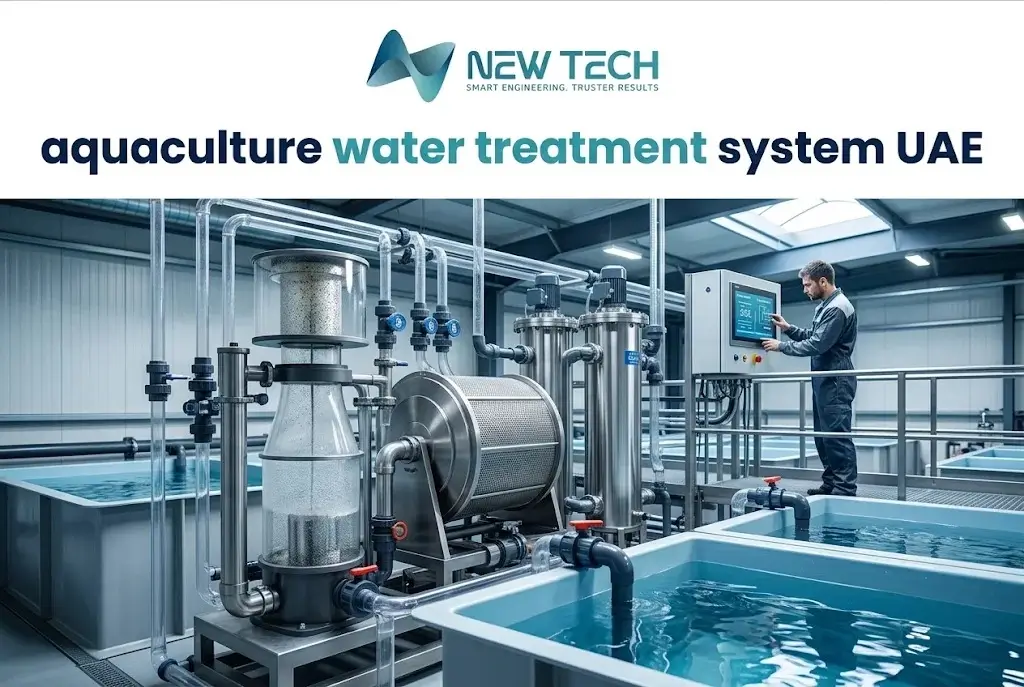
Mechanical filtration removes suspended particles before they break down and increase dissolved organic loading. Common solids include fish faeces and uneaten feed. Mechanical separation can reduce loading on downstream treatment equipment, but it cannot replace the biological conversion of dissolved nitrogen compounds.
Drum Filters and Mechanical Screens
Rotary drum filters, screens and other separators may be suitable for specific aquaculture applications. Selection should consider circulation flow, particle characteristics, filtration rating and cleaning requirements. Filter performance at the intended operating conditions is more important than nominal capacity alone.
Settling and Alternative Separation
Settling devices may help remove particles that can separate under suitable hydraulic conditions. Their effectiveness depends on particle characteristics and residence time. Small or poorly settling particles may require alternative separation technologies.
Filter Backwash and Sludge Handling
Mechanical filtration generates concentrated residual streams when captured solids are removed. The farm should account for backwash water consumption, waste volume and sludge handling. These losses can contribute to the make-up water requirement.
Mechanical Filter Selection Checklist
- Operating and maximum circulation flow.
- Expected solids loading.
- Required particle separation.
- Pressure loss and hydraulic limitations.
- Cleaning and backwash requirements.
- Waste collection and disposal arrangements.
- Materials suitable for freshwater or marine use.
- Maintenance access and equipment documentation.
Compare Mechanical Filtration Equipment Specifications. Include flow, solids loading and cleaning requirements in your enquiry.
Request a Free Consultation Now
Get in touch with our experts to help you choose the right water treatment plant for your needs with maximum efficiency and minimum cost.
Biological Filtration and Ammonia Control in Aquaculture
Biological filtration is an important component of many RAS designs because fish continuously generate ammonia. Under suitable aerobic conditions, microorganisms convert ammonia into nitrite and subsequently into nitrate. This process is called nitrification.
How Nitrification Works
Nitrifying microorganisms require suitable surfaces and operating conditions. Their performance depends on oxygen availability, temperature, pH, alkalinity and ammonia loading. The process may become unstable if feeding increases beyond the treatment capacity or if environmental conditions deteriorate.
Why Biofilter Size Is Not Determined by Tank Volume Alone
The total water volume and circulation rate are important hydraulic design variables, but they do not establish the ammonia-removal duty. Biofilter sizing must consider the amount of nitrogen generated by fish metabolism and feeding, together with the demonstrated treatment capacity of the selected biological process.
Two farms with the same tank volume may need different biofilters if their fish biomass, feed rates and water conditions are different.
Factors That Determine Biofilter Performance
| Design Factor | Why It Matters |
|---|---|
| Daily Feed Input | Influences nitrogen generated during production. |
| Feed Composition | Affects nitrogen loading and waste characteristics. |
| Fish Biomass | Influences metabolic loading. |
| Media Type | Determines available biological attachment characteristics. |
| Effective Media Area | Contributes to available biological treatment capacity. |
| Temperature | Influences microbial treatment activity. |
| pH and Alkalinity | Support nitrification and chemical stability. |
| Dissolved Oxygen | Required for aerobic ammonia and nitrite oxidation. |
| Hydraulic Conditions | Influence contact and process performance. |
Illustrative Nitrogen-Load Screening Calculation
Consider a hypothetical fish farm feeding 100 kg of feed per day. Assume, purely for an early calculation, that the process generates 30 g of TAN-N per kilogram of feed.
Estimated TAN-N Production = Daily Feed × Assumed TAN-N Generation Factor
Estimated TAN-N Production = 100 kg/day × 30 g/kg = 3,000 g/day
Estimated TAN-N Production = 3 kg TAN-N/day
The assumed 30 g/kg factor is not a universal production rate. Actual TAN generation depends on feed composition, species, nutrient retention, growth and other conditions.
Why This Calculation Is Only a Starting Point
A design engineer would evaluate the nitrogen load against an appropriate biofilter removal rate, usually expressed using a specified mass of TAN-N removed over time relative to a defined media or reactor basis. The applicable rate depends on the biofilter technology and operating conditions.
For example, if a manufacturer or qualified design assessment establishes an applicable removal rate expressed in grams of TAN-N per square metre of effective media area per day, the required effective media area may be calculated by dividing the design nitrogen load by that verified rate. The calculation must use consistent units and appropriate engineering allowances.
Actual media quantity cannot be determined reliably without validated performance information, hydraulic checks and suitable startup and operating assumptions. A nominal circulation rate must not be used as a substitute for biological sizing.
Biofilter Startup and Maturation
New biological filters require time to develop active nitrifying populations. During startup, TAN and nitrite should be monitored closely and the system should not be loaded beyond its demonstrated treatment capacity. Biological activity can be affected by oxygen limitations, pH instability, temperature changes and incompatible substances.
Nitrate Still Requires Management
Conventional nitrification transforms ammonia into nitrate rather than removing all nitrogen from the water. Nitrate may accumulate unless addressed through suitable water exchange or another approved management process.
Evaluate Your Nitrogen Treatment Requirements. Use feeding data, water chemistry and validated biofilter performance when planning aquaculture treatment equipment.
Request a Free Consultation Now
Get in touch with our experts to help you choose the right water treatment plant for your needs with maximum efficiency and minimum cost.
Oxygenation, Degassing, UV and Ozone Treatment
Gas management and selected polishing processes can support a recirculating aquaculture system, but each technology serves a different purpose. Oxygenation, degassing and disinfection-related processes should not be assumed interchangeable with mechanical or biological filtration.
Aeration and Oxygenation
Aeration supports gas exchange, while suitable oxygenation equipment may provide additional oxygen where required. Capacity should account for fish respiration, biofilter activity and other oxygen-consuming processes. A reliable design should also address interruptions in the normal oxygen supply.
Carbon Dioxide Removal
Fish and microorganisms release carbon dioxide. Excessive dissolved CO2 can affect water chemistry and fish physiology. Suitable degassing equipment should be assessed according to gas load, flow and the required culture-water conditions.
UV Treatment
Ultraviolet equipment may be used for selected microbial control objectives. Its effectiveness depends on UV dose, flow, water transparency and equipment condition. UV cannot replace ammonia conversion or solids removal and does not provide a persistent disinfectant residual.
Ozone Treatment
Ozone may be applied in specialized treatment systems, but inappropriate exposure can harm fish and beneficial microorganisms. Selection requires qualified engineering, suitable monitoring and safeguards to prevent unsafe residual oxidants from entering culture tanks.
Specify Aquaculture Polishing Equipment Carefully. Match treatment technology to the intended function and operating safeguards.
Request a Free Consultation Now
Get in touch with our experts to help you choose the right water treatment plant for your needs with maximum efficiency and minimum cost.
When Is Reverse Osmosis Suitable for Aquaculture?
Reverse osmosis may be considered when incoming water has unsuitable dissolved-mineral content for the intended aquaculture application. It is primarily a source-water treatment option in this context, not a replacement for the biological and gas-management processes inside a conventional RAS loop.
Evaluating Source-Water Salinity and Minerals
Freshwater and marine species require different water chemistry. If the available source water needs dissolved-salt reduction, RO may be appropriate after technical assessment. The treatment target should reflect the cultured species and the intended operating conditions.
RO Pretreatment
RO systems require suitable feedwater conditions to reduce fouling and scaling risks. Pretreatment may include filtration or appropriate conditioning based on the water analysis. Membrane operation also creates a concentrate stream that must be managed appropriately.
New Tech Water discusses these considerations in its Industrial RO Plant UAE</a guide.
Why RO Permeate May Require Conditioning
Low-mineral RO permeate may not have the mineral balance, alkalinity or salinity required for the cultured species. Appropriate blending or conditioning may therefore be necessary before it enters the aquaculture system.
When RO Is Unnecessary
Where incoming water already meets the approved culture-water specification, RO may introduce unnecessary energy costs, equipment complexity and concentrate disposal requirements. Installing RO will not correct insufficient biofilter capacity or low dissolved oxygen.
Check Whether Your Source Water Requires RO. Compare water chemistry with the species-specific target before selecting membrane equipment.
Request a Free Consultation Now
Get in touch with our experts to help you choose the right water treatment plant for your needs with maximum efficiency and minimum cost.
Freshwater, Marine and Hatchery Treatment Requirements
Aquaculture water treatment requirements differ according to species, life stage and production environment. Water treatment equipment should support these requirements without causing inappropriate changes to salinity, mineral balance or other critical conditions.
Freshwater Aquaculture
Freshwater farms should monitor suitable water chemistry, dissolved oxygen, nitrogen compounds and temperature. The required treatment stages depend on the source water and production system. Source-water conditioning should avoid unnecessary changes to the environment required by the fish.
Marine Aquaculture
Marine production requires suitable seawater characteristics and materials compatible with saltwater exposure. Pumps, vessels and other components should be evaluated for corrosion resistance, pressure and operating duty. Equipment designed for freshwater use may not be suitable for marine systems.
Hatchery Water Treatment
Hatcheries may involve eggs, larvae or juveniles with specialized environmental requirements. Water clarity, source-water quality and microbial management should be evaluated with qualified aquaculture specialists, taking account of the sensitivity of the relevant life stages.
Match Equipment to Your Aquaculture Application. Define the species, water type and production stage before requesting technical specifications.
Request a Free Consultation Now
Get in touch with our experts to help you choose the right water treatment plant for your needs with maximum efficiency and minimum cost.
How to Calculate RAS Circulation and Make-Up Water
RAS sizing requires separate consideration of circulation flow, make-up water, biological treatment capacity and oxygen demand. These values are related, but they are not interchangeable. Preliminary hydraulic calculations can support equipment planning, while final engineering requires verified biological and process data.
Example 1: Calculate Nominal Circulation Flow
Assume a hypothetical RAS containing 100 m3 of water. For illustration, use a turnover period of two hours.
| Parameter | Illustrative Value |
|---|---|
| System Water Volume | 100 m3 |
| Assumed Turnover Period | 2 hours |
| Nominal Circulation Flow | 50 m3/h |
Nominal Circulation Flow = System Volume / Turnover Period
Nominal Circulation Flow = 100 / 2 = 50 m3/h
This is a hypothetical hydraulic calculation, not a universal turnover recommendation. The final circulation design must consider fish biomass, feeding, waste transport, oxygen demand, hydraulic losses and the treatment process.
Example 2: Calculate Daily Make-Up Water
Assume the same 100 m3 system requires new water equal to 5% of its total water volume each day to replace controlled discharge and other net losses.
Daily Make-Up Water = 100 × 0.05 = 5 m3/day
The example therefore has a nominal circulation rate of 50 m3/h and daily make-up demand of 5 m3/day. These values represent different duties.
Why the Make-Up Percentage Is Not Universal
Actual make-up water demand depends on mechanical filter cleaning, sludge removal, evaporation, controlled exchange, nitrate management and other operational losses. The assumed 5% rate is illustrative and should not be treated as a recommended or guaranteed requirement.
Example 3: Account for Hydraulic Losses
Pump selection should consider the required operating flow and the total dynamic head arising from piping, elevation differences and equipment resistance. A pump rated at 50 m3/h under one condition may deliver a different flow at the actual system head.
Suppliers should therefore receive the duty-point flow, total head, liquid properties and applicable materials requirements. A circulation-flow calculation alone does not establish the correct pump model.
Hydraulic Capacity vs Biological Treatment Capacity
| Design Parameter | Determined From |
|---|---|
| Circulation Flow | Hydraulic and water quality requirements. |
| Make-Up Water | Actual losses and controlled exchange. |
| Mechanical Filter Capacity | Flow and solids loading. |
| Biofilter Capacity | TAN load and validated treatment performance. |
| Oxygenation Capacity | Biological oxygen demand and gas-transfer requirements. |
| Pump Duty | Required flow and total dynamic head. |
Calculate Your RAS Equipment Requirements. Keep hydraulic, biological and oxygen-demand calculations separate when preparing your equipment enquiry.
Request a Free Consultation Now
Get in touch with our experts to help you choose the right water treatment plant for your needs with maximum efficiency and minimum cost.
Aquaculture Water Treatment System UAE Cost and Operating Expenses
Aquaculture water treatment system UAE cost depends on farming method, equipment capacity, water chemistry, production scale and operational safeguards. Comparing quotations requires an understanding of what each supplier is actually providing, particularly when one offer covers individual treatment components and another covers a larger engineered system.
Capital Expenditure Considerations
| Cost Factor | Procurement Consideration |
|---|---|
| Mechanical Filtration | Flow, solids loading and cleaning arrangements. |
| Biological Filtration | Nitrogen load, media type and process design. |
| Circulation Pumps | Flow, total head, materials and efficiency. |
| Gas Management | Oxygen supply and carbon dioxide removal. |
| Source-Water Treatment | Feedwater analysis and target water quality. |
| Monitoring and Controls | Sensors, alarms and calibration requirements. |
| Backup Equipment | Operational continuity for critical systems. |
| Effluent Management | Waste separation and disposal requirements. |
Operating Expenditure
Annual operating costs may include electricity, oxygen supply, cleaning water, filtration maintenance, laboratory testing, calibration, equipment servicing and waste handling. Temperature control and replacement water may also contribute to expenses, depending on the facility.
Example 1: Cost per Cubic Meter Circulated
Consider a hypothetical treatment system operating at 50 m3/h for 8,000 hours annually, with treatment-related operating expenses of AED 90,000 per year.
Annual Circulated Volume = 50 × 8,000 = 400,000 m3
Operating Cost per Circulated m3 = 90,000 / 400,000 = AED 0.225/m3
This value is a theoretical operating-cost allocation, not a UAE supplier price or the cost of producing fresh water. The same water is counted repeatedly as it passes through the recirculation loop.
Example 2: Treatment Cost per Kilogram of Fish Produced
Assume the same farm produces 60,000 kg of marketable fish during the year, and the same AED 90,000 represents the defined annual water treatment operating expenses.
Water Treatment OPEX per kg of Fish = 90,000 / 60,000 = AED 1.50/kg
The calculated AED 1.50/kg is an illustrative allocation of treatment operating expenses only. It does not include feed, fingerlings, labour, mortality, financing, depreciation or other farm production costs unless those items are explicitly included in the underlying cost total.
Comparison of Financial Indicators
| Financial Metric | Hypothetical Result | What It Measures |
|---|---|---|
| Annual Treatment OPEX | AED 90,000/year | Defined annual treatment operating expenditure. |
| Annual Circulated Volume | 400,000 m3/year | Total water passed through the circulation loop. |
| OPEX per Circulated m3 | AED 0.225/m3 | Treatment operating cost relative to circulated volume. |
| Annual Fish Production | 60,000 kg/year | Assumed annual marketable fish output. |
| Treatment OPEX per kg Fish | AED 1.50/kg | Treatment operating expense allocated to fish output. |
All figures are illustrative, not actual aquaculture project costs, water tariffs or New Tech Water quotations. A complete investment assessment should also consider capital recovery, replacement equipment, financing, production performance and other project-specific expenses.
Which Cost Indicator Is Most Useful?
Cost per circulated cubic meter may help compare defined hydraulic treatment duties. Annual OPEX supports budgeting, while treatment cost per kilogram of marketable fish can be more useful for evaluating how treatment expenses contribute to production economics.
However, financial indicators are meaningful only when the compared systems deliver similar required performance and the same expense categories are included.
Compare Aquaculture Treatment Operating Costs. Request equipment specifications and estimate annual expenses using realistic production assumptions.
Request a Free Consultation Now
Get in touch with our experts to help you choose the right water treatment plant for your needs with maximum efficiency and minimum cost.
Monitoring, Biofilter Startup and Emergency Planning
Water treatment performance must be maintained during normal operation and abnormal conditions. Fish farming systems can respond rapidly to oxygen loss, circulation failure or changes in biological filtration. An appropriate monitoring program should therefore identify critical parameters, alarm thresholds and responsibilities before the farm begins full-scale production.
Monitor Critical Water Quality Parameters
Dissolved oxygen, temperature, pH and relevant nitrogen compounds should be monitored according to the system’s operating requirements. Some intensive operations may need continuous instruments and alarms for critical parameters, while other tests may be performed through a documented sampling schedule.
Plan for Pump and Circulation Failure
Circulation interruptions can reduce oxygen delivery and the movement of wastewater through treatment equipment. The emergency plan should identify critical pumps, available backup capacity, alarm escalation and the actions authorized by the farm’s qualified technical team.
Plan for Low Dissolved Oxygen
A low-oxygen event may require immediate activation of approved emergency systems. The required response depends on species, stocking biomass, oxygen supply arrangement and the operating conditions. Farms should have site-specific procedures and trained personnel rather than depend on a generic emergency recommendation.
Respond to Biofilter Performance Problems
Increasing TAN or nitrite may indicate a biological treatment problem, excessive nitrogen loading or changing water conditions. The operating team should verify measurements, review feeding load and inspect relevant treatment conditions under the approved farm management plan.
Sensor Failure and Alarm Reliability
Monitoring instruments require calibration and maintenance. A sensor malfunction can produce incorrect readings or prevent an alarm from being triggered. Operators should establish verification procedures and suitable redundancy where justified by the risk.
Emergency Planning Checklist
| Potential Failure | Planning Priority |
|---|---|
| Circulation Pump Failure | Backup capacity, alarms and approved response procedure. |
| Oxygen Supply Interruption | Emergency oxygen arrangements and escalation. |
| Power Failure | Backup power and critical equipment prioritization. |
| Rising TAN or Nitrite | Monitoring, loading assessment and specialist review. |
| Biofilter Performance Decline | Check oxygen, alkalinity, pH, temperature and operation. |
| Sensor or Alarm Failure | Calibration, verification and appropriate backup monitoring. |
| Mechanical Filter Blockage | Inspection, maintenance and hydraulic contingency. |
The final emergency response plan must be established by qualified aquaculture personnel and appropriate engineers. Equipment guidance alone cannot replace fish health and emergency operating procedures.
Plan Reliable Aquaculture Operation. Include monitoring, alarms and backup requirements in your treatment equipment specifications.
Request a Free Consultation Now
Get in touch with our experts to help you choose the right water treatment plant for your needs with maximum efficiency and minimum cost.
Aquaculture Licensing and Environmental Requirements in the UAE
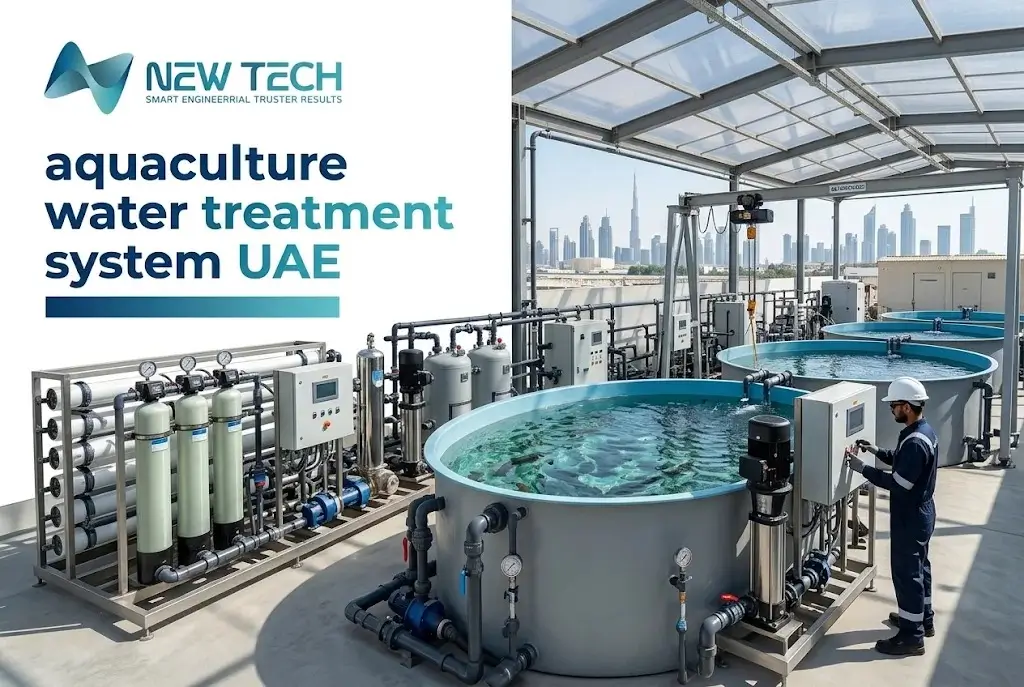
Aquaculture projects in the UAE require attention to licensing, farm location, environmental conditions and relevant operational requirements. Buying filtration or purification equipment does not automatically authorize the establishment or operation of a fish farm.
MOCCAE Aquaculture Farm Licensing
The UAE Ministry of Climate Change and Environment publishes a service for licensing the establishment of an aquaculture production farm. The service identifies documents such as a valid commercial licence or trade-name approval and an environmental permit or approval from the relevant environmental authority.
See the official aquaculture farm establishment licensing service.
The UAE Aquaculture Guide
The ministry also publishes a UAE Aquaculture Guide covering the regulatory framework, farm classification, licensing procedures, site-selection considerations and aquaculture health and operational requirements.
The official UAE Aquaculture Guide provides relevant background for project planning. Operators should verify current requirements and updates with the responsible authorities because the guide is not a substitute for current permits or legal advice.
Environmental and Site Requirements
Environmental considerations may include water intake, source-water availability, farm effluent, sludge, site conditions and the compatibility of the proposed operation with relevant local requirements. Freshwater and coastal marine farms can have different environmental obligations.
Licensing and Environmental Checklist
- Confirm the species and proposed farming activity.
- Identify the applicable federal and local authorities.
- Review farm establishment and environmental approvals.
- Verify site and water intake requirements.
- Assess wastewater, sludge and concentrate disposal.
- Confirm the conditions for the selected production system.
- Check current monitoring and reporting requirements.
- Complete relevant approvals before procurement decisions that depend on them.
Align Treatment Equipment with Your Farm’s Approved Requirements. Confirm the current licensing and environmental conditions before finalizing the project.
Request a Free Consultation Now
Get in touch with our experts to help you choose the right water treatment plant for your needs with maximum efficiency and minimum cost.
Technical RFQ for Aquaculture Water Treatment Equipment
A detailed Request for Quotation helps aquaculture operators compare equipment under consistent technical conditions. The information should identify the exact treatment objective and distinguish between individual industrial water treatment components and a complete specialized RAS design.
| RFQ Requirement | Information to Provide |
|---|---|
| Project Location | Emirate, installation site and delivery destination. |
| Farm Type | Freshwater, marine, hatchery or RAS. |
| Cultured Species | Species and production stage. |
| System Water Volume | Total water volume and tank arrangement. |
| Maximum Biomass | Planned production loading. |
| Feed Requirements | Daily feed quantity and composition where relevant. |
| Water Analysis | Source-water chemistry and relevant contaminants. |
| Required Flow | Normal and peak equipment flow. |
| Target Water Quality | Applicable species-specific specification. |
| Treatment Objective | Filtration, RO, chemical dosing or another component. |
| Operating Pressure | Applicable pressure and hydraulic duty. |
| Materials | Freshwater or marine compatibility requirements. |
| Monitoring | Required instruments, controls and alarms. |
| Utilities | Power supply, pressure, drainage and space. |
| Supply Scope | Equipment, accessories, documentation and requested services. |
Compare Technical Performance and Scope
Two equipment quotations with the same nominal flow may differ in filtration performance, material suitability, pressure requirements and maintenance arrangements. Buyers should compare offers using the same design basis and target performance.
Distinguish Components from a Complete RAS Package
A quotation for an industrial filter, RO unit or dosing pump does not establish responsibility for biological system design, aquaculture oxygenation, fish health management or complete RAS integration. Those responsibilities should be explicitly assigned to appropriately qualified suppliers or specialists.
Request a Technical Equipment Quotation. Send New Tech Water your water analysis, required flow and equipment specifications.
Request a Free Consultation Now
Get in touch with our experts to help you choose the right water treatment plant for your needs with maximum efficiency and minimum cost.
Aquaculture Water Treatment in Dubai, Sharjah and Abu Dhabi
Aquaculture treatment projects across the UAE may differ in water source, salinity, installation conditions and environmental approvals. Geographic location is relevant to procurement and operation, but the final equipment choice must be based on the farm’s technical and biological requirements.
Fish Farm Water Treatment in Dubai
Dubai aquaculture projects should evaluate source-water suitability, treatment requirements, available utilities and permitted waste handling. Indoor recirculating facilities may have different operational needs from open or coastal systems. Equipment specifications should clearly identify flow, water chemistry and installation conditions.
RAS Treatment in Sharjah
Projects in Sharjah should assess whether the intended operation uses freshwater, brackish or marine water. Mechanical filtration, biological treatment and source-water conditioning must match the species and production system. Procurement enquiries should include equipment materials, electrical supply and waste management arrangements.
Aquaculture Water Treatment in Abu Dhabi
Abu Dhabi aquaculture projects may include marine or freshwater production methods with different requirements for salinity, corrosion resistance and water supply. Equipment selection should address the site’s actual operating conditions and applicable environmental approvals.
What UAE Buyers Should Include in Their Enquiries
Provide the project location, available water analysis, required equipment specifications, site utilities and intended supply scope. These details help distinguish straightforward component procurement from specialized aquaculture engineering requirements.
Discuss Water Treatment Equipment for Your UAE Aquaculture Project. Provide the location and technical design requirements when requesting product information.
Request a Free Consultation Now
Get in touch with our experts to help you choose the right water treatment plant for your needs with maximum efficiency and minimum cost.
Why Discuss Aquaculture-Related Water Treatment Equipment with New Tech Water?
New Tech Water publishes information about industrial water treatment plants, reverse osmosis and chemical dosing equipment. These technologies may be relevant to selected aquaculture source-water treatment or supporting industrial treatment duties when they meet the actual technical requirements.
Industrial Water Treatment Components
New Tech Water’s water treatment plant solutions page provides information about treatment technologies that may be considered for suitable water purification applications.
Chemical Dosing Equipment
Some engineered water treatment processes use chemical metering pumps for controlled injection. Pump selection must address chemical compatibility, required dosing rate, operating pressure and other process conditions.
New Tech Water discusses these specifications in its Chemical Dosing Pump Supplier UAE guide.
Any chemical application involving aquaculture requires qualified evaluation of effects on aquatic animals and biological treatment microorganisms. The presence of chemical dosing equipment in a supplier catalogue does not demonstrate that a chemical or treatment procedure is safe for fish.
Clarifying Available Products and Services
General industrial water treatment equipment does not automatically establish that New Tech Water supplies complete RAS installations, specialized aquaculture biofilters, oxygenation systems or fish health consulting services. Buyers should confirm actual product availability, specifications and commercial scope directly.
How to Prepare a Technical Enquiry
- Identify the water source and treatment objective.
- Provide representative laboratory analysis.
- Specify the required equipment category.
- Include flow, pressure and target water quality.
- Describe the farming conditions relevant to equipment selection.
- Provide available electrical and installation requirements.
- Request the specific product documentation and accessories needed.
Discuss Suitable Water Treatment Equipment with New Tech Water. Share your aquaculture project specifications to confirm available products and request a quotation.
Request a Free Consultation Now
Get in touch with our experts to help you choose the right water treatment plant for your needs with maximum efficiency and minimum cost.
Frequently Asked Questions About Aquaculture Water Treatment System UAE
What is an aquaculture water treatment system?
It is an arrangement of treatment equipment used to prepare source water, manage water quality inside aquaculture systems or treat farm effluent. Equipment selection depends on the cultured species, production method and required water quality.
How does a recirculating aquaculture system work?
A RAS circulates water through selected treatment stages and returns it to the culture tanks. Common functions include solids removal, biological ammonia conversion and gas management. The system also requires monitoring and appropriate make-up water.
What water quality parameters are most important for fish farming?
Important parameters include dissolved oxygen, ammonia, nitrite, pH, alkalinity, temperature, salinity and suspended solids. Appropriate targets depend on the species, life stage and operating conditions.
How can ammonia be removed from aquaculture water?
A properly designed nitrifying biofilter converts ammonia into nitrite and then nitrate under suitable conditions. Treatment capacity depends on nitrogen loading, biological media, oxygen and water chemistry.
What is the difference between a mechanical filter and a biofilter?
A mechanical filter removes selected suspended particles, while a biofilter supports microorganisms that convert dissolved ammonia and nitrite. They perform different functions and may both be required.
Does an aquaculture system need reverse osmosis?
Not always. RO may be appropriate when source-water minerals or salinity require treatment. It does not replace ammonia conversion, mechanical solids removal or oxygen management inside a conventional RAS.
Can UV or ozone replace biological filtration?
No. UV and ozone may address selected treatment objectives, but neither replaces nitrifying biological filtration. Ozone also requires safeguards to avoid harmful exposure to aquatic animals and treatment microorganisms.
How do I calculate RAS water circulation capacity?
A preliminary estimate divides total water volume by an assumed turnover period. Final circulation design must also consider biological loading, oxygen demand, hydraulic losses and the actual treatment process.
How much does aquaculture water treatment cost in UAE?
Cost depends on treatment technologies, required capacity, equipment materials, monitoring, operating conditions and supply scope. A reliable quotation requires a technical design basis and actual project specifications.
What information is needed for an aquaculture equipment quotation?
Provide source-water analysis, farming method, system volume, required flow, treatment objective, equipment operating conditions, utilities and requested products or services.
Need Help Comparing Aquaculture Water Treatment Equipment? Send your water quality data and technical specifications to New Tech Water.
Request a Free Consultation Now
Get in touch with our experts to help you choose the right water treatment plant for your needs with maximum efficiency and minimum cost.
Request Aquaculture Water Treatment Equipment Information
Choosing an aquaculture water treatment system UAE requires understanding water chemistry, mechanical filtration, biological nitrogen conversion and operational reliability. Circulation flow, make-up water and biofilter capacity must be calculated separately, while monitoring and emergency planning protect daily operations.
New Tech Water publishes industrial treatment equipment relevant to selected applications. Share your water analysis, equipment requirements and project specifications to discuss suitable available products and request a technical quotation.
Contact New Tech Water Today to Discuss Your Aquaculture Water Treatment Equipment Requirements and Request a Quote.
Request a Free Consultation Now
Get in touch with our experts to help you choose the right water treatment plant for your needs with maximum efficiency and minimum cost.

 English
 Arabic