
Looking for an oil water separator supplier in the UAE for a workshop, factory or industrial wastewater project? The right separation technology depends on more than treatment capacity. Free oil, dispersed droplets and stable emulsions behave differently, and each may require a different process.
This guide explains gravity separators, coalescing systems, dissolved air flotation, equipment sizing and operating costs to help you evaluate your requirements and discuss relevant wastewater treatment options with New Tech Water.
Oil Water Separator Supplier UAE: What to Know Before Requesting a Quote
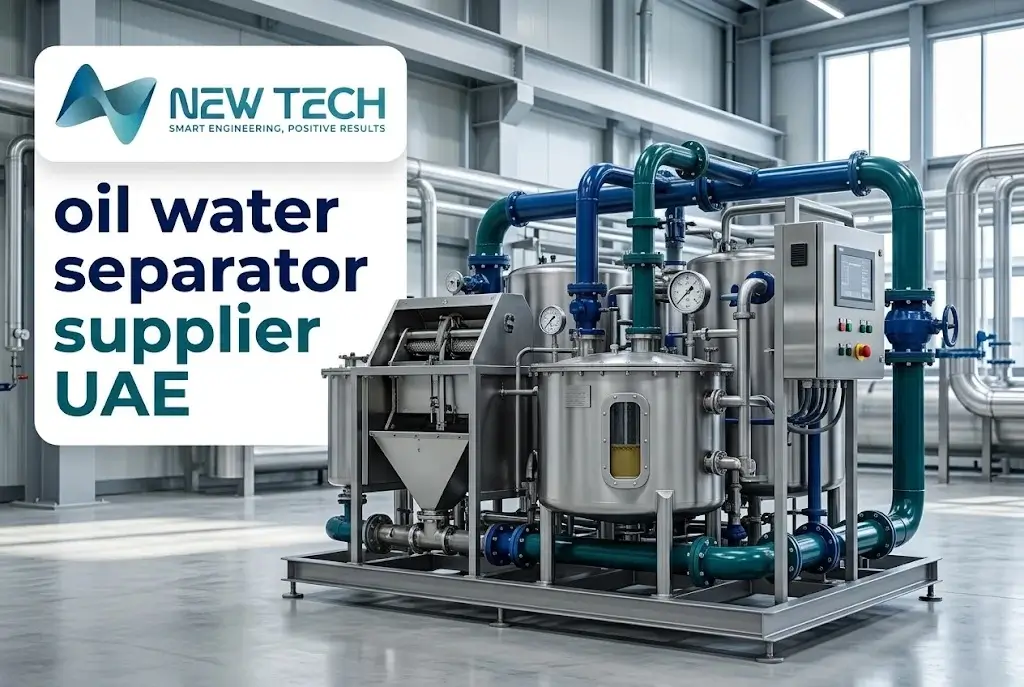
Choosing an Oil Water Separator Supplier UAE starts with understanding the wastewater generated by your facility. Oil from vehicle maintenance, industrial machinery or manufacturing operations may be present as a floating layer, dispersed droplets or stable emulsions. These forms do not respond equally to the same equipment.
A conventional gravity separator may remove suitable free-floating oil, but it cannot be assumed to treat stable emulsions or dissolved hydrocarbons. Selecting the wrong technology can result in oil carryover, higher operating costs and additional treatment requirements.
Before comparing industrial oil water separator quotations, establish the wastewater flow, contaminant characteristics, required outlet quality and intended discharge or reuse route. This information helps determine whether a standalone separator is appropriate or whether the project requires several treatment stages.
Which Oil Separation Technology Might Your Wastewater Need?
| Oil Form | Potential Treatment Approach | Key Consideration |
|---|---|---|
| Free Oil | Gravity separation. | Oil must be capable of separating under the hydraulic conditions. |
| Dispersed Oil | Coalescing equipment or suitable flotation. | Droplet size and separation behavior are critical. |
| Stable Oil Emulsions | Emulsion breaking followed by suitable separation. | Surfactants and chemical conditioning may affect performance. |
| Dissolved Hydrocarbons | Additional treatment selected for the contaminants. | Conventional gravity separation is generally insufficient. |
| Oil with High Suspended Solids | Solids pretreatment followed by suitable oil separation. | Sludge accumulation and component fouling must be managed. |
This table is a preliminary selection guide, not a final equipment specification. Representative testing and an engineering assessment are required to establish an appropriate treatment process.
Technical Information to Prepare Before Buying
- Wastewater source and industrial activity.
- Average operating flow and maximum expected flow.
- Oil and grease concentration.
- Free, dispersed or emulsified oil characteristics.
- Suspended solids and detergent content.
- Required treated-water quality.
- Available installation space and utilities.
- Project location and required supply scope.
Find the Right Separation Technology for Your Wastewater. Share your wastewater characteristics and project requirements with New Tech Water to discuss the relevant treatment scope.
اطلب استشارة مجانية الآن
تواصل مع خبرائنا لمساعدتك في اختيار محطة المياه المناسبة لاحتياجاتك بأفضل كفاءة وأقل تكلفة.
How Oil Water Separators Protect Industrial Treatment Equipment
Oil water separation is often an early treatment stage in facilities handling oily wastewater. Its objective is to remove suitable oil fractions before the water reaches additional equipment or an approved wastewater-management route.
When free oil is not removed effectively, it may accumulate in downstream tanks, foul selected treatment components or increase the loading on subsequent processes. However, a separator’s actual performance depends on its design and the characteristics of the wastewater entering it.
Free Oil vs Dispersed Oil
Free oil forms a separable phase that may rise to the surface when its density is lower than that of water and the hydraulic conditions are suitable.
Dispersed oil consists of droplets distributed within the water. Larger droplets generally separate more readily, while smaller droplets can remain suspended for longer periods.
Coalescing equipment can help suitable small droplets combine into larger ones, improving their separation under compatible conditions.
Why Stable Emulsions Require Special Attention
Stable emulsions may develop when oil is mixed with surfactants, detergents or other substances that prevent droplets from combining and separating normally.
These mixtures can appear cloudy or milky. A conventional gravity separator may allow emulsified oil to pass through even when the unit is operating at its nominal design flow.
Emulsion breaking may require selected chemical conditioning followed by flotation or another suitable separation method. The treatment approach should be evaluated using the actual wastewater.
Why Oil and Grease Results Are Not Enough on Their Own
Total oil and grease testing provides useful information about contaminant loading, but it does not necessarily establish how readily the oil will separate.
Two wastewater streams with similar oil and grease concentrations can have very different treatment requirements because their droplet characteristics, temperatures and chemical compositions differ.
Identify Whether Your Wastewater Needs Emulsion Treatment. Contact New Tech Water with representative laboratory results before choosing equipment.
اطلب استشارة مجانية الآن
تواصل مع خبرائنا لمساعدتك في اختيار محطة المياه المناسبة لاحتياجاتك بأفضل كفاءة وأقل تكلفة.
Gravity, Coalescing and DAF Oil Water Separation: Technical Comparison
Industrial buyers commonly encounter three different treatment approaches: gravity separation, enhanced gravity separation using coalescing components, and dissolved air flotation. Each has a different separation mechanism and suitable range of applications.
Gravity Oil Water Separators
Gravity separators use the density difference between separable oil and water. Under appropriate conditions, oil droplets rise to the surface and form a floating layer that can be removed through a suitable collection arrangement.
Conventional units may use inlet baffles to reduce turbulence and provide a more favorable hydraulic environment. The separator must provide adequate conditions for the intended droplets to rise before the treated water leaves the unit.
Gravity separation may be suitable for selected industrial streams containing predominantly free oil. It is generally not an adequate standalone process for stable emulsions or dissolved hydrocarbons.
Coalescing Oil Water Separators
Coalescing separators use plates, media or other specially designed surfaces to encourage suitable oil droplets to contact each other and combine.
Larger combined droplets can rise more readily, making coalescing technology useful for some wastewater streams containing smaller dispersed droplets.
Corrugated Plate Interceptors and other enhanced gravity designs may reduce the space needed for a particular separation duty, depending on the wastewater characteristics and equipment configuration.
Coalescing components can become fouled by excessive solids, sludge or incompatible contaminants. Suitable pretreatment and cleaning access are therefore important.
Dissolved Air Flotation Systems
Dissolved Air Flotation, commonly called DAF, introduces fine air bubbles that attach to suitable suspended particles and oil droplets, helping them rise to the surface for removal.
DAF can be considered for selected industrial wastewater streams containing finely dispersed oil, suspended solids or fats. It may also be used after appropriate chemical conditioning.
However, DAF is not automatically capable of removing every stable oil emulsion. Where emulsifying agents prevent separation, a suitable chemical treatment stage may be needed before flotation.
Gravity vs Coalescing vs DAF
| Technology | Main Treatment Role | Important Limitations |
|---|---|---|
| Gravity Separator | Bulk removal of separable free oil. | Limited effectiveness for fine droplets and stable emulsions. |
| Coalescing Separator | Enhanced separation of suitable free and dispersed oil. | Media fouling and wastewater compatibility must be considered. |
| Corrugated Plate Interceptor | Compact enhanced gravity separation. | Performance depends on droplet behavior and hydraulic conditions. |
| DAF | Flotation of suitable fine droplets and suspended particles. | May require chemical conditioning and more complex operation. |
| Emulsion Breaking and Separation | Treatment of selected stable emulsions. | Requires appropriate testing, chemical controls and residuals handling. |
Technical Reference: How Enhanced Gravity Separators Work
The United States Environmental Protection Agency explains how standard gravity separators allow oil droplets to rise and how enhanced gravity equipment uses coalescing components to improve the separation of suitable smaller droplets.
For more technical background, see the EPA guidance on oil/water separators, Chapter 5.
This document provides technical information and discusses United States regulations. It should not be treated as a statement of regulatory requirements for UAE industrial facilities.
Compare Gravity, Coalescing and DAF Options. Share the characteristics of your oily wastewater with New Tech Water to evaluate the relevant treatment technologies.
اطلب استشارة مجانية الآن
تواصل مع خبرائنا لمساعدتك في اختيار محطة المياه المناسبة لاحتياجاتك بأفضل كفاءة وأقل تكلفة.
Oil Water Separator Sizing: Flow Rate Is Only the Starting Point
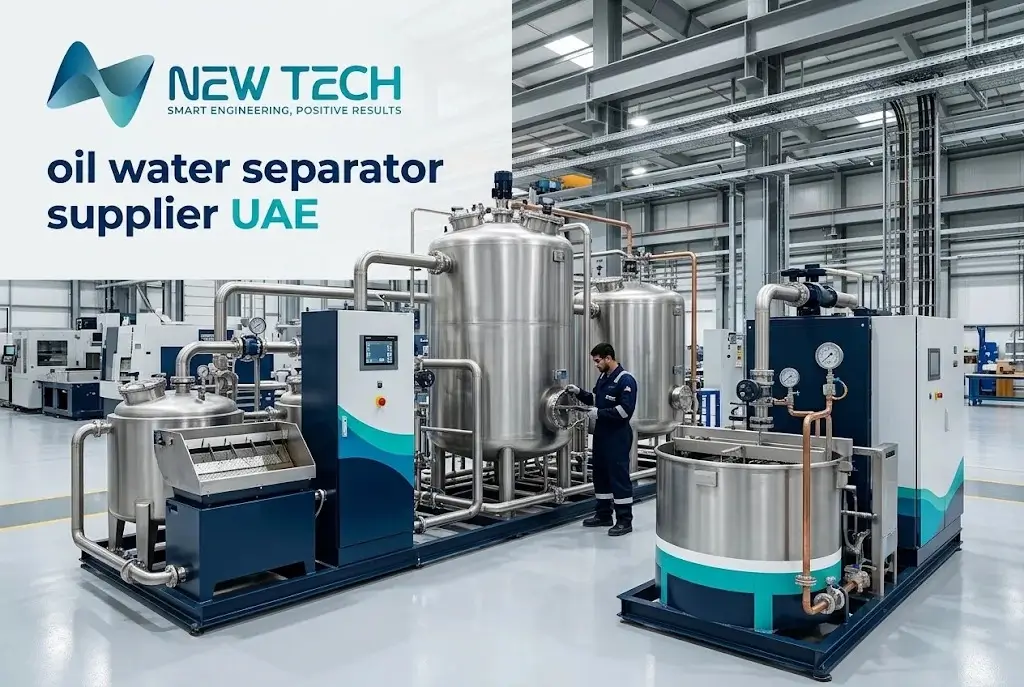
Correct equipment sizing is essential for reliable oil separation. A separator may be hydraulically capable of accepting a stated flow rate but still fail to remove the intended oil droplets under the actual operating conditions.
Industrial separator design should therefore consider flow, droplet characteristics, density difference, water viscosity, temperature, hydraulic loading and the required separation performance.
Normal Flow, Peak Flow and Equalization
Many industrial facilities generate wastewater intermittently. Workshop washdowns, equipment cleaning or batch operations can create temporary flows well above normal operating demand.
When the incoming flow rises beyond the separator’s suitable operating conditions, oil can be carried through the equipment before sufficient separation occurs.
Where flow variations are substantial, equalization may be evaluated to moderate hydraulic peaks before the separation stage.
Illustrative Hydraulic Retention Time Calculation
Consider a hypothetical industrial wastewater stream with an operating flow of 12 m³/h. Assume a nominal hydraulic retention time of 20 minutes for the purpose of explaining the calculation.
| Parameter | Illustrative Value |
|---|---|
| Wastewater Flow | 12 m³/h |
| Assumed Retention Time | 20 minutes |
| Retention Time in Hours | 0.333 h |
| Calculated Liquid Volume | Approximately 4.0 m³ |
Nominal Liquid Volume = Flow Rate × Retention Time
Nominal Liquid Volume = 12 × (20 / 60)
Nominal Liquid Volume ≈ 4.0 m³
This calculation gives an illustrative volume only. It does not establish the correct size of a commercial oil water separator, and 20 minutes is not a universal design criterion.
Why Oil Droplet Rise Velocity Matters
In gravity separation, a suitable oil droplet must rise far enough to reach the collection zone before the surrounding water leaves the separator.
The rise velocity depends on droplet diameter, the difference between oil and water densities, water viscosity and other operating conditions.
For small spherical droplets moving under ideal laminar conditions, Stokes’ law provides a theoretical relationship between these properties and the terminal rise velocity.
In its simplified form, the relationship shows that rise velocity is proportional to the square of the droplet diameter when other variables remain constant.
For example, under the ideal assumptions of Stokes’ law, reducing a droplet’s diameter by half reduces its calculated rise velocity to one-quarter of the original value.
This demonstrates why a separator that removes relatively large free-oil droplets may struggle with much smaller dispersed droplets.
Actual industrial wastewater can deviate from the ideal assumptions, particularly when droplets interact, emulsions remain stable or turbulence is present.
Why Surface Loading and Hydraulic Distribution Matter
Gravity separation design also considers the available separation area, internal flow distribution and the distance droplets must rise.
Short-circuiting, excessive turbulence and unsuitable inlet or outlet arrangements can reduce effective separation even when the nominal tank volume appears adequate.
For enhanced gravity or coalescing systems, manufacturers may provide additional performance criteria and equipment-specific design limits.
What Engineers Need for Final Sizing
- Normal and maximum wastewater flow.
- Oil density and relevant physical characteristics.
- Water temperature and viscosity.
- Expected oil droplet characteristics.
- Free-oil and emulsified-oil behavior.
- Suspended solids and sludge loading.
- Required treated-water quality.
- Available installation space and maintenance access.
Get Equipment Sizing Based on Your Actual Flow. Share your operating conditions and oil characteristics with New Tech Water before requesting a separator quotation.
اطلب استشارة مجانية الآن
تواصل مع خبرائنا لمساعدتك في اختيار محطة المياه المناسبة لاحتياجاتك بأفضل كفاءة وأقل تكلفة.
Industrial Oil Water Separator Applications for Workshops and Factories
Different industrial processes produce different types of oily wastewater. Selecting suitable separation equipment requires understanding what enters the drainage or wastewater collection system during normal operations and cleaning activities.
Automotive Workshops and Vehicle Maintenance
Vehicle maintenance facilities may generate wastewater containing lubricating oil, fuel residues, cleaning products and suspended solids.
Where the wastewater contains primarily separable free oil, gravity or enhanced gravity separation may be worth evaluating. Detergent-stabilized emulsions may require additional treatment.
Grit collection and maintenance access should also be considered when significant sediments are present.
Vehicle Washing Facilities
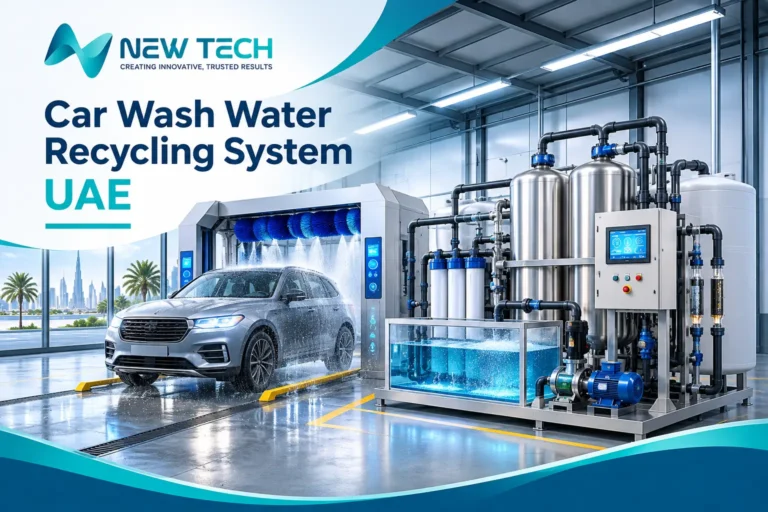
Vehicle washing wastewater can contain oil droplets, detergents, sand and other suspended material. A treatment arrangement may require preliminary solids removal followed by oil separation and additional treatment.
Where water recycling is proposed, the final process must address the full range of contaminants relevant to the reuse application.
Manufacturing and Machinery Operations
Manufacturing wastewater may include lubricants, cutting fluids, coolants and emulsified oils. These mixtures can behave differently from ordinary free-oil wastewater.
For projects involving industrial coolants or stable emulsions, bench-scale testing may help determine whether chemical conditioning or a more specialized separation process is necessary.
Oil Removal Before an Effluent Treatment Plant
In a broader wastewater treatment process, primary oil removal may reduce loading on downstream equipment. However, it does not necessarily remove dissolved organics, salts or other contaminants.
For a wider discussion of industrial wastewater systems, read New Tech Water’s wastewater treatment plant supplier UAE guide.
Match Oil Separation Technology to Your Industrial Process. Discuss your workshop, washing or manufacturing wastewater with New Tech Water.
اطلب استشارة مجانية الآن
تواصل مع خبرائنا لمساعدتك في اختيار محطة المياه المناسبة لاحتياجاتك بأفضل كفاءة وأقل تكلفة.
What Wastewater Testing Is Needed Before Selecting Equipment?
Representative wastewater analysis is one of the most valuable inputs to equipment selection. It helps establish whether physical separation is likely to be sufficient or whether the wastewater requires conditioning and additional treatment stages.
| Parameter | Why It Matters |
|---|---|
| Oil and Grease | Establishes extractable oil and grease loading using a suitable analytical method. |
| Free and Emulsified Oil | Helps assess likely separation behavior. |
| Total Suspended Solids | Influences sludge accumulation and component fouling. |
| pH | Supports evaluation of chemical conditioning and material compatibility. |
| Temperature | Affects viscosity and separation behavior. |
| COD | Provides information about chemically oxidizable wastewater constituents. |
| Surfactants and Detergents | May indicate conditions favoring stable emulsions. |
| Operating Flow | Defines normal and peak hydraulic requirements. |
| Required Outlet Quality | Determines the necessary treatment performance. |
Why Representative Sampling Is Important
A single sample may not capture the full wastewater variation at a manufacturing site. Oil loading and detergent concentrations can change during production, washdown or equipment-cleaning activities.
Sampling should therefore reflect the actual operating pattern and the intended treatment objective.
When Should Bench Testing Be Used?
Bench testing may be appropriate where the wastewater contains stable emulsions, variable chemical constituents or uncertain separation behavior.
Depending on the proposed process, testing may help assess emulsion destabilization, chemical conditioning, flotation or other relevant treatment mechanisms.
Final process selection should be based on verified performance rather than assuming that a standard oil separator can treat every industrial wastewater stream.
Build Your Separator Specification Around Reliable Testing. Contact New Tech Water with your laboratory results and treatment requirements.
اطلب استشارة مجانية الآن
تواصل مع خبرائنا لمساعدتك في اختيار محطة المياه المناسبة لاحتياجاتك بأفضل كفاءة وأقل تكلفة.
Installation, Oil Collection and Sludge Handling Requirements
Industrial oil water separator installation requires suitable hydraulic connections, safe equipment access and arrangements for collecting separated oil and accumulated solids.
The exact requirements depend on the equipment type, wastewater characteristics, site layout and applicable project specifications.
Inlet and Outlet Arrangements
Appropriate inlet distribution helps reduce turbulence that may interfere with oil separation. The outlet configuration should support the intended hydraulic operation without unnecessarily disturbing collected oil or settled materials.
Where pumps are used, the design should consider how pumping conditions affect droplet behavior and flow distribution.
Recovered Oil Collection
Separated oil must be removed and managed appropriately. Depending on the separator, this may involve skimmers, collection chambers, pumps or other approved arrangements.
The expected oil accumulation should be considered when determining storage and removal requirements.
Sludge and Sediment Management
Workshops and industrial facilities may generate wastewater containing sand, grit, metal particles or other settleable material.
Without suitable solids management, sediment can reduce effective separation volume, obstruct internal components or increase cleaning requirements.
Some projects may benefit from upstream grit removal or other solids pretreatment.
Site Safety and Maintenance Access
Equipment layout should permit safe inspection, cleaning and component replacement according to the manufacturer’s instructions.
Potential hazards may include confined spaces, combustible materials, hazardous vapors and contaminated residuals. Relevant site safety procedures must be established before operation or maintenance.
Plan a Separator That Is Practical to Operate and Maintain. Discuss site access, hydraulic connections and residuals handling with New Tech Water.
اطلب استشارة مجانية الآن
تواصل مع خبرائنا لمساعدتك في اختيار محطة المياه المناسبة لاحتياجاتك بأفضل كفاءة وأقل تكلفة.
Oil Water Separator Maintenance: Common Problems and Solutions
Separator performance can deteriorate when accumulated oil or sludge reduces effective operating capacity, coalescing components become fouled or wastewater conditions change.
Routine monitoring helps operators identify these issues before they affect downstream treatment or the required outlet-water quality.
| Problem | Possible Cause | What to Check |
|---|---|---|
| High Outlet Oil Concentration | Hydraulic overload or unsuitable separation technology. | Operating flow, oil form and equipment capacity. |
| Persistent Milky Water | Stable oil emulsion or detergent contamination. | Surfactants and potential conditioning requirements. |
| Coalescer Fouling | Excessive suspended solids or incompatible contaminants. | Upstream solids control and coalescing components. |
| Oil Carryover During Peak Flow | Hydraulic surges or reduced effective separation capacity. | Peak flow, internal condition and accumulated oil. |
| Rapid Sludge Accumulation | High solids loading. | Grit removal and cleaning arrangements. |
| Variable Outlet Quality | Changing wastewater composition or operating conditions. | Production records and representative test results. |
| Unexpected Odors | Wastewater accumulation or changes in wastewater condition. | Operating conditions and relevant safety procedures. |
Routine Operating Checks
- Review influent and effluent oil measurements where applicable.
- Record actual operating flow and peak conditions.
- Check accumulated oil and sludge levels.
- Inspect coalescing components for fouling.
- Verify oil removal and skimming equipment.
- Review relevant instrumentation and alarms.
- Maintain cleaning and inspection records.
The correct maintenance frequency depends on wastewater loading, separator design and actual performance. A fixed interval should not be applied to every installation without considering these factors.
When Is Equipment Replacement Necessary?
Poor separation does not always justify replacing the entire unit. The underlying cause may involve an unsuitable design flow, emulsion formation, sludge accumulation or insufficient maintenance.
Before replacement, evaluate whether cleaning, process changes, suitable pretreatment or another approved modification could address the problem.
Improve Oil Removal Before Replacing Equipment. Share your operating data and treatment problems with New Tech Water for a technical discussion.
اطلب استشارة مجانية الآن
تواصل مع خبرائنا لمساعدتك في اختيار محطة المياه المناسبة لاحتياجاتك بأفضل كفاءة وأقل تكلفة.
Oil Water Separator Price UAE: Equipment and Operating Cost Factors
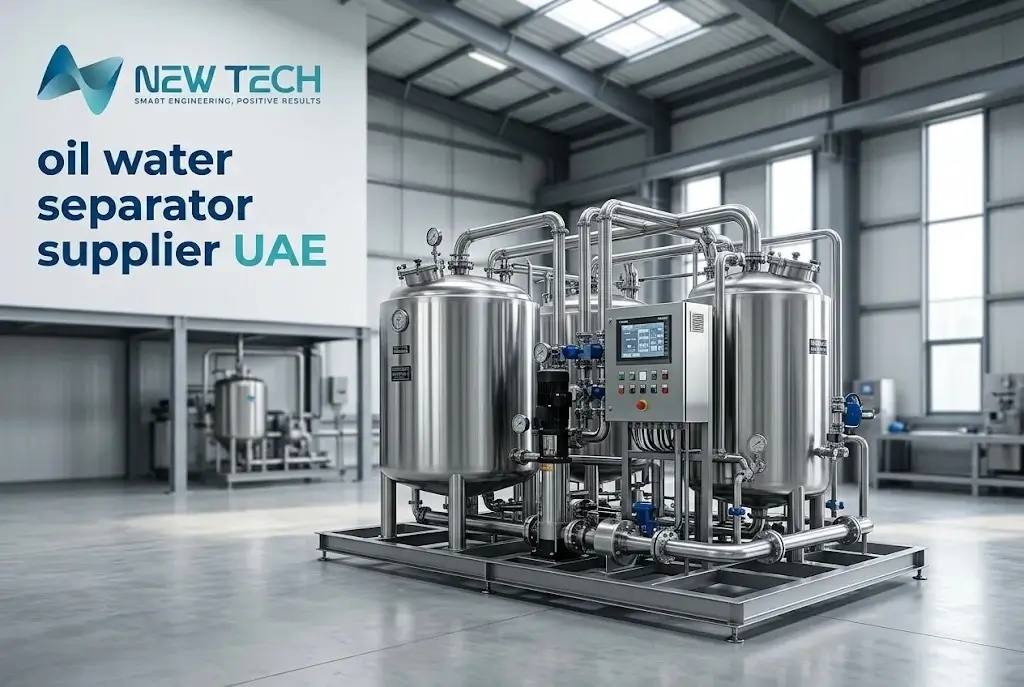
Oil water separator prices in the UAE depend on the selected technology, required treatment capacity, wastewater characteristics and complete project scope.
When comparing an Oil Water Separator Supplier UAE quotation, industrial buyers should assess the technical basis for the offered equipment rather than selecting the lowest listed price.
Main Factors That Affect Separator Cost
| Cost Factor | What Buyers Should Verify |
|---|---|
| Technology | Gravity, coalescing, plate-based or flotation process. |
| Hydraulic Capacity | Normal and maximum wastewater flow. |
| Oil Characteristics | Concentration, droplet behavior and emulsion stability. |
| Construction Materials | Compatibility with wastewater and site conditions. |
| Automation | Skimmers, controls, pumps and monitoring requirements. |
| Additional Treatment | Equalization, chemical conditioning or further separation. |
| Installation Scope | Pipework, utilities, civil works and commissioning responsibilities. |
| Operating Costs | Energy, chemicals, inspection and residuals handling. |
| Documentation | Datasheets, drawings, operating manuals and agreed tests. |
Why a Low Purchase Price Can Be Misleading
A lower-cost gravity separator may be unsuitable for wastewater containing stable emulsions. Similarly, a compact coalescing unit may require additional solids pretreatment to operate reliably.
Equipment comparisons should therefore account for treatment performance, installation requirements, maintenance and the likely need for other processing stages.
Technical RFQ Checklist
For a meaningful commercial comparison, include the following information:
- Facility type and industrial application.
- Average and peak wastewater flow.
- Oil and grease concentrations.
- Available data on droplet size and oil form.
- Detergent and surfactant information.
- Suspended solids concentration.
- Wastewater temperature and relevant chemistry.
- Required outlet-water quality.
- Discharge or reuse route.
- Site space and utility availability.
- Required supply and installation scope.
- Project location in the UAE.
Where the wastewater is difficult to characterize, additional testing may be required before a reliable quotation can be prepared.
Request a Technical Quote for Your Wastewater Project. Send your site and laboratory specifications to New Tech Water to confirm the relevant project options.
اطلب استشارة مجانية الآن
تواصل مع خبرائنا لمساعدتك في اختيار محطة المياه المناسبة لاحتياجاتك بأفضل كفاءة وأقل تكلفة.
Industrial Oil Water Separation Projects in Dubai, Sharjah and Abu Dhabi
Industrial facilities throughout the UAE can generate wastewater containing hydrocarbons, lubricants, fats, detergents and suspended solids. However, treatment requirements are determined by the actual industrial activity and wastewater conditions rather than location alone.
Dubai: Workshop and Industrial Drainage
Vehicle maintenance areas, washing facilities and selected manufacturing operations may require oil separation as part of their wastewater-management arrangements.
Before choosing equipment, project owners should establish the approved route for the wastewater and the quality required at the relevant outlet.
Sharjah: Manufacturing and Maintenance Wastewater
Industrial sites may generate oily wastewater during machinery maintenance, production and cleaning operations. Changes in flow and detergent use can influence the treatment process.
Facilities should assess whether the wastewater contains separable free oil or stable emulsions before selecting a gravity or enhanced separation system.
Abu Dhabi: Industrial Treatment Integration
Oil removal may be required as one stage of a wider industrial wastewater treatment project. Where additional contaminants are present, the separator should be evaluated together with the downstream process.
Site access, treatment capacity, wastewater variability and residuals handling are important project considerations.
Discharge and Waste Handling Requirements
Wastewater discharge, reuse and waste-management requirements can differ by jurisdiction, industrial activity and receiving system.
Before installation, project owners should verify the applicable site permissions, oil and grease limits, requirements for recovered oil and sludge, and any necessary approvals from the relevant authorities.
There is no single oil and grease discharge limit that should be assumed for every industrial facility in the UAE.
Plan Your UAE Oil Separation Project Around Site Requirements. Share your facility location, wastewater analysis and intended outlet route with New Tech Water.
اطلب استشارة مجانية الآن
تواصل مع خبرائنا لمساعدتك في اختيار محطة المياه المناسبة لاحتياجاتك بأفضل كفاءة وأقل تكلفة.
Integrating Oil Separation into a Complete Wastewater Treatment Plant
Oil water separation may be a preliminary stage in a broader industrial effluent treatment plant. Its purpose is to remove suitable oil fractions before the water reaches additional treatment equipment.
However, the water leaving a separator may still contain emulsified oil, dissolved organics, suspended solids or other contaminants that require further treatment.
Example Industrial Treatment Sequence
Depending on wastewater characteristics, a suitable process may include screening, grit removal, equalization, primary oil separation and additional chemical or physical treatment.
Where stable emulsions occur, chemical conditioning and flotation may be evaluated. Other wastewater contaminants may require separate treatment processes.
The treatment sequence should be established through engineering assessment and verified testing where necessary.
Can Oily Wastewater Be Reused After Separation?
Water reuse may be feasible for selected applications, but removing free oil does not establish that the treated water is suitable for reuse.
The required treatment depends on the final application and may include further removal of suspended solids, dissolved contaminants or microorganisms.
Why Integration Matters
Suitable upstream oil removal can reduce the loading on some downstream treatment equipment. However, compatibility with membranes, filtration systems or other sensitive processes must be evaluated carefully.
For an overview of wider industrial treatment applications, explore New Tech Water’s industrial water treatment solutions in the UAE.
Evaluate Oil Separation as Part of a Complete Treatment Process. Discuss the wastewater characteristics and downstream treatment requirements with New Tech Water.
اطلب استشارة مجانية الآن
تواصل مع خبرائنا لمساعدتك في اختيار محطة المياه المناسبة لاحتياجاتك بأفضل كفاءة وأقل تكلفة.
Why Discuss Your Oily Wastewater Project with New Tech Water?
Choosing suitable oil separation equipment requires understanding the wastewater and defining the complete treatment objective. New Tech Water publishes industrial water treatment solutions, including filtration, reverse osmosis and other related equipment and engineering applications.
These capabilities provide relevant technical context when evaluating how preliminary oil removal might fit into a wider industrial water treatment project.
However, the company’s publicly available pages reviewed for this article do not establish the availability of a particular standalone oil water separator, coalescing unit or DAF model. Buyers should confirm any proposed equipment and services directly.
What Can You Discuss in a Technical Enquiry?
- Wastewater analysis and treatment requirements.
- Oil type and anticipated separation challenges.
- Required plant capacity and operating schedule.
- Potential integration with other treatment stages.
- Available equipment and technical documentation.
- Project specifications and relevant supply options.
- Installation requirements and operating considerations.
- Scope of engineering and commercial support available for the project.
A clear technical enquiry makes it easier to determine whether the requested equipment falls within the company’s available product and project scope.
New Tech Water’s published water treatment plant information can also help buyers understand the broader filtration and process-treatment technologies relevant to industrial facilities.
For projects involving complex oily wastewater, specialist separation design or testing may be required before the appropriate equipment can be specified.
Discuss the Available Equipment and Engineering Scope for Your Project. Contact New Tech Water with your wastewater analysis and technical requirements.
اطلب استشارة مجانية الآن
تواصل مع خبرائنا لمساعدتك في اختيار محطة المياه المناسبة لاحتياجاتك بأفضل كفاءة وأقل تكلفة.
Frequently Asked Questions About Oil Water Separators in UAE
Where can I buy an oil water separator in UAE?
Industrial wastewater equipment suppliers can be contacted with your required flow, oil characteristics and outlet-water targets. You can also enquire with New Tech Water to confirm whether the relevant equipment or integration scope is available.
How much does an industrial oil water separator cost?
The price depends on the technology, operating flow, materials, automation, wastewater characteristics and installation scope. Accurate quotations require technical information about the intended duty.
What is the difference between gravity and coalescing separators?
Gravity separators use density differences to remove suitable free oil. Coalescing separators encourage certain smaller oil droplets to combine into larger droplets that separate more readily.
Which oil water separator is best for a workshop?
The correct equipment depends on the amount and form of oil, detergent use, suspended solids, wastewater flow and required outlet quality. Representative testing should guide selection.
Can an oil water separator remove emulsified oil?
Conventional gravity separators are generally unsuitable for stable emulsions. Some emulsified wastewater requires chemical conditioning and a suitable downstream separation method.
How do I size an oil water separator?
Evaluate normal and peak flow, droplet behavior, density difference, temperature, hydraulic conditions and required separation performance. Final design must follow the selected technology’s criteria.
What wastewater testing is needed before oil separation?
Relevant testing may include oil and grease, suspended solids, pH, temperature, COD and an assessment of oil form or emulsion behavior.
Does an oil water separator require chemical treatment?
Not always. Selected free-oil streams may be treated through physical separation. Stable emulsions may require chemical conditioning before effective separation.
How often should oil separators be cleaned?
Cleaning frequency depends on oil and solids loading, equipment configuration and actual operating performance. Maintenance should follow the manufacturer’s instructions and site conditions.
Can oil water separation be integrated with an ETP?
Yes. Oil separation can be incorporated into a wider effluent treatment plant. Additional treatment processes are selected according to the remaining contaminants and required outlet quality.
Need Help Defining Your Oil Separation Requirements? Share your wastewater data with New Tech Water to discuss the relevant project options.
اطلب استشارة مجانية الآن
تواصل مع خبرائنا لمساعدتك في اختيار محطة المياه المناسبة لاحتياجاتك بأفضل كفاءة وأقل تكلفة.
Choose the Right Oil Separation Approach for Your UAE Facility
Choosing an Oil Water Separator Supplier UAE starts with reliable wastewater data and a clear treatment objective. Gravity, coalescing and DAF technologies serve different applications, so equipment selection must consider oil form, droplet behavior, operating flow and outlet-water requirements.
New Tech Water can be contacted to discuss relevant industrial treatment requirements and confirm its available equipment or project scope. Submit your wastewater analysis and facility specifications to begin an informed technical enquiry.
Plan Your Industrial Oil Separation Project with New Tech Water. Contact the team to discuss your specifications and request project-specific guidance.
اطلب استشارة مجانية الآن
تواصل مع خبرائنا لمساعدتك في اختيار محطة المياه المناسبة لاحتياجاتك بأفضل كفاءة وأقل تكلفة.

 Arabic
 English