
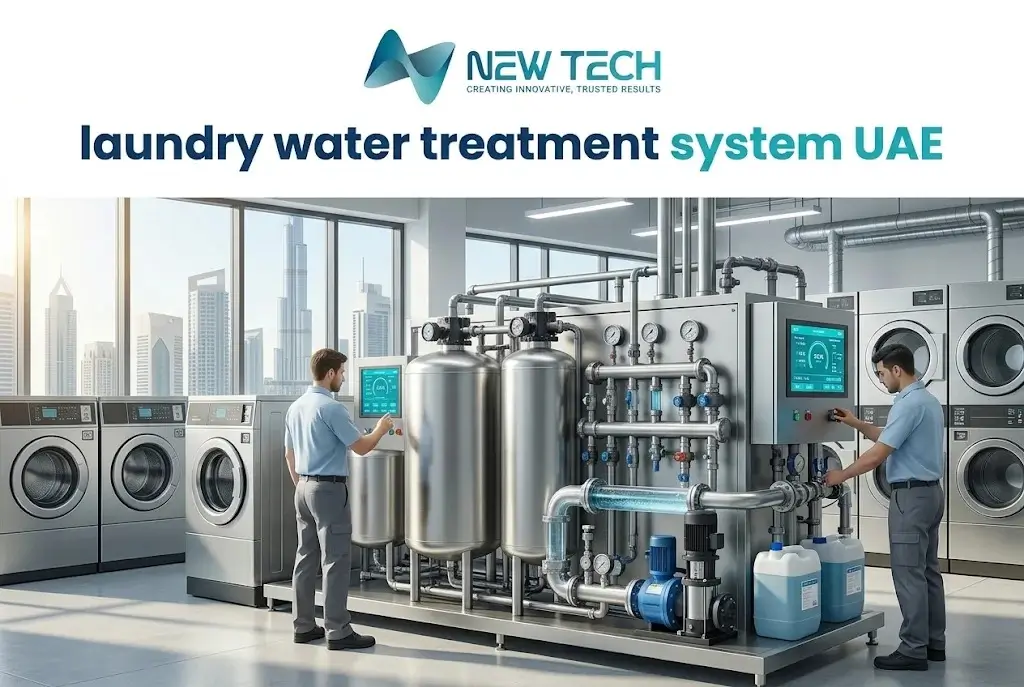
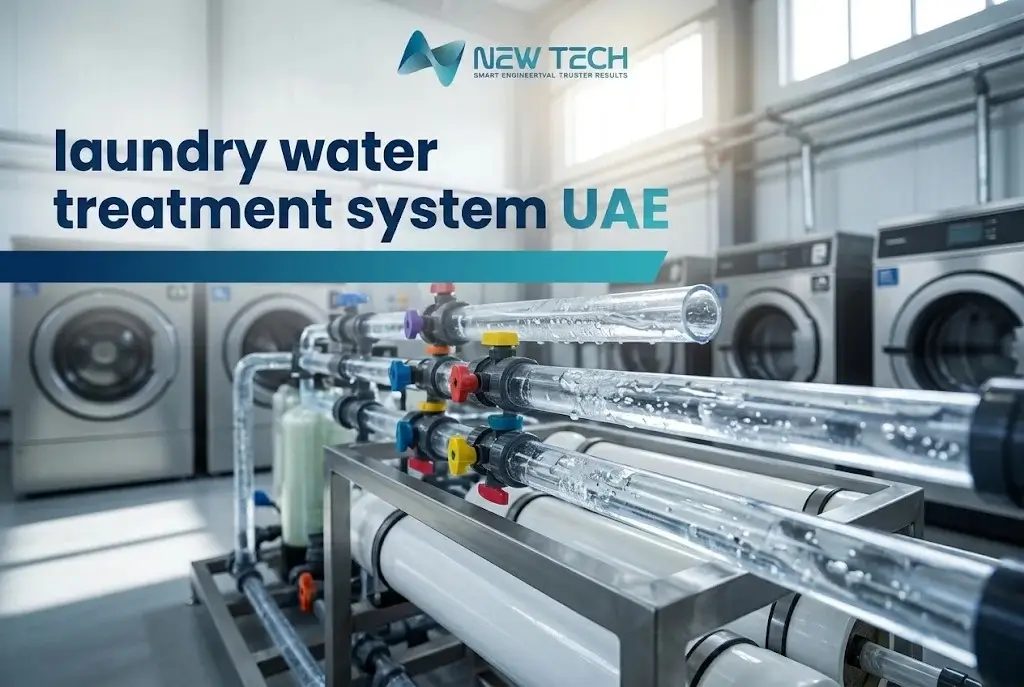
Struggling with hard water, detergent inefficiency or rising laundry operating costs? Choosing a laundry water treatment system UAE businesses can rely on starts with water testing and suitable equipment specifications. Whether you operate a hotel, hospital or industrial laundry, your facility may need softening, filtration, reverse osmosis or wastewater treatment.
Explore treatment technologies, capacity calculations, operating costs and regulatory considerations before requesting a technical equipment quote from New Tech Water.
Laundry Water Treatment System UAE: What Does Your Facility Need?
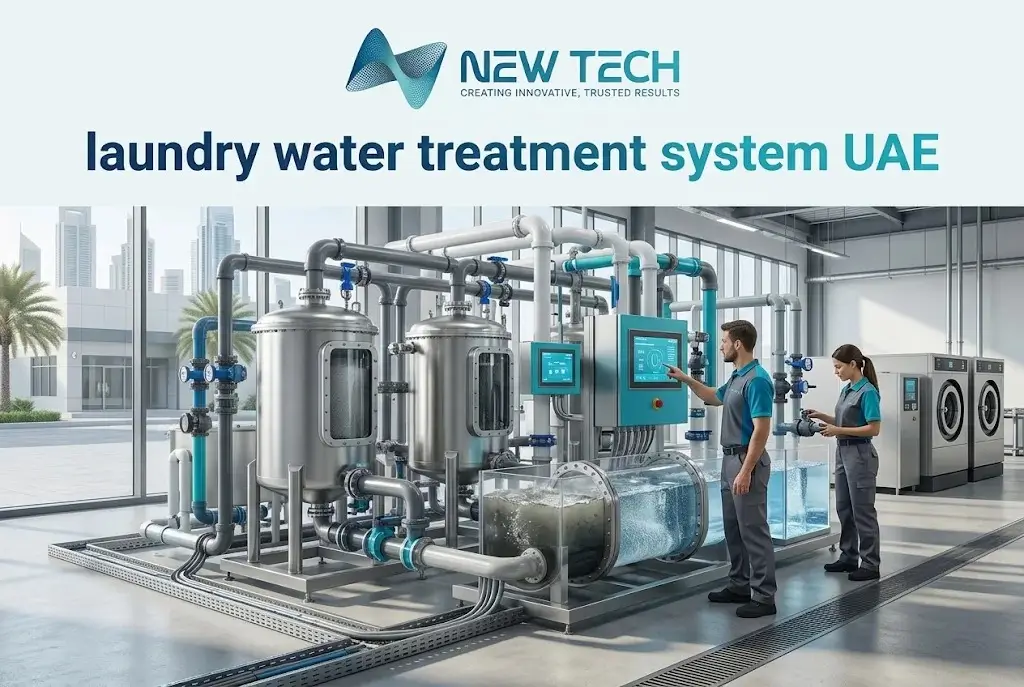
Selecting a laundry water treatment system UAE requires understanding the difference between the water entering your washing equipment and the wastewater leaving the facility. These two water streams have different treatment objectives. Incoming water may need hardness removal or filtration, while wastewater can contain lint, surfactants, organic contamination and residual cleaning chemicals that require separate evaluation.
For a commercial laundry, water quality affects equipment performance, washing consistency and operating costs. However, not every facility needs the same treatment package. A water softener may be suitable when calcium and magnesium hardness are the primary problems. Reverse osmosis may be appropriate for selected low-mineral-water requirements, while wastewater recycling requires a different treatment and monitoring strategy.
Start with These Technical Questions
- What is the incoming water source and its chemical composition?
- Is the main problem hardness, scaling, dissolved minerals or suspended solids?
- How many kilograms of laundry are processed daily?
- What are the washing-machine manufacturer’s water specifications?
- What is the maximum simultaneous water demand?
- Does the facility require water treatment for steam generation?
- Is wastewater treatment or recycling part of the project?
- What equipment, documentation and services are required?
The answers help define whether the facility needs individual water treatment components or a more complex engineered system. Water quality targets and equipment selection should be established before comparing quotations.
Find the Right Laundry Water Treatment Equipment. Share your water analysis, operating capacity and equipment requirements with New Tech Water.
اطلب استشارة مجانية الآن
تواصل مع خبرائنا لمساعدتك في اختيار محطة المياه المناسبة لاحتياجاتك بأفضل كفاءة وأقل تكلفة.
Why Water Quality Matters in Commercial Laundry Operations
Commercial laundries use water for washing, rinsing, cleaning and sometimes heating or steam generation. Poor source-water quality can contribute to detergent interaction, mineral deposits, discoloration and inconsistent washing performance. These effects depend on the incoming water chemistry, textile type, detergent formulation and equipment operating conditions.
Hardness and Detergent Performance
Hard water contains calcium and magnesium ions that can interact with certain cleaning formulations. While some detergents include ingredients designed to manage hardness, excessive hardness may still affect chemical consumption and washing consistency under particular operating conditions.
The appropriate hardness specification should come from the washing-machine manufacturer, detergent supplier and process requirements. A universal hardness target should not be applied to every commercial laundry.
Scaling in Heating Equipment
Mineral deposits can form on heating surfaces when water chemistry and operating conditions encourage precipitation. Scale may reduce heat-transfer efficiency and increase maintenance requirements. Evaluating hardness, alkalinity and operating temperature helps determine whether softening or additional conditioning is justified.
Iron, Manganese and Textile Discoloration
Iron and manganese can cause deposits or contribute to unwanted textile discoloration under certain conditions. Their removal depends on concentration, chemical form, oxidation conditions and other water characteristics. A conventional softener should not automatically be selected as the complete solution for significant iron or manganese contamination.
Consistent Water Quality for Washing Processes
Stable treated-water quality supports process control, but water treatment works alongside appropriate detergent dosing, washing programs and equipment maintenance. Installing a treatment plant cannot compensate for incorrect chemical selection, unsuitable temperatures or overloaded machinery.
Identify Your Water Hardness and Treatment Needs. Test the incoming water before selecting softening, filtration or RO equipment.
اطلب استشارة مجانية الآن
تواصل مع خبرائنا لمساعدتك في اختيار محطة المياه المناسبة لاحتياجاتك بأفضل كفاءة وأقل تكلفة.
Inlet Water Treatment vs Laundry Wastewater Treatment
A commercial laundry may need to address two different water streams. Inlet-water treatment focuses on preparing water for washing machines and utilities, while wastewater treatment focuses on reducing pollutants after laundering. Water recycling adds further requirements because reclaimed water must be suitable for its intended reuse application.
| Application | Primary Objective | Important Parameters |
|---|---|---|
| Inlet Water Treatment | Improve water supplied to washing equipment. | Hardness, TDS, iron, turbidity and pH. |
| Wastewater Treatment | Control contaminants before discharge. | TSS, COD, surfactants, temperature and pH. |
| Wastewater Recycling | Produce water suitable for a defined reuse application. | Reuse-specific chemical, physical and microbial quality. |
| Boiler Feedwater Treatment | Meet steam-system water quality requirements. | Hardness, alkalinity, silica, conductivity and other design parameters. |
Why the Treatment Objective Matters
A water softener addresses calcium and magnesium hardness but does not remove the organic pollutants present in laundry wastewater. Conversely, a wastewater filtration system designed to remove lint will not necessarily provide the low-hardness water required by certain washing or heating applications.
Procurement teams should identify the treatment objective for each water stream rather than request one general purification package to solve unrelated operational problems.
Choose Equipment for the Correct Water Stream. Define whether your priority is inlet-water conditioning, wastewater treatment or controlled reuse.
اطلب استشارة مجانية الآن
تواصل مع خبرائنا لمساعدتك في اختيار محطة المياه المناسبة لاحتياجاتك بأفضل كفاءة وأقل تكلفة.
What Water Quality Parameters Should a Laundry Test?
A reliable laundry water treatment system UAE specification starts with representative water analysis. Total hardness is important when evaluating softeners, but other parameters may determine whether filtration, iron removal or membrane treatment is necessary.
| Parameter | Potential Problem | Technology to Evaluate |
|---|---|---|
| Total Hardness | Scale formation and detergent interaction. | Ion-exchange softening. |
| Calcium and Magnesium | Hardness-related deposits. | Softening based on the required outlet quality. |
| TDS / Conductivity | High dissolved-mineral content. | RO where the target quality justifies desalination. |
| TSS / Turbidity | Particles and equipment fouling. | Media or cartridge filtration as appropriate. |
| Iron / Manganese | Deposits or discoloration. | Source-specific pretreatment. |
| pH / Alkalinity | Precipitation and process compatibility. | Appropriate conditioning based on water chemistry. |
| Silica | Potential scaling concerns in certain utilities. | Specialized treatment where required. |
| COD / Surfactants | Detergent-related wastewater contamination. | Combined wastewater treatment processes. |
| Lint / Suspended Wastewater Solids | Blockage and downstream treatment problems. | Screening and suitable filtration. |
Why TDS Is Not the Same as Hardness
Total Dissolved Solids represents dissolved constituents in water, while hardness primarily reflects calcium and magnesium. Two samples with similar TDS can have different hardness values. Therefore, a softener should be selected from measured hardness and the required service conditions rather than a TDS reading alone.
How Water Testing Supports Equipment Procurement
Testing helps determine the treatment objective, expected equipment performance and potential pretreatment requirements. The laboratory report should be evaluated together with daily demand, peak flow, water temperature and manufacturer specifications.
Test Your Laundry Water Before Buying Equipment. Send your laboratory results and target water quality to New Tech Water.
اطلب استشارة مجانية الآن
تواصل مع خبرائنا لمساعدتك في اختيار محطة المياه المناسبة لاحتياجاتك بأفضل كفاءة وأقل تكلفة.
Water Softeners for Commercial and Industrial Laundries
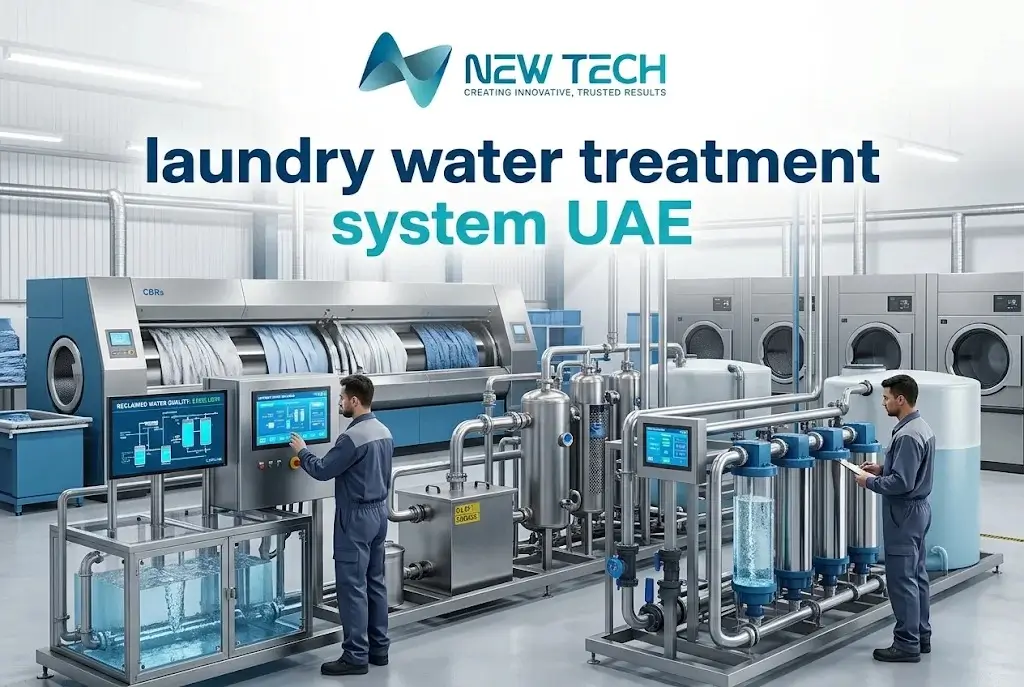
Water softening is commonly evaluated when a laundry needs to reduce calcium and magnesium hardness. A conventional sodium-cycle ion-exchange softener contains resin that exchanges hardness ions for sodium ions. After its usable exchange capacity is depleted, the resin is regenerated using a suitable brine solution.
How Ion-Exchange Water Softening Works
As hard water passes through the resin, calcium and magnesium are exchanged for sodium. The treated water generally has reduced hardness, helping meet selected washing and utility requirements. Once the resin approaches exhaustion, the equipment requires regeneration to restore its service capacity.
Does a Softener Reduce TDS?
Conventional sodium-cycle softening is not a desalination process. It changes the ionic composition of the water but does not remove most dissolved minerals in the way reverse osmosis can. Where a process requires low conductivity or reduced overall dissolved salts, additional treatment may be necessary.
Understanding Softener Service Flow, Capacity and Regeneration
| Design Factor | What It Means | Why It Matters |
|---|---|---|
| Service Flow | Water flow through the softener during operation. | Must accommodate the required hydraulic duty. |
| Peak Flow | Highest expected instantaneous demand. | May exceed the average hourly demand. |
| Usable Exchange Capacity | Amount of hardness the resin can remove before regeneration under specified conditions. | Determines the treated volume between regenerations. |
| Regeneration Frequency | How often resin regeneration is required. | Influences water use, salt consumption and availability. |
| Salt Dose | Regenerant consumption per cycle. | Affects usable capacity and operating cost. |
| Resin Volume | Amount of ion-exchange media installed. | Must suit hydraulic and exchange-capacity requirements. |
Single and Duplex Softener Arrangements
A single softener may be appropriate where sufficient storage or a planned regeneration interruption is acceptable. Facilities requiring continuous softened-water availability may consider duplex or duty-standby arrangements, provided the selected control configuration meets the required duty.
Regeneration Wastewater
Softener regeneration consumes salt and water and generates a brine-containing wastewater stream. The operator should consider regeneration frequency, drain capacity and the applicable discharge requirements when selecting equipment.
Request a Water Softener Specification. Share feedwater hardness, peak flow and daily softened-water demand with New Tech Water.
اطلب استشارة مجانية الآن
تواصل مع خبرائنا لمساعدتك في اختيار محطة المياه المناسبة لاحتياجاتك بأفضل كفاءة وأقل تكلفة.
How to Calculate Commercial Laundry Softener Capacity
Softener sizing involves both hydraulic capacity and hardness-removal capacity. Nominal flow alone is insufficient because the exchange capacity needed between regenerations depends on the incoming hardness and water volume.
Illustrative Hardness Load Calculation
Consider a commercial laundry requiring 24 m³ of softened water per day, with incoming hardness of 250 mg/L as CaCO3.
| Design Parameter | Illustrative Value |
|---|---|
| Daily Water Volume | 24,000 L/day |
| Feedwater Hardness | 250 mg/L as CaCO3 |
| Daily Hardness Load | 6 kg/day as CaCO3 equivalent |
Daily Hardness Load = Water Volume × Hardness / 1,000,000
Daily Hardness Load = 24,000 × 250 / 1,000,000 = 6 kg/day as CaCO3 equivalent
The calculated 6 kg/day represents the hardness-removal burden. It is not the required resin mass, resin volume or regeneration salt quantity.
Estimating the Hardness Load Between Regenerations
If a facility plans an illustrative 24-hour operating period between regeneration events, the theoretical daily load remains 6 kg as CaCO3 equivalent. A longer interval increases the required usable exchange capacity proportionally if demand and hardness remain unchanged.
Actual resin volume must be calculated using the manufacturer’s usable exchange capacity at the selected regeneration conditions, service flow and required outlet hardness. Design allowances and water quality variation should also be evaluated.
Why Peak Flow Must Be Checked Separately
Multiple washing machines may fill simultaneously. This can create a higher instantaneous demand than the average daily production rate. A suitable design may require additional hydraulic capacity or treated-water storage, depending on the laundry’s operation.
Calculate Softener Capacity Using Real Operating Data. Request equipment specifications based on hardness load, service flow and regeneration requirements.
اطلب استشارة مجانية الآن
تواصل مع خبرائنا لمساعدتك في اختيار محطة المياه المناسبة لاحتياجاتك بأفضل كفاءة وأقل تكلفة.
When Should a Laundry Use Reverse Osmosis Instead of Softening?
Reverse osmosis is considered when a defined process requires reduced dissolved-mineral content beyond what a conventional softener can provide. RO membranes reject many dissolved salts and other constituents, but actual treatment performance depends on membrane characteristics, feedwater chemistry and operating conditions.
| Comparison | Ion-Exchange Softener | Reverse Osmosis |
|---|---|---|
| Main Treatment Objective | Reduce calcium and magnesium hardness. | Reduce many dissolved salts. |
| TDS Reduction | Not general desalination. | Can provide substantial dissolved-salt reduction. |
| Main Consumables | Regeneration salt and water. | Membrane-related consumables and appropriate pretreatment. |
| Residual Stream | Regeneration brine and rinse wastewater. | Concentrate and other relevant treatment residuals. |
| Design Basis | Hardness, flow and usable exchange capacity. | Feedwater chemistry, permeate target and recovery. |
When RO May Be Appropriate
Some specialized washing, rinsing or utility applications require lower dissolved-salt concentrations. The target quality should be established by the equipment manufacturer and operating process. RO should not be installed simply because dissolved minerals are detectable in source water.
RO Pretreatment and Operating Requirements
Membrane systems may require filtration and suitable scaling control based on the source-water analysis. Designers must consider feedwater pressure, target permeate quality, membrane recovery and concentrate disposal.
For related technical information, see New Tech Water’s Industrial RO Plant UAE guide.
Does Every Laundry Need RO?
No. Where source-water hardness is the main problem and other constituents already meet the required quality, a suitable softener may be sufficient. RO introduces additional operating and concentrate management requirements that should be justified by a clearly defined process target.
Compare Softening and RO for Your Laundry. Select equipment according to the water quality specification rather than unnecessary treatment complexity.
اطلب استشارة مجانية الآن
تواصل مع خبرائنا لمساعدتك في اختيار محطة المياه المناسبة لاحتياجاتك بأفضل كفاءة وأقل تكلفة.
Boiler Feedwater Treatment for Laundry Steam Systems
Some commercial laundries use steam-generating equipment for heating, ironing or other processing operations. Boiler feedwater quality can require stricter control than washing water because mineral impurities and dissolved constituents may contribute to scaling, corrosion or carryover under certain operating conditions.
Why Boiler Requirements Are Different
The appropriate boiler feedwater specification depends on boiler pressure, operating temperature, design, steam purity requirements and manufacturer guidance. Water softening may address hardness, but it does not automatically resolve every boiler-water concern.
Potential Boiler Water Treatment Stages
Depending on the system, treatment may involve hardness control, deaeration, dissolved-mineral reduction, chemical conditioning and appropriate blowdown management. These requirements must be established by qualified boiler-water specialists using the equipment specifications and relevant standards.
Information Required Before Equipment Selection
- Boiler manufacturer and model.
- Operating pressure and steam demand.
- Feedwater and condensate analyses where relevant.
- Required feedwater and boiler-water specifications.
- Make-up water quantity and available utilities.
- Existing treatment and monitoring arrangements.
Neither a conventional softener nor an industrial RO unit should be presented as a complete boiler-water treatment solution without evaluating the actual system.
Specify Laundry Utility Water Treatment Correctly. Include boiler requirements and water quality data in your technical enquiry.
اطلب استشارة مجانية الآن
تواصل مع خبرائنا لمساعدتك في اختيار محطة المياه المناسبة لاحتياجاتك بأفضل كفاءة وأقل تكلفة.
Laundry Wastewater Treatment and Recycling Technologies
Laundry wastewater can contain lint, suspended solids, surfactants, detergent residues, organic substances and variable pH. Its characteristics depend on the textiles, washing chemicals and process cycles. Wastewater generated by industrial workwear cleaning may differ significantly from that of a hotel linen facility.
Screening and Lint Removal
Screening helps intercept lint and larger debris before wastewater reaches pumps or downstream treatment equipment. The selected screening arrangement should match the solids loading, hydraulic flow and maintenance requirements.
Equalization and Flow Management
Different washing cycles may release wastewater with varying temperature, concentration and flow. Equalization tanks can reduce these variations and support more stable operation of downstream treatment stages.
COD and Surfactant Removal
Some detergent-related contaminants cannot be removed effectively by ordinary sediment filtration. Physicochemical, biological, adsorption or membrane-based treatment may be evaluated according to wastewater composition and the desired quality. Treatment selection should be based on actual analysis and validated performance requirements.
Ultrafiltration, Nanofiltration and Advanced Processes
Membrane technologies may be considered in selected wastewater treatment and polishing applications. Their suitability depends on fouling risks, required quality, operating pressure, recovery and maintenance. Complex wastewater often benefits from a carefully selected treatment sequence rather than one process operating alone.
A 2019 study published in the Journal of Water Process Engineering examined combined membrane filtration, electrochemical treatment and adsorption for commercial laundry wastewater. It illustrates how different processes can address different pollutants, including suspended solids, COD and surfactants.
Read the scientific study on laundry wastewater treatment and reuse for technical context.
Treatment Technology Comparison
| Technology | Main Purpose | Important Limitation |
|---|---|---|
| Screening | Lint and larger solids removal. | Does not remove dissolved chemicals. |
| Equalization | Manage flow and concentration variation. | Not a standalone pollutant-removal process. |
| Media Filtration | Selected particle removal. | Limited effect on dissolved contaminants. |
| Biological Treatment | Suitable biodegradable organic pollutants. | Requires controlled operating conditions. |
| Physicochemical Treatment | Specified pollutant removal or conditioning. | May generate sludge and require chemical management. |
| Ultrafiltration | Selected membrane separation. | Requires appropriate fouling control. |
| Activated Carbon | Selected dissolved organic compounds. | Requires adsorption and replacement assessment. |
| RO / Nanofiltration | Selected dissolved-contaminant removal. | Concentrate and membrane performance must be managed. |
Compare Laundry Wastewater Treatment Technologies. Define contaminant concentrations and discharge or reuse targets before selecting equipment.
اطلب استشارة مجانية الآن
تواصل مع خبرائنا لمساعدتك في اختيار محطة المياه المناسبة لاحتياجاتك بأفضل كفاءة وأقل تكلفة.
Can Laundry Wastewater Be Reused for Washing and Rinsing?
Some laundry wastewater streams may be suitable for controlled reuse following appropriate treatment, testing and any required approvals. However, reclaimed water quality must match the intended operation. Meeting a wastewater discharge specification does not automatically mean the water is suitable for textile contact, rinsing or healthcare applications.
Water Quality Requirements by Reuse Application
| Reuse Application | Water Quality Priority | Important Consideration |
|---|---|---|
| Selected Initial Washing Stages | Appropriate solids, organic and detergent control. | Validate compatibility with the actual wash process. |
| Main Washing | Controlled residual contamination and suitable chemistry. | Confirm process and textile requirements. |
| Final Rinsing | Potentially higher chemical, clarity and microbial quality. | Validate against the required textile finish and hygiene. |
| Healthcare Laundry | Specialist laundering and infection prevention requirements. | No direct reuse without appropriate validation and approvals. |
| Non-Textile Applications | Quality specific to the proposed use. | Verify technical and regulatory suitability. |
Healthcare Laundry Requires Additional Caution
Hospital textile laundering may involve contamination and infection prevention requirements that are not addressed by ordinary industrial water treatment specifications. Water reuse proposals should be evaluated through relevant healthcare hygiene procedures, risk assessment and competent professional review.
Storage and Monitoring of Reclaimed Water
Reclaimed-water storage should support appropriate turnover, prevent unintended cross-connections and allow monitoring of relevant water quality parameters. Operators should define conditions for stopping reuse or switching to a suitable alternative water supply.
Evaluate Laundry Water Reuse Safely. Identify the intended reuse stage and its exact water quality requirements before investing.
اطلب استشارة مجانية الآن
تواصل مع خبرائنا لمساعدتك في اختيار محطة المياه المناسبة لاحتياجاتك بأفضل كفاءة وأقل تكلفة.
Hotel, Hospital and Industrial Laundry Treatment Requirements
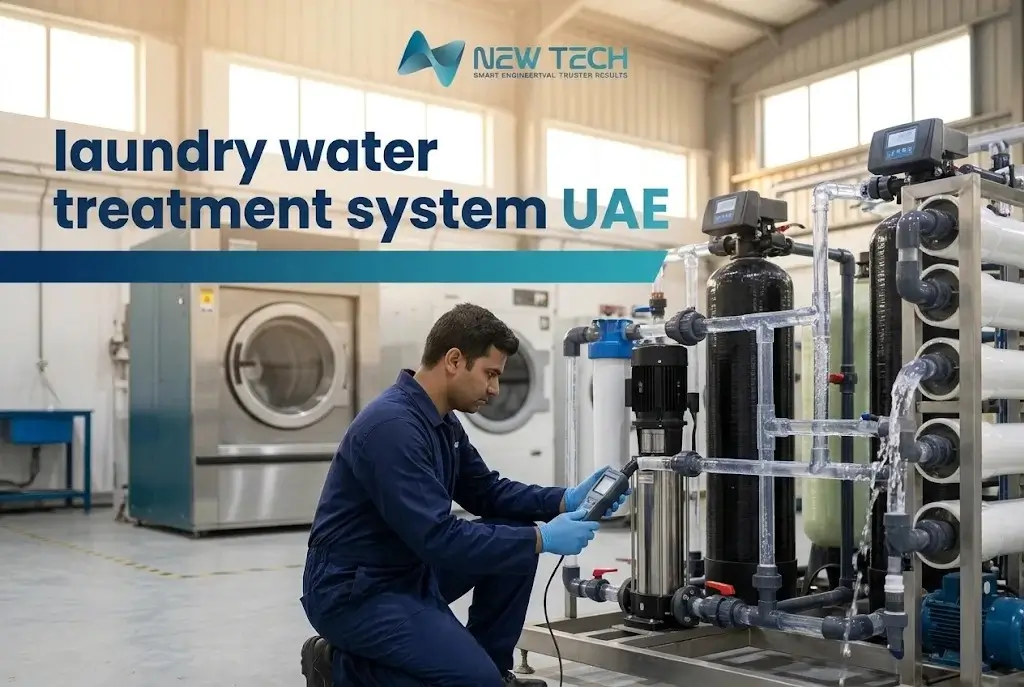
Different laundry facilities process different textiles and operate with different washing requirements. The correct equipment specification should reflect textile loading, water chemistry, hygiene requirements and wastewater contamination.
Hotel Laundry Water Treatment
Hotel laundries may process linen, towels and uniforms. Their treatment needs can involve hardness reduction, filtration and support for associated heating equipment. Equipment sizing should reflect actual daily textile loads, washing-machine requirements and operating hours rather than relying on the number of guest rooms alone.
Hospital Laundry Water Treatment
Hospital laundries require appropriate infection prevention and validated laundering procedures. Water treatment equipment may support process requirements, but it does not replace healthcare hygiene controls. Wastewater discharge classification should also be verified, especially where the facility processes hospital linen or other potentially contaminated materials.
Industrial Workwear Laundry
Industrial uniforms and cleaning materials may carry oils, solvents or other contaminants. Wastewater characterization should reflect these potential pollutants. A treatment process suitable for hotel linen wastewater may not be appropriate for heavily contaminated industrial textiles.
Independent Commercial Laundries
Independent laundries may have limited space and variable operating schedules. A compact water softener or filtration package may be sufficient when incoming water quality and equipment requirements support that choice. More complex wastewater treatment should be justified by the actual wastewater and relevant obligations.
Match Water Treatment to Your Laundry Application. Include your textile type, daily throughput and machine specifications when requesting equipment information.
اطلب استشارة مجانية الآن
تواصل مع خبرائنا لمساعدتك في اختيار محطة المياه المناسبة لاحتياجاتك بأفضل كفاءة وأقل تكلفة.
How to Size a Laundry Water Treatment System
The required capacity of a laundry water treatment system UAE depends on textile throughput, water use, production schedule and peak machine demand. Average hourly production and instantaneous service flow are different design values. The final equipment configuration should consider both.
Illustrative Daily Water Demand
Consider a hypothetical commercial laundry processing 2,000 kilograms of textiles daily and consuming 12 litres of water per kilogram.
| Parameter | Illustrative Value |
|---|---|
| Daily Textile Load | 2,000 kg/day |
| Assumed Water Use | 12 L/kg |
| Daily Water Demand | 24,000 L/day |
| Daily Water Demand | 24 m³/day |
Daily Water Demand = Textile Load × Water Consumption per Kilogram
Daily Water Demand = 2,000 × 12 = 24,000 L/day = 24 m³/day
The assumed consumption figure is illustrative and not a fixed benchmark for UAE laundries. Actual consumption depends on machinery, wash programs and operating practices.
Average Treatment Production Rate
If the facility needs to produce 24 m³ of treated water during 10 operating hours:
Average Production Rate = 24 / 10 = 2.4 m³/h
The calculated 2.4 m³/h is an average production rate, not necessarily the required instantaneous service flow.
Peak Flow and Storage Requirements
Several washing machines may fill simultaneously, creating flow demand above the daily average. A suitable design may use sufficient treatment capacity, properly sized storage or an appropriate combination of the two. The required arrangement depends on machine filling cycles, distribution pressure and available space.
Accounting for Regeneration or RO Recovery
Softener regeneration may interrupt treatment or use additional water. Where RO is used, permeate production is lower than the feedwater flow because concentrate is generated. These considerations should be included in the final hydraulic balance.
Calculate Your Required Laundry Treatment Capacity. Share actual daily demand, machine peak flow and operating hours with New Tech Water.
اطلب استشارة مجانية الآن
تواصل مع خبرائنا لمساعدتك في اختيار محطة المياه المناسبة لاحتياجاتك بأفضل كفاءة وأقل تكلفة.
Laundry Water Treatment System UAE Cost and Operating Expenses
Laundry water treatment system UAE cost depends on incoming water quality, treatment objectives, system capacity and equipment configuration. A softening package may have different capital and operating expenses from an RO plant or wastewater recycling system. Buyers should compare equipment using the same target water quality and operating duty.
Capital Cost Factors
| Cost Factor | What Buyers Should Evaluate |
|---|---|
| Water Quality | Hardness, dissolved salts and relevant contaminants. |
| System Capacity | Daily demand and peak service flow. |
| Softener Configuration | Resin, control valves and regeneration equipment. |
| RO Configuration | Pretreatment, membranes, pumps and controls. |
| Wastewater Treatment | Required stages and residual waste management. |
| Storage and Utilities | Tanks, pressure, electricity and drainage. |
| Monitoring | Instruments, sampling and control requirements. |
| Supply Scope | Equipment, documentation and requested services. |
Operating Expenses
Operating costs may include regeneration salt, water, electricity, filter replacement, membrane maintenance, treatment chemicals, laboratory testing and servicing. Wastewater systems may also require sludge handling and disposal of other treatment residuals.
Illustrative Treatment Cost per Cubic Meter
Operating Treatment Cost per m³ = Annual Operating Expenses / Annual Acceptable Treated-Water Production
For example, assume annual treatment operating expenses of AED 18,000 and annual production of 7,200 m³ of acceptable treated water.
Operating Treatment Cost = 18,000 / 7,200 = AED 2.50/m³
The figures are hypothetical calculation inputs, not verified UAE market prices or supplier quotations. The resulting cost excludes capital recovery, financing and any expenses not included in the assumed operating total.
Compare Lifecycle Costs
Suppliers should provide equipment specifications, expected consumables, regeneration or membrane operating requirements, and maintenance information where available. A lower purchase price may not offer the best overall value if the equipment fails to meet the required flow or water quality specification.
Compare Equipment and Operating Costs Before Purchasing. Request a specification-based quotation using your actual water analysis and production requirements.
اطلب استشارة مجانية الآن
تواصل مع خبرائنا لمساعدتك في اختيار محطة المياه المناسبة لاحتياجاتك بأفضل كفاءة وأقل تكلفة.
Maintenance, Regeneration and Water Quality Monitoring
Maintenance requirements depend on whether the facility uses softening, filtration, RO or wastewater treatment. Monitoring should focus on the parameters that show whether the equipment continues to deliver the required performance.
| Equipment | Key Monitoring Parameter | Possible Problem |
|---|---|---|
| Water Softener | Outlet hardness and regeneration performance. | Hardness breakthrough. |
| Resin System | Salt consumption, valve operation and resin condition. | Ineffective regeneration. |
| Media Filter | Pressure differential and cleaning performance. | Reduced flow or particle breakthrough. |
| RO System | Permeate conductivity, pressures and normalized flow. | Fouling or scaling. |
| Wastewater Screen | Lint accumulation. | Blockage or overflow. |
| Wastewater Treatment | Relevant COD, TSS, pH and process indicators. | Unsuitable effluent quality. |
| Reuse Storage | Quality, turnover and operating condition. | Odour or contamination concerns. |
Managing Softener Regeneration
Regeneration frequency should reflect feedwater hardness, actual water demand and usable resin capacity. Incorrect regeneration settings may lead to hardness breakthrough or unnecessary consumption of salt and water.
RO Monitoring and Maintenance
Membrane performance should be assessed using relevant operating data and manufacturer guidance. Maintenance decisions should not be based solely on a generic calendar interval, because fouling and scaling depend on source-water chemistry and operating conditions.
Wastewater Treatment and Reuse Monitoring
Wastewater monitoring should reflect discharge or reuse objectives. Where reclaimed water is used, operators must establish acceptance criteria and procedures for diverting water that does not meet the required specification.
Protect Laundry Equipment with Appropriate Monitoring. Review treated-water quality, operating performance and maintenance requirements regularly.
اطلب استشارة مجانية الآن
تواصل مع خبرائنا لمساعدتك في اختيار محطة المياه المناسبة لاحتياجاتك بأفضل كفاءة وأقل تكلفة.
Laundry Wastewater Discharge Regulations in the UAE
Wastewater discharge obligations vary according to the emirate, laundry activity, wastewater composition and receiving sewerage system. Commercial operators must verify the current requirements with the competent authority. General information about low-risk laundry activities should not be interpreted as an exemption applying to every laundry facility.
Dubai Laundry Wastewater Requirements
Dubai Local Order No. 8 of 2002 addresses sewerage and wastewater management. Article 6 covers approvals concerning wastewater treatment plants and the use of treated water, while Article 8 addresses industrial wastewater discharge to the public sewerage network. Article 17 restricts wastewater discharge under specified conditions involving hazardous substances, treatment capacity or non-compliance with prescribed requirements.
See the official Dubai Local Order No. 8 of 2002. The current regulatory framework, amendments and project-specific conditions must be verified before installation.
Abu Dhabi: Low-Risk and Higher-Risk Laundry Activities
Abu Dhabi’s published Code of Practice for Low-Risk Trade Effluent Discharges from Laundry Services, issued in January 2012, distinguishes small low-risk activities from operations that require different controls. Under that historical framework, small commercial or on-premise laundries handling mainly domestic linen and discharging less than 7 m³ per working day were generally considered lower risk, subject to the applicable classification and conditions.
The Code identifies industrial laundries, certain large-scale operations and facilities processing hospital linen, industrial workwear or other specified materials as potentially higher-risk activities requiring a Trade Effluent Consent under the framework described in that document. The wastewater volume is not the only classification factor.
Read the official Abu Dhabi Code of Practice for Laundry Trade Effluent.
Current TAQA Water Solutions Approval Information
TAQA Water Solutions publishes a service for approval of non-domestic trade effluent discharge and describes predefined low-risk categories that can include laundries. However, this service description does not establish that every hotel, hospital or industrial laundry automatically qualifies as low risk.
Operators should confirm the current classification, applicable consent requirements and wastewater quality conditions directly with the relevant authority. The 2012 Code provides useful regulatory context but must not be assumed to represent every current requirement without verification.
See TAQA Water Solutions: Trade Effluent Discharge Approval.
Sharjah and Other Emirates
Laundries in Sharjah and other emirates should verify local sewerage, wastewater and environmental requirements. A facility cleaning heavily contaminated industrial textiles may face different obligations from a small commercial laundry processing ordinary garments.
Wastewater Compliance Checklist
- Identify the wastewater authority and discharge route.
- Confirm the correct laundry activity classification.
- Determine whether trade effluent consent is required.
- Test wastewater for relevant contaminants.
- Evaluate any necessary pretreatment.
- Confirm treatment residual and regeneration brine arrangements.
- Verify permissions for any planned water reuse.
- Maintain applicable monitoring and maintenance records.
Check Laundry Wastewater Compliance Before Investing. Confirm the current requirements for your facility and provide the relevant specifications when requesting equipment.
اطلب استشارة مجانية الآن
تواصل مع خبرائنا لمساعدتك في اختيار محطة المياه المناسبة لاحتياجاتك بأفضل كفاءة وأقل تكلفة.
Technical RFQ for Laundry Water Treatment Equipment
A detailed Request for Quotation helps suppliers compare equipment requirements using consistent technical data. Procurement teams should clearly distinguish between incoming-water treatment, boiler feedwater treatment, wastewater treatment and recycling objectives.
| RFQ Item | Information to Provide |
|---|---|
| Project Location | Dubai, Sharjah, Abu Dhabi or another UAE location. |
| Laundry Type | Commercial, hotel, hospital or industrial. |
| Textile Throughput | Daily processing volume in kilograms. |
| Water Demand | Daily consumption and peak service flow. |
| Source Water | Municipal, groundwater or other approved source. |
| Water Analysis | Hardness, TDS, iron, pH and other relevant parameters. |
| Treatment Objective | Softening, filtration, RO or wastewater treatment. |
| Target Quality | Equipment and process water specifications. |
| Softener Requirements | Service flow, exchange capacity and regeneration duty. |
| Boiler Requirements | Steam-system specifications if applicable. |
| Wastewater Analysis | COD, TSS, surfactants and relevant contaminants. |
| Utilities | Power supply, pressure, drainage and installation space. |
| Commercial Scope | Equipment, accessories, documentation and requested services. |
Compare Performance, Not Just Equipment Price
Two water treatment packages with identical nominal flow may perform differently because of their treatment stages, water quality assumptions and operating requirements. Quotations should be compared against the same design basis, target performance and installation conditions.
Clarify the Supply Scope
Confirm whether the quotation includes resin, vessels, valves, pumps, membranes, controls, tanks or other accessories. Installation, commissioning and maintenance services should only be included where expressly confirmed by the supplier.
Send Your Laundry Equipment RFQ to New Tech Water. Include your water analysis, required flow and equipment specifications to request a technical quotation.
اطلب استشارة مجانية الآن
تواصل مع خبرائنا لمساعدتك في اختيار محطة المياه المناسبة لاحتياجاتك بأفضل كفاءة وأقل تكلفة.
Laundry Water Treatment in Dubai, Sharjah and Abu Dhabi
Commercial laundry facilities across the UAE can differ in water quality, textile processing requirements and wastewater discharge obligations. The appropriate treatment design should reflect the actual project conditions rather than the city name alone.
Commercial Laundry Water Treatment in Dubai
Dubai laundry operators should evaluate incoming water hardness, peak machine filling requirements and any specialized process needs. Projects involving wastewater treatment or reuse should verify the current sewerage and discharge conditions relevant to the facility.
Laundry Water Treatment in Sharjah
Facilities in Sharjah may require treatment for hardness, sediment or other incoming-water characteristics. Equipment selection should also consider available floor space, operating schedule, regeneration drainage and local wastewater obligations.
Hotel and Industrial Laundry in Abu Dhabi
Hotel, healthcare and industrial laundry operations in Abu Dhabi should assess water treatment requirements together with wastewater classification. The applicable trade effluent requirements depend on the operation and should be checked with the competent authority rather than assumed from a general low-risk category.
Discuss Laundry Water Treatment for Your UAE Facility. Provide the project location, equipment requirements and relevant water analysis.
اطلب استشارة مجانية الآن
تواصل مع خبرائنا لمساعدتك في اختيار محطة المياه المناسبة لاحتياجاتك بأفضل كفاءة وأقل تكلفة.
Why Discuss Laundry Water Treatment Equipment with New Tech Water?
New Tech Water publishes information about industrial water treatment plants, reverse osmosis and chemical dosing equipment. These technologies may support selected laundry applications when the available products match the required water quality, treatment duty and technical specifications.
Water Treatment Equipment Options
The company’s water treatment plant solutions page provides information about general treatment technologies relevant to industrial water applications.
Chemical Dosing Equipment
Certain treatment processes may require controlled chemical injection for a specified process objective. Pump selection should account for chemical compatibility, dosing flow, injection pressure and the intended control arrangement.
New Tech Water provides relevant technical guidance in its Chemical Dosing Pump Supplier UAE page.
Confirming Equipment Suitability
The availability of general industrial water treatment products does not automatically establish that New Tech Water supplies every specialized laundry softener, turnkey wastewater recycling plant or healthcare laundry validation service. Buyers should confirm the available product models, specifications and scope directly.
Information for a Useful Enquiry
- Incoming water analysis.
- Laundry type and textile application.
- Required treatment objective.
- Daily and maximum water demand.
- Target treated-water specification.
- Available pressure, electricity and drainage.
- Requested equipment, documentation and delivery requirements.
Discuss Your Laundry Water Treatment Requirements with New Tech Water. Share your specifications to confirm available equipment and request a quotation.
اطلب استشارة مجانية الآن
تواصل مع خبرائنا لمساعدتك في اختيار محطة المياه المناسبة لاحتياجاتك بأفضل كفاءة وأقل تكلفة.
Frequently Asked Questions About Laundry Water Treatment System UAE
What is a laundry water treatment system?
It is a treatment arrangement used to improve incoming water quality or treat wastewater generated by laundering. The selected technologies depend on whether the priority is hardness removal, filtration, desalination or wastewater treatment.
Why is water softening important for commercial laundries?
Softening reduces calcium and magnesium hardness that may contribute to deposits or interact with washing chemicals. Its suitability depends on the incoming water analysis and the laundry equipment requirements.
Does a commercial laundry need reverse osmosis?
Not necessarily. RO may be useful when a process requires reduced dissolved-mineral content. Many facilities can meet their water quality objectives through appropriate softening or filtration.
What water hardness is suitable for laundry operations?
There is no universal hardness specification for every laundry. The correct target depends on washing equipment, detergent chemistry, utility requirements and the manufacturer’s recommendations.
Can laundry wastewater be recycled?
Selected wastewater streams may be reused after appropriate treatment when the reclaimed water meets the intended application’s quality requirements and relevant approvals. Healthcare laundry reuse requires particularly careful assessment.
What contaminants are found in laundry wastewater?
Common contaminants include lint, suspended solids, detergent residues, surfactants, organic substances and variable pH. Industrial laundries may generate additional pollutants depending on the textiles processed.
How do I calculate laundry water treatment capacity?
Estimate daily water demand from textile throughput and consumption, then assess treatment hours, peak machine flow, storage and process losses. A final design must use the equipment’s actual operating requirements.
How much does laundry water treatment cost in UAE?
Cost depends on water quality, required treatment performance, capacity, equipment configuration and maintenance. A supplier quotation based on technical specifications is needed for reliable pricing.
What maintenance does a laundry water softener require?
Maintenance may include checking treated-water hardness, regeneration settings, salt supply, valve condition and resin performance. The schedule depends on source-water hardness and equipment operating conditions.
What should I include in a laundry water treatment RFQ?
Provide water analysis, laundry type, textile throughput, daily and peak demand, target water quality, available utilities, installation conditions and the requested equipment scope.
Need Help Comparing Laundry Water Treatment Equipment? Share your water analysis and technical requirements with New Tech Water.
اطلب استشارة مجانية الآن
تواصل مع خبرائنا لمساعدتك في اختيار محطة المياه المناسبة لاحتياجاتك بأفضل كفاءة وأقل تكلفة.
Request Laundry Water Treatment Equipment Information
Choosing a laundry water treatment system UAE starts with accurate water testing, suitable equipment sizing and a clear understanding of the treatment objective. Water softening, RO, filtration and wastewater recycling address different operational challenges, so the right selection depends on the facility’s actual requirements. New Tech Water publishes industrial treatment equipment relevant to selected applications. Share your water analysis, daily demand and technical specifications to discuss available products and request a focused quotation.
Contact New Tech Water Today to Discuss Your Laundry Water Treatment Requirements and Request a Technical Equipment Quote.
اطلب استشارة مجانية الآن
تواصل مع خبرائنا لمساعدتك في اختيار محطة المياه المناسبة لاحتياجاتك بأفضل كفاءة وأقل تكلفة.

 Arabic
 English