
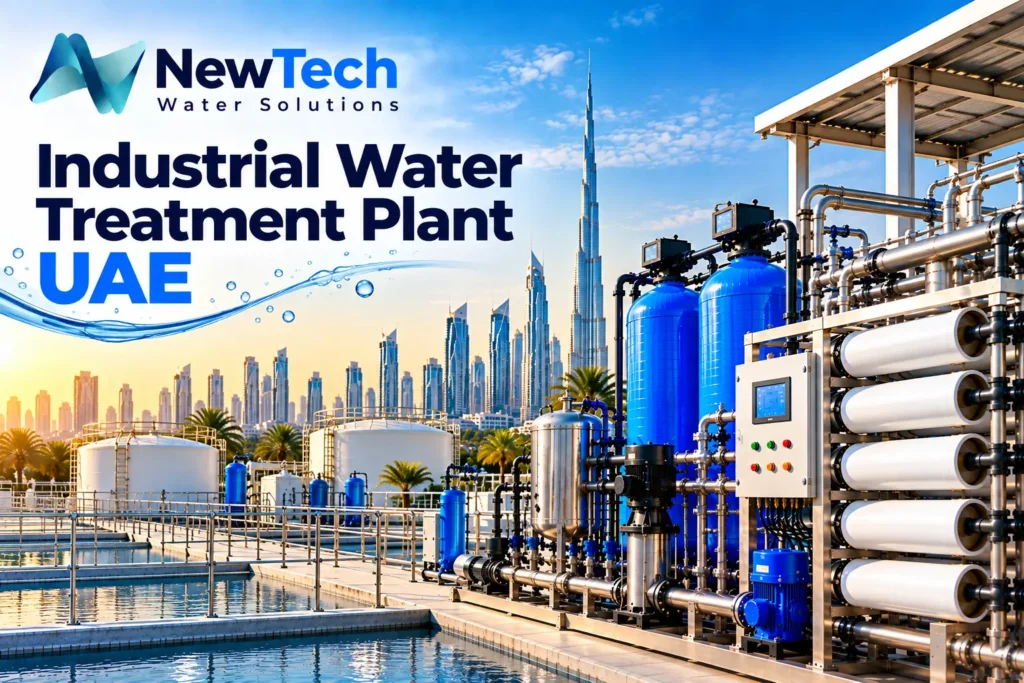
industrial water treatment plant UAE
Looking for an industrial water treatment plant UAE facilities can rely on for process, production or utility water requirements? The right plant starts with more than a target flow rate. Feed-water quality, required product-water quality, daily demand, operating conditions, treatment stages and project scope all influence the final design. New Tech Water helps industrial projects define these requirements and develop water treatment solutions around the actual needs of the facility. Industrial Water Treatment Plant UAE: How Should Your Project Be Scoped? Industrial water treatment plant UAE projects should begin with a clear design basis before equipment is selected or quotations are compared. The objective is to establish what water enters the plant, what treated-water quality the facility requires, how much water is needed and under what operating conditions the system will run. These inputs provide the technical foundation for process selection and equipment sizing. A useful project scope should define: The feed-water source. Available feed-water analysis. Required treated-water quality. Average and peak water demand. Daily operating hours. Storage requirements. Available utilities. Space and site constraints. Required monitoring and automation. Installation and commissioning scope. Future capacity requirements where already defined. A factory water treatment plant in the UAE can require a very different configuration from another facility with a similar nominal capacity. Differences in feed water, process requirements and final water quality can change the treatment stages and equipment required. This is why the design basis should be established before the project moves into equipment selection. The clearer the scope, the easier it becomes for engineering and procurement teams to evaluate whether competing proposals are technically comparable. For a broader view of supplier selection, buyers can also review New Tech Water’s guide to choosing a water treatment company in the UAE. Planning an industrial water treatment project in the UAE? Send New Tech Water your water analysis, required capacity and target water quality to start defining the appropriate plant configuration. Feed-Water Quality and Product-Water Targets: Where Plant Design Begins Feed-water analysis establishes what the treatment process needs to address, while product-water requirements define the result the plant needs to achieve. These two sides of the design basis should be considered together before filtration, softening, reverse osmosis or other treatment stages are selected. Depending on the water source and application, relevant parameters can include: TDS or conductivity. Hardness. Alkalinity. Silica. Iron. Manganese. Turbidity. pH. Other parameters relevant to the intended process. Not every parameter carries the same significance in every industrial water treatment plant UAE project. The required analysis should reflect the source water and intended treatment process rather than relying on a generic list alone. The required product-water quality is equally important. Process water, utility water and other industrial applications can have different requirements, so the design should be developed around the actual application rather than the assumption that every facility needs the same treatment train. Providing a recent and representative water analysis gives New Tech Water a stronger technical basis for discussing the required treatment stages and equipment with the project team. Have a recent feed-water analysis? Send it to New Tech Water together with your required product-water quality and application to discuss the treatment requirements for your project. How to Calculate the Capacity Your Industrial Water Plant Actually Needs Plant capacity should reflect how the facility actually consumes treated water. Selecting a system only from an estimated hourly flow can overlook peak demand, production schedules, storage and the number of hours the plant is expected to operate each day. Capacity planning should consider: Average daily water consumption. Peak demand. Required production flow. Operating hours per day. Product-water storage strategy. Expected system recovery where relevant. Production or process schedules. Future demand where expansion requirements are already known. An undersized industrial water plant may struggle to meet a UAE facility’s treated-water demand during peak operating periods. This can reduce operational flexibility and make the facility more dependent on storage or extended plant operating hours. Oversizing is not automatically a better solution. Unnecessary capacity can increase the initial investment and may result in operating patterns that do not suit the facility’s actual demand. The objective is therefore not to specify the largest plant possible, but to establish an appropriate relationship between production capacity, operating time and storage. For an industrial water treatment plant UAE project, capacity should ultimately be supported by real consumption and operating data wherever available. This creates a more defensible design basis for both engineering and procurement. Need help defining plant capacity? Share your daily consumption, peak demand, operating hours and production requirements with New Tech Water for project-specific evaluation. Which Treatment Process Does Your Industrial Facility Need? Not every industrial facility requires the same treatment technology, and not every project automatically requires reverse osmosis. Process selection should follow the feed-water characteristics, required product-water quality and final application. For an industrial water treatment plant UAE project, this means the treatment sequence should be justified by the actual feed-water conditions and the quality required at the point of use. Depending on these requirements, an industrial water treatment system UAE project may combine several stages, such as: Pretreatment. Mechanical or media filtration. Activated carbon treatment where required. Softening or ion exchange where appropriate. Chemical dosing. Cartridge filtration. Reverse osmosis where the required water quality supports its use. Additional treatment stages where specified by the application. The purpose of process design is not to add as many stages as possible. Each stage should address a defined treatment requirement or support the performance of downstream equipment. An industrial filtration plant, for example, may have a different treatment objective from an industrial water purification plant designed to reduce dissolved salts. The treatment train should therefore be selected according to what the incoming water and final application actually require. For general background on the principles used to improve water quality, readers can review this overview of water purification. Actual industrial process selection should still be based on project-specific analysis and design requirements. Unsure which treatment stages your facility requires? Send New Tech Water your

 Arabic
 English