

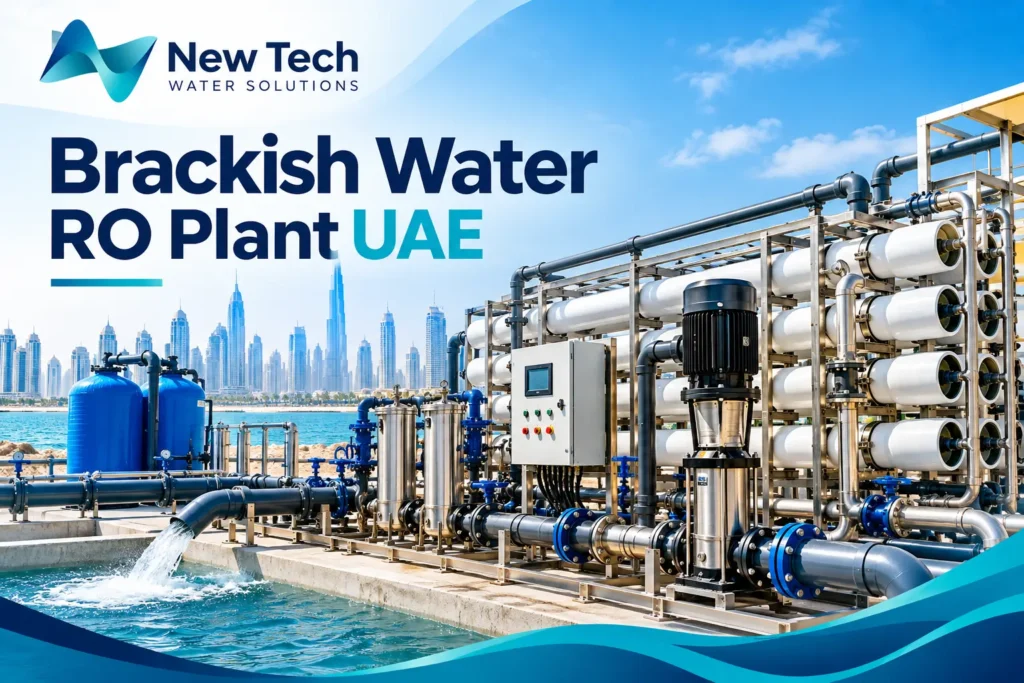
brackish water RO plant UAE
Looking for a reliable brackish water RO plant UAE solution to treat borewell or high-TDS groundwater? Choosing the right system requires careful evaluation of feed-water chemistry, daily capacity, target water quality and scaling risks to ensure efficient and reliable operation. New Tech Water provides tailored solutions for industrial facilities, farms and remote sites. Each brackish water RO plant is designed around specific water conditions and operational requirements to support consistent water quality and long-term performance. Brackish Water RO Plant UAE: When Is BWRO the Right Solution? A brackish water RO plant UAE project is typically considered when borewell water, groundwater or another saline source requires dissolved-salt reduction before use. Brackish water reverse osmosis, commonly called BWRO, uses membrane separation to produce treated water for a defined application. However, not every borewell needs reverse osmosis. Some water sources may require filtration or targeted treatment, while others need a complete desalination process. The appropriate technology depends on the source-water analysis and the quality required by the facility. A brackish water RO plant in the UAE may be suitable for: Factories using groundwater for selected industrial processes or utilities. Farms requiring controlled salinity for specific irrigation applications. Remote facilities with limited access to alternative water supplies. Industrial compounds operating independent water systems. Facilities where dissolved salts affect the intended use of borewell water. The design should establish production capacity, operating hours, permeate quality, recovery requirements and concentrate-management considerations before equipment is selected. Need a brackish water RO plant UAE solution for your facility? Send New Tech Water your water analysis and required production capacity to discuss the appropriate treatment approach. Borewell Water Analysis, TDS and Scaling Risks Reliable brackish water treatment begins with a clear understanding of the feed water. Two borewells in the same region can have different mineral compositions, even when their total dissolved solids appear similar. TDS is useful for understanding dissolved-salt content, but it does not fully describe scaling potential. Hardness, alkalinity, silica and other constituents can influence membrane operation and the treatment process. Before designing a brackish water RO plant UAE project, the water analysis should consider relevant parameters such as: Total dissolved solids and electrical conductivity. pH and alkalinity. Calcium and magnesium hardness. Silica concentration. Iron and manganese. Sulfate and chloride. Turbidity and suspended solids. Other parameters relevant to the water source and intended application. Scaling occurs when dissolved constituents reach conditions that encourage mineral precipitation. As an RO system produces permeate, rejected salts become more concentrated in the remaining water. This makes recovery selection and scaling assessment closely connected. Groundwater chemistry may also change over time. Where seasonal or operational variation is expected, representative samples can help establish a more reliable design basis. Have a borewell water report? Share it with New Tech Water to evaluate TDS, scaling risks and the information needed to design your BWRO system. How Brackish Water RO Differs from Seawater RO Both brackish water and seawater desalination use reverse osmosis membranes to reduce dissolved salts. However, the two applications should not be treated as interchangeable because their feed-water conditions and equipment requirements differ. Seawater typically has much higher salinity, while brackish groundwater may present different challenges involving hardness, silica, iron or other constituents. These differences influence operating pressure, membrane selection, pretreatment and recovery strategy. Important design differences include: Feed-water salinity and mineral composition. Required membrane type and operating pressure. Pretreatment configuration. Recovery and concentrate characteristics. Pumping and energy requirements. Scaling-control and maintenance considerations. A brackish water RO plant in the UAE should therefore be specified for its actual groundwater conditions rather than selected from a generic seawater or industrial RO configuration. For additional background on treatment technologies, see this water purification reference. Unsure whether your project needs BWRO or another RO configuration? Ask New Tech Water to review your feed-water conditions and required treatment quality. Pretreatment Requirements for Groundwater RO Systems Pretreatment is essential for protecting reverse osmosis membranes from feed-water conditions that could affect performance. In groundwater applications, the correct pretreatment arrangement depends on the water analysis rather than a fixed equipment package. Depending on the source, pretreatment may involve filtration, chemical conditioning or additional treatment stages designed to address specific contaminants. When evaluating pretreatment for a brackish water RO plant UAE installation, project teams should consider: Suspended solids and turbidity. Iron and manganese concentrations. Hardness and potential mineral precipitation. Silica and other scaling-related constituents. Membrane compatibility with feed-water chemicals. Required monitoring before the membrane stage. Pretreatment should also be practical to operate. Filters, chemical dosing equipment and other components need appropriate monitoring, maintenance access and consumable planning. New Tech Water provides information about its treatment-system offerings through the water treatment plants section. Planning pretreatment for a brackish water RO plant UAE project? Contact New Tech Water to discuss the treatment stages required by your groundwater analysis. BWRO Membrane Selection, Recovery and Antiscalant Strategy Membrane selection is one of the main technical decisions in brackish water desalination. The membrane configuration should match the feed-water chemistry, target permeate quality, required flow and intended operating conditions. Recovery is another important design factor. It describes the proportion of feed water converted into treated permeate. Increasing recovery reduces the proportion discharged as concentrate, but it also raises the concentration of dissolved constituents within the system. For a brackish water RO plant UAE project, recovery should therefore be evaluated alongside membrane performance and scaling potential. Where water chemistry indicates a scaling risk, an appropriate antiscalant strategy may be considered. Chemical selection and dosage should follow a suitable assessment of the feed water and proposed operating conditions. Important technical considerations include: Membrane compatibility with the feed-water characteristics. Required permeate flow and quality. Operating pressure and pump selection. Recovery and concentrate conditions. Scaling assessment. Antiscalant selection where appropriate. Instrumentation and performance monitoring. A high recovery percentage should not be treated as an automatic advantage. The objective is a technically suitable balance between water production, scaling control and sustainable operation. Need to select BWRO membranes or evaluate recovery and antiscalant requirements? Send New Tech Water your water
 English
 Arabic