
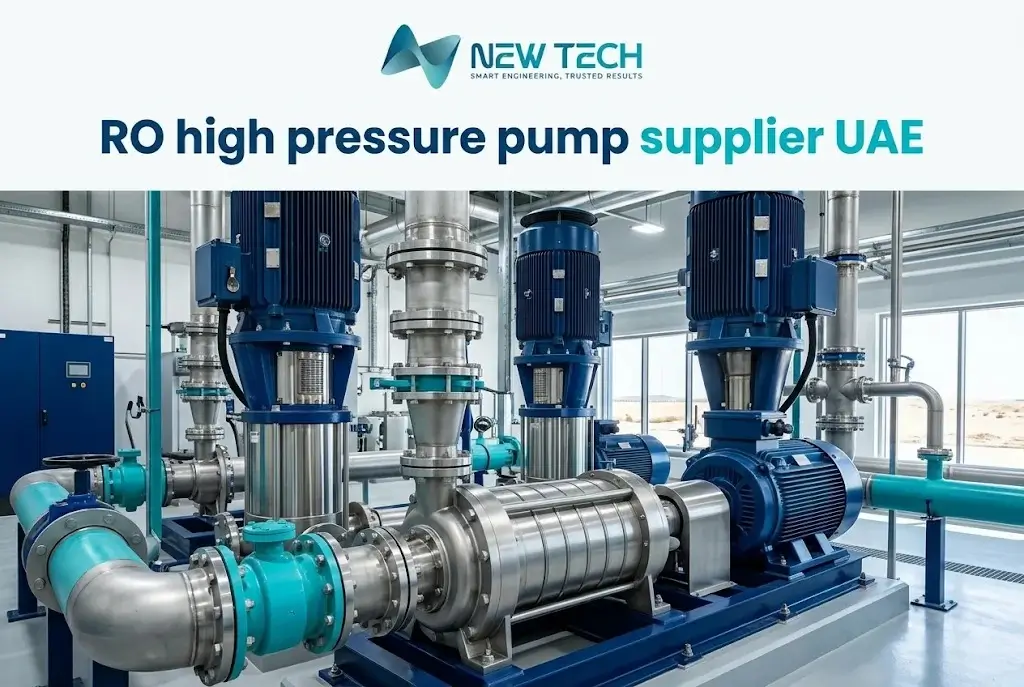
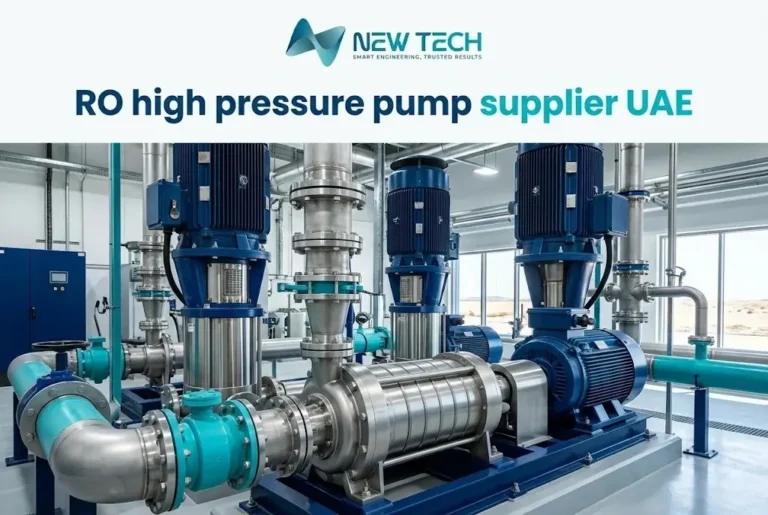
Looking for an RO High Pressure Pump Supplier UAE to support your industrial reverse osmosis project? Choosing the right pump requires more than selecting the highest available pressure. Feedwater salinity, hydraulic flow, membrane specifications, energy efficiency and material compatibility all affect performance.
Whether you are installing a new RO plant or replacing existing equipment, this guide explains pump technologies, selection criteria, operating costs and technical requirements to help you make informed decisions with New Tech Water.
RO High Pressure Pump Supplier UAE: What Matters Before Buying?
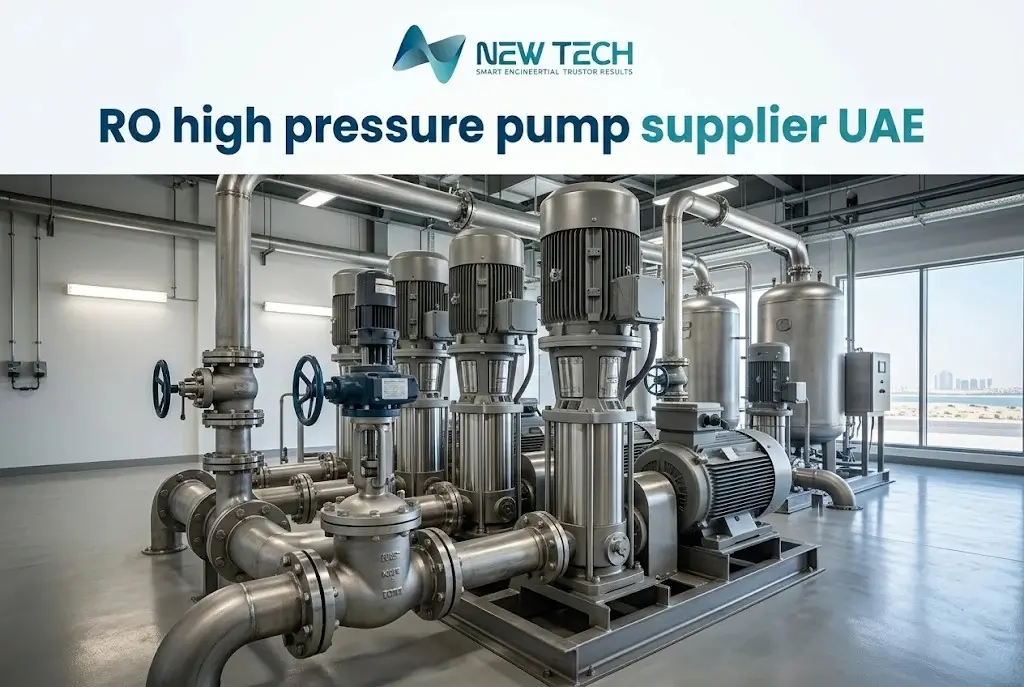
High-pressure pumps are essential components in industrial reverse osmosis systems. They provide the hydraulic energy required to move feedwater through RO membranes under the specified operating conditions. However, pump selection must begin with the overall treatment process rather than an isolated pressure rating.
For buyers evaluating an RO High Pressure Pump Supplier UAE, the first step is establishing the required feed flow, suction pressure, discharge pressure and expected operating conditions. Feedwater salinity, temperature, membrane configuration and system recovery also influence the final pumping requirements.
Choosing a pump with a higher maximum pressure than necessary does not automatically improve performance. An oversized or incorrectly selected pump may operate inefficiently, create control challenges or place additional stress on the equipment.
Essential Pump Selection Requirements
- Feedwater source, salinity and chemical composition.
- Required operating flow in m³/h.
- Suction pressure and discharge pressure.
- Differential pressure across the pump.
- Available NPSH and suction-line conditions.
- Selected membrane system and operating limits.
- Pump materials and mechanical seal compatibility.
- Motor efficiency and electrical requirements.
- Operating hours and maintenance conditions.
A technical quotation should identify the proposed pump’s actual performance at the specified operating point, not simply its maximum rated flow and pressure.
Find the Right Pump for Your RO System. Share your flow, pressure and feedwater requirements with New Tech Water to discuss the appropriate equipment specifications.
اطلب استشارة مجانية الآن
تواصل مع خبرائنا لمساعدتك في اختيار محطة المياه المناسبة لاحتياجاتك بأفضل كفاءة وأقل تكلفة.
How High Pressure Pumps Support Reverse Osmosis Performance
Reverse osmosis uses hydraulic pressure to drive water through a semipermeable membrane. Water passes through the membrane as permeate, while much of the dissolved material remains in the concentrate stream.
The required feed pressure depends on osmotic pressure, membrane characteristics, feedwater conditions, recovery and hydraulic losses. Pump selection must therefore reflect the complete membrane system design.
RO High Pressure Pump vs Feed Pump vs Booster Pump
| Pump Type | Primary Function | Key Selection Factor |
|---|---|---|
| Feed Pump | Transfers water to a treatment stage. | Flow and required system head. |
| Booster Pump | Increases pressure for a specific process duty. | Required pressure rise and flow. |
| RO High Pressure Pump | Provides the hydraulic duty required for membrane operation. | Duty point, efficiency and membrane-system compatibility. |
Some treatment configurations combine these functions, while others use separate pumps. The correct arrangement depends on the overall system design.
Why Higher Pressure Is Not Always Better
Increasing pressure may influence permeate production, but excessive pressure can exceed membrane, pressure-vessel or piping limits. It can also increase energy consumption and mechanical loading.
When defining an RO high-pressure pumping duty, engineers must consider both pressure and flow at the expected operating conditions.
Explore New Tech Water’s industrial RO plant UAE guide for more information about membrane-system design and equipment selection.
Match Pump Performance to Your Membrane Requirements. Contact New Tech Water with your RO capacity and feedwater analysis for a technical discussion.
اطلب استشارة مجانية الآن
تواصل مع خبرائنا لمساعدتك في اختيار محطة المياه المناسبة لاحتياجاتك بأفضل كفاءة وأقل تكلفة.
Multistage Centrifugal vs Positive Displacement RO Pumps
Industrial RO plants may use different high-pressure pumping technologies depending on flow requirements, operating pressure, feedwater conditions and equipment configuration.
Two important categories are multistage centrifugal pumps and specialized positive displacement pumps. Their operating principles differ, making it important to evaluate each technology at the intended duty.
Multistage Centrifugal Pumps
Multistage centrifugal pumps use multiple impeller stages to increase liquid pressure. They can be suitable for industrial water treatment applications when the selected model meets the required flow, pressure and material specifications.
Their operating flow and developed head depend on the system resistance and pump performance curve. Proper selection should consider the recommended operating range, best efficiency point and suction conditions.
Positive Displacement Pumps
Positive displacement pumps move liquid through a defined pumping mechanism. Specialized axial piston designs are used in certain reverse osmosis applications, including high-pressure desalination.
Their flow is closely related to operating speed and displacement, subject to internal leakage and operating conditions. Appropriate pressure protection and manufacturer-approved operating arrangements are essential.
Comparison of High Pressure Pump Technologies
| Factor | Multistage Centrifugal | Positive Displacement |
|---|---|---|
| Operating Principle | Multiple rotating impeller stages. | Defined liquid displacement mechanism. |
| Flow Response | Depends on the pump and system curves. | Strongly related to speed and displacement. |
| Efficiency | Varies with the operating duty point. | Depends on the design and operating conditions. |
| Control | May use compatible speed-control arrangements. | Requires appropriate flow and pressure management. |
| Selection | Evaluate pump curve, NPSH and materials. | Evaluate operating envelope, materials and protective controls. |
Neither technology should be selected solely on general claims of efficiency. Engineers should compare actual operating performance, maintenance requirements and compatibility with the RO process.
Compare Pump Technologies with Confidence. Share your target flow and operating pressure with New Tech Water to discuss the relevant RO equipment requirements.
اطلب استشارة مجانية الآن
تواصل مع خبرائنا لمساعدتك في اختيار محطة المياه المناسبة لاحتياجاتك بأفضل كفاءة وأقل تكلفة.
Brackish Water and Seawater RO Pump Requirements
Feedwater salinity strongly influences the operating pressure required for reverse osmosis. As salinity increases, osmotic pressure generally increases, affecting the hydraulic duty needed to achieve the required separation.
High Pressure Pumps for Brackish Water RO
Brackish water RO systems may use suitable multistage pumping arrangements depending on feedwater chemistry, plant capacity and membrane specifications.
The required pressure cannot be determined from salinity alone. Temperature, recovery, membrane design and hydraulic losses must also be considered.
High Pressure Pumps for Seawater RO
Seawater RO generally involves higher operating pressures than typical brackish water applications. The pumping equipment must be suitable for the specified pressure range and the corrosive characteristics of the liquid.
Specialized high-pressure pumps and energy recovery equipment may be included in the system design. Material selection should reflect chloride exposure, temperature and other corrosion considerations.
Why Pump Materials Matter
Not every stainless steel grade is suitable for high-chloride applications. Depending on the project, corrosion-resistant materials such as appropriately specified duplex or super-duplex stainless steel may be considered.
Alloy selection must follow the actual operating conditions and manufacturer recommendations rather than assuming one material is universally suitable for seawater.
Choose Pump Materials That Match Your Feedwater. Discuss your brackish or seawater RO requirements with New Tech Water.
اطلب استشارة مجانية الآن
تواصل مع خبرائنا لمساعدتك في اختيار محطة المياه المناسبة لاحتياجاتك بأفضل كفاءة وأقل تكلفة.
How to Select the Correct RO Pump Duty Point
The duty point defines the flow and pressure conditions at which a pump is expected to operate. For centrifugal pumps, engineers evaluate the relationship between the manufacturer’s pump curve and the resistance of the hydraulic system.
When reviewing an RO High Pressure Pump Supplier UAE quotation, confirm that the proposed pump delivers the required pressure rise at the specified flow rather than evaluating maximum pressure and maximum flow as independent capabilities.
Flow Rate and Differential Pressure
Differential pressure is the pressure increase across the pump. It is commonly calculated from the difference between discharge and suction pressure.
For example, consider a system with a suction pressure of 2 bar and a required discharge pressure of 18 bar.
Differential Pressure = 18 – 2 = 16 bar
This simplified example shows that the pump must provide a pressure rise of approximately 16 bar under the specified conditions. Actual pump selection also requires reviewing fluid properties, elevation, line losses and the applicable hydraulic design.
Understanding the Pump Curve and BEP
The pump curve describes how a centrifugal pump’s head, flow, efficiency and other characteristics vary across its operating range.
The Best Efficiency Point (BEP) represents the operating condition where the pump achieves its highest hydraulic efficiency under the specified test conditions.
Operating significantly outside the recommended range may increase vibration, mechanical loading, energy consumption or reliability concerns.
Choose a Pump Based on Its Actual Duty Point. Send New Tech Water your required flow, suction pressure and discharge pressure for a technical discussion.
اطلب استشارة مجانية الآن
تواصل مع خبرائنا لمساعدتك في اختيار محطة المياه المناسبة لاحتياجاتك بأفضل كفاءة وأقل تكلفة.
NPSH and Cavitation: Protecting Your RO High Pressure Pump
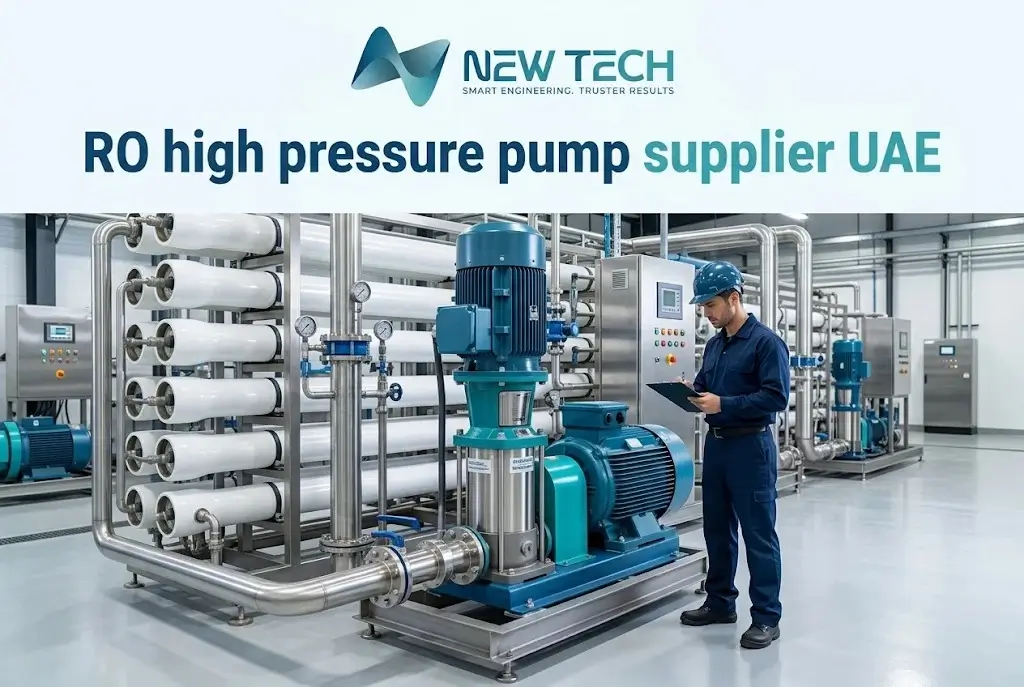
Net Positive Suction Head (NPSH) is an important consideration in pump selection because it relates to conditions at the pump inlet and the risk of vapor formation.
Cavitation occurs when local pressure falls sufficiently for vapor bubbles to form and subsequently collapse in higher-pressure regions. Severe or repeated cavitation may damage components, increase vibration and reduce performance.
What Is NPSH Available?
NPSH Available (NPSHa) describes the suction head available from the actual installation above the liquid vapor-pressure head. It depends on factors such as supply pressure, static liquid level, suction piping losses and liquid temperature.
The available value must be calculated for the real suction arrangement, including unfavorable expected operating conditions.
What Is NPSH Required?
NPSH Required (NPSHr) is provided by the pump manufacturer for specified operating conditions, typically based on a defined performance criterion.
NPSHr is not a universal value for an entire pump range. It can vary with flow and operating speed.
Why Is an NPSH Margin Important?
For suitable centrifugal pump operation, the available NPSH should exceed the manufacturer’s required NPSH by an appropriate engineering margin. Merely matching the two values may not provide adequate protection against cavitation-related problems.
The required margin depends on the pump, application and applicable design guidance. Specialized positive displacement pumps may have different inlet-condition specifications that must be followed.
Common Conditions That Increase Cavitation Risk
- Insufficient inlet pressure or liquid level.
- Excessive suction-pipe friction losses.
- Blocked suction strainers.
- Higher liquid temperatures.
- Operation beyond the recommended flow range.
- Unsuitable suction piping arrangements.
Qualified personnel should investigate abnormal noise, vibration or pressure fluctuations before continuing operation outside the approved equipment limits.
Protect Your RO Pump from Avoidable Operating Problems. Discuss your suction conditions and pump specifications with New Tech Water.
اطلب استشارة مجانية الآن
تواصل مع خبرائنا لمساعدتك في اختيار محطة المياه المناسبة لاحتياجاتك بأفضل كفاءة وأقل تكلفة.
How RO Pump Efficiency Affects Energy Consumption
High-pressure pumping can represent a substantial portion of the electricity required by an RO plant. Pump efficiency therefore affects operating costs, particularly in facilities operating for extended periods.
An RO High Pressure Pump Supplier UAE technical proposal should include the expected performance at the actual duty point, allowing engineers to assess potential energy requirements.
Understanding Hydraulic Power
Hydraulic power depends on the volumetric flow rate and differential pressure across the pump.
Hydraulic Power (kW) = Flow (m³/s) × Differential Pressure (Pa) / 1000
The actual shaft power required is higher than the useful hydraulic power because the pump experiences efficiency losses.
Practical Example: Calculating Pump Power
Consider a hypothetical industrial RO pump with the following conditions:
| Parameter | Value |
|---|---|
| Flow Rate | 18 m³/h |
| Differential Pressure | 16 bar |
| Pump Efficiency | 80% |
First, convert the flow rate to cubic meters per second:
18 / 3600 = 0.005 m³/s
Next, convert the differential pressure:
16 bar = 1,600,000 Pa
Hydraulic Power = (0.005 × 1,600,000) / 1000 = 8 kW
Assuming a pump efficiency of 80%:
Shaft Power = 8 / 0.80 = 10 kW
The pump therefore requires approximately 10 kW of mechanical shaft power at this hypothetical operating point, before accounting for motor and drive losses.
For illustration, if motor efficiency were 95% and no additional drive losses were included, electrical input would be approximately 10.53 kW.
These are calculation examples, not confirmed energy figures for a specific RO pump or plant. Actual performance must be determined using the manufacturer’s data and the complete operating conditions.
Why the Best Efficiency Point Matters
Two pumps delivering the same flow and pressure may require different input power if their efficiencies differ at that duty point.
Selecting a pump close to its suitable operating range can therefore improve the overall technical and economic evaluation.
Variable Frequency Drives and Energy Recovery
Variable Frequency Drives (VFDs) may provide useful speed control for compatible pumping arrangements. Their energy-saving potential depends on the pump technology, process requirements and operating profile.
Seawater RO installations may also use energy recovery devices to recover part of the hydraulic energy contained in the concentrate stream.
For manufacturer information about specialized RO pumping technologies, see Danfoss APP high-pressure pumps for reverse osmosis.
Make Every Kilowatt Count. Discuss pump efficiency, operating hours and hydraulic requirements with New Tech Water before selecting RO equipment.
اطلب استشارة مجانية الآن
تواصل مع خبرائنا لمساعدتك في اختيار محطة المياه المناسبة لاحتياجاتك بأفضل كفاءة وأقل تكلفة.
Common RO High Pressure Pump Problems and Their Causes
RO high-pressure pumps operate under demanding hydraulic conditions. Poor suction conditions, equipment wear, installation defects and unsuitable operation can affect performance.
Correct troubleshooting begins with reliable measurements and the manufacturer’s instructions, not immediate replacement of the pump.
Low Discharge Pressure
Reduced pressure may result from inadequate suction supply, worn internal components, changing process resistance or inaccurate instrumentation. Operators should review actual flow, suction pressure and equipment conditions before determining the cause.
Mechanical Seal Leakage
Seal leakage can result from wear, improper installation, incompatible materials or operating conditions outside the approved limits.
The equipment should be isolated and inspected according to applicable safety procedures where leakage creates a hazard or exceeds permitted limits.
Vibration and Excessive Noise
Unusual vibration may indicate alignment issues, cavitation, bearing problems or unsuitable hydraulic operation. Regular inspections and relevant condition measurements can help identify developing faults.
Motor Overheating
Motor overheating may be associated with excessive load, electrical problems, cooling limitations or mechanical faults. The complete motor-pump system should be assessed before changing operating settings.
Improve RO Pump Reliability. Share your operating readings and equipment details with New Tech Water to discuss the relevant treatment-system requirements.
اطلب استشارة مجانية الآن
تواصل مع خبرائنا لمساعدتك في اختيار محطة المياه المناسبة لاحتياجاتك بأفضل كفاءة وأقل تكلفة.
Replacing an Existing RO High Pressure Pump
Replacing a pump requires more than matching the physical dimensions or motor power shown on its nameplate. The replacement must provide the intended hydraulic duty while remaining compatible with the electrical, mechanical and control arrangements.
Information Required for Replacement
- Existing pump manufacturer and model.
- Nameplate information and available pump curve.
- Measured operating flow and pressure.
- Suction conditions and liquid temperature.
- Feedwater analysis and salinity.
- Motor rating, voltage and frequency.
- Seal arrangement and wetted materials.
- Connection sizes and installation drawings.
- Operating history and reason for replacement.
When evaluating an RO pump replacement UAE project, engineers should determine whether the original pump operated at the intended design point. Replacing an incorrectly selected pump with an identical model may reproduce the same operating problems.
Installation and Commissioning Checks
A replacement project may require verification of alignment, electrical protection, suction conditions, operating pressure, flow and protective controls.
The selected commissioning scope should be documented and performed according to manufacturer instructions and site safety requirements.
For additional information about startup verification, review New Tech Water’s water treatment plant commissioning UAE guide.
Replace Your RO Pump with Confidence. Share the existing pump specifications and performance data with New Tech Water to discuss your replacement requirements.
اطلب استشارة مجانية الآن
تواصل مع خبرائنا لمساعدتك في اختيار محطة المياه المناسبة لاحتياجاتك بأفضل كفاءة وأقل تكلفة.
RO High Pressure Pump Price UAE: What Influences the Quotation?
RO high-pressure pump prices in the UAE depend on the required flow, pressure, technology, construction materials and equipment scope. A pump for a relatively small brackish water RO system may have significantly different specifications from one intended for seawater desalination.
When comparing an RO High Pressure Pump Supplier UAE quotation, procurement teams should focus on technical equivalence and lifetime operating requirements rather than the purchase price alone.
| Cost Factor | What Buyers Should Verify |
|---|---|
| Pump Technology | Multistage centrifugal or suitable positive displacement design. |
| Hydraulic Duty | Required operating flow and differential pressure. |
| Materials | Compatibility with feedwater chemistry and salinity. |
| Motor | Power, efficiency, voltage and electrical protection. |
| Mechanical Seal | Pressure rating, materials and maintenance requirements. |
| Control Equipment | Applicable speed controls and protective devices. |
| Accessories | Couplings, baseplates, guards and required fittings. |
| Project Services | Installation, testing, commissioning and documentation. |
Total Cost of Ownership
Initial equipment price is only one part of the financial assessment. Electricity consumption, maintenance requirements, spare parts and expected operating hours can substantially influence total costs.
A technically suitable, efficient pump may provide long-term advantages, but savings should be evaluated using documented performance data and realistic operating assumptions.
Information Needed for a Technical RFQ
A meaningful pump quotation should include the water analysis, required flow, suction and discharge pressure, operating temperature, available electrical supply, material requirements and project location.
For replacement projects, include the existing pump datasheet and relevant installation drawings.
Request a Quote Based on Your Actual Pump Duty. Contact New Tech Water with your RO specifications to discuss the available project scope.
اطلب استشارة مجانية الآن
تواصل مع خبرائنا لمساعدتك في اختيار محطة المياه المناسبة لاحتياجاتك بأفضل كفاءة وأقل تكلفة.
7 Questions to Ask Before Selecting an RO Pump Supplier
Selecting a supplier involves more than comparing catalog ratings. Procurement engineers should confirm that the proposed equipment meets the design requirements and that the quotation includes the necessary technical information.
- Can the pump provide the required flow and pressure at the intended operating point?
- Is a manufacturer performance curve available for the proposed configuration?
- Are the materials suitable for the feedwater salinity and operating temperature?
- Have NPSH and suction conditions been evaluated?
- Are the motor, control equipment and protective arrangements compatible?
- What maintenance, mechanical seal and spare-part requirements apply?
- What equipment, documents and project services are included in the quotation?
These questions are particularly important when comparing pumps from different manufacturers or considering alternatives to an existing model.
Compare RO Pump Specifications Before Purchasing. Share your technical requirements with New Tech Water for an informed project discussion.
اطلب استشارة مجانية الآن
تواصل مع خبرائنا لمساعدتك في اختيار محطة المياه المناسبة لاحتياجاتك بأفضل كفاءة وأقل تكلفة.
RO High Pressure Pumps for Industrial Facilities in UAE
Industrial RO projects in Dubai, Abu Dhabi, Sharjah and other emirates may involve different water sources, production requirements and site conditions.
High-pressure pump selection should therefore reflect the actual application, not simply the geographic location.
Industrial RO Projects in Dubai
Manufacturing facilities using RO may require pumps selected for specific feedwater conditions, operating hours and permeate production targets.
Existing systems may also need replacement equipment that fits the available piping, electrical connections and maintenance arrangements.
For related project considerations, explore New Tech Water’s industrial RO plant Dubai guide.
RO Applications in Abu Dhabi and Sharjah
Industrial treatment systems can involve brackish water, seawater or other feedwater sources. Their pump requirements depend on salinity, pressure, flow and the selected treatment process.
Equipment installed outdoors or in demanding industrial areas should also be evaluated for temperature, environmental exposure and maintenance access.
Project Documentation and Site Requirements
Procurement teams should confirm relevant consultant specifications, electrical requirements, documentation needs and applicable site procedures.
Authority requirements vary by project and application and should be verified with the responsible parties before installation.
Power Your UAE RO Project with Better Equipment Planning. Contact New Tech Water with your site conditions and treatment requirements.
اطلب استشارة مجانية الآن
تواصل مع خبرائنا لمساعدتك في اختيار محطة المياه المناسبة لاحتياجاتك بأفضل كفاءة وأقل تكلفة.
Why Consider New Tech Water for Your RO Pump Requirements?
Reliable pumping performance depends on the complete reverse osmosis process. New Tech Water works with industrial water treatment solutions, including RO systems and related equipment requirements.
This engineering perspective helps project owners consider the relationship between pump selection, feedwater quality, membrane configuration, operating conditions and maintenance.
Instead of selecting equipment solely by its maximum pressure, a more useful approach begins with the actual required hydraulic duty and treatment objectives.
Technical Considerations for RO Projects
- Evaluating feedwater chemistry and salinity.
- Defining required production capacity.
- Reviewing membrane operating requirements.
- Determining pump duty and efficiency needs.
- Considering materials and corrosion resistance.
- Reviewing electrical and control requirements.
- Planning installation and commissioning responsibilities.
- Considering maintenance and replacement needs.
For an RO High Pressure Pump Supplier UAE enquiry, the availability of specific standalone models, brands, seawater-rated pumps or specialist replacement services should be confirmed through the project’s technical and commercial proposal.
This helps ensure that the selected equipment and agreed responsibilities match the actual requirements rather than an assumed product offering.
Choose Smarter Engineering for Your RO Project. Discuss your water analysis, hydraulic duty and treatment requirements with New Tech Water.
اطلب استشارة مجانية الآن
تواصل مع خبرائنا لمساعدتك في اختيار محطة المياه المناسبة لاحتياجاتك بأفضل كفاءة وأقل تكلفة.
Frequently Asked Questions About RO High Pressure Pumps in UAE
What is an RO high pressure pump?
It is a pump selected to provide the hydraulic flow and pressure required for a reverse osmosis membrane system under specified operating conditions.
How much pressure does an RO pump need?
Required pressure depends on feedwater salinity, membrane selection, temperature, recovery and hydraulic losses. There is no universal pressure for all RO plants.
What is the difference between a booster pump and an RO high pressure pump?
A booster pump increases pressure for a defined application, while an RO high-pressure pump is selected for the membrane system’s required hydraulic duty.
Which type of pump is best for industrial RO?
Suitable options may include multistage centrifugal or specialized positive displacement pumps, depending on flow, pressure and operating conditions.
Can one pump be used for brackish water and seawater RO?
Only when its operating limits, materials and full specifications meet both applications. The two duties should not be assumed interchangeable.
What is NPSH in RO pump selection?
NPSH describes relevant suction-head conditions. Adequate available NPSH or compliance with the manufacturer’s inlet requirements helps limit cavitation risk.
How is RO pump power calculated?
Hydraulic power equals volumetric flow multiplied by differential pressure using consistent SI units. Shaft and electrical input power also depend on efficiency.
Can a VFD reduce RO pump energy consumption?
A suitable VFD may improve flexibility and reduce power use in certain applications, but the benefits depend on the pump and process conditions.
How much does an RO high pressure pump cost in UAE?
Cost depends on the pump technology, flow, pressure, materials, motor, accessories and scope of supply.
What information should I provide for an RO pump quotation?
Provide the water analysis, required flow, suction and discharge pressure, operating temperature, electrical requirements and available equipment documentation.
Have Questions About RO Pump Selection? Contact New Tech Water with your project specifications for a technical discussion.
اطلب استشارة مجانية الآن
تواصل مع خبرائنا لمساعدتك في اختيار محطة المياه المناسبة لاحتياجاتك بأفضل كفاءة وأقل تكلفة.
Power Your RO Project with Smarter Pump Selection
Selecting an RO High Pressure Pump Supplier UAE project teams can evaluate requires accurate hydraulic data, suitable materials and reliable operating specifications. The right pump should deliver the required flow and pressure while meeting suction, efficiency and membrane-system requirements.
New Tech Water can discuss your industrial RO project and relevant pumping considerations. Share your feedwater analysis, production capacity and equipment specifications to begin a focused technical consultation.
Contact New Tech Water Today to Discuss Your Industrial RO Project and Take the Next Step Toward Reliable Pumping Performance.
اطلب استشارة مجانية الآن
تواصل مع خبرائنا لمساعدتك في اختيار محطة المياه المناسبة لاحتياجاتك بأفضل كفاءة وأقل تكلفة.

 Arabic
 English