
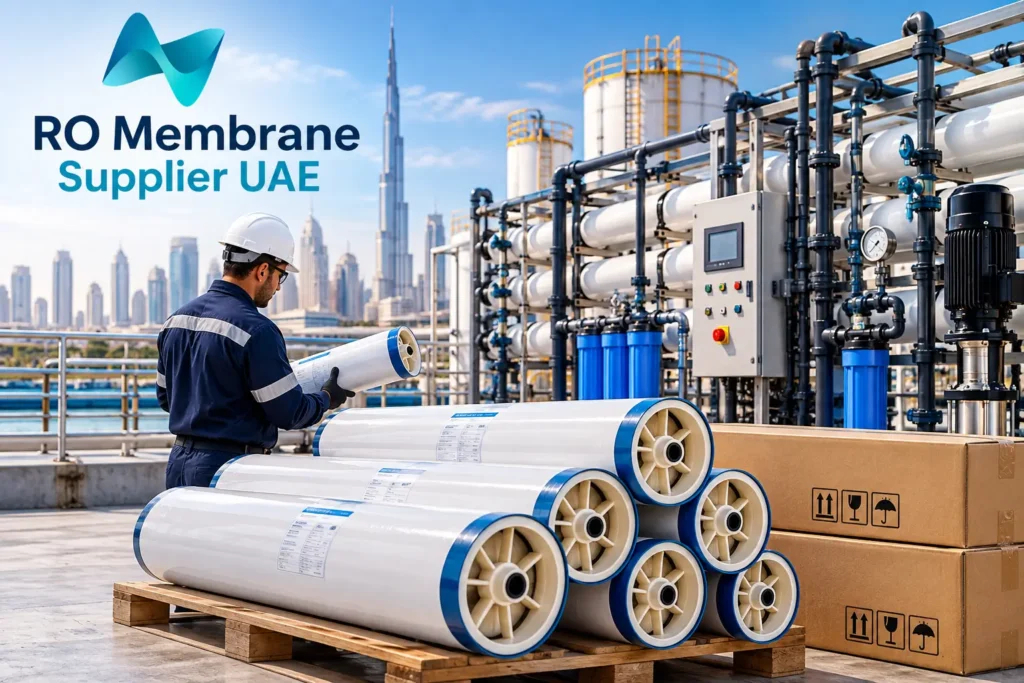
RO Membrane Supplier UAE
Searching for an RO membrane supplier UAE industrial projects can depend on for accurate specifications and compatible replacement elements? Selecting the right reverse osmosis membrane is essential for maintaining water quality, production capacity and efficient operation. The correct choice depends on feed-water chemistry, pressure requirements, membrane performance and compatibility with the existing treatment system. New Tech Water provides industrial water treatment equipment and related technical solutions. Whether you are purchasing membranes for a new RO plant or replacing elements in an existing installation, the right specifications can help reduce operating problems, avoid unnecessary replacements and support consistent treated-water production. How to Evaluate an RO Membrane Supplier in the UAE Choosing an RO membrane supplier UAE procurement teams can approach with confidence requires more than comparing prices. Industrial buyers should evaluate product specifications, technical documentation, compatibility requirements and commercial terms before placing an order. A reliable purchasing process starts with the membrane’s intended application. Brackish water, seawater and industrial process water can require different membrane characteristics. Selecting an element based only on its physical dimensions may create performance problems. RO Membrane Supplier UAE: Essential Purchasing Criteria Membrane manufacturer and exact model number. Element dimensions and intended application. Rated permeate flow and salt rejection. Operating pressure and temperature limits. Feed-water quality and pretreatment requirements. Compatibility with existing pressure vessels and seals. Manufacturer datasheets and installation instructions. Warranty conditions and available technical documentation. Confirmed stock status and delivery lead time. Check Technical Compatibility Before Ordering An industrial RO membrane may fit an existing pressure vessel without matching the original system’s hydraulic performance. Differences in membrane permeability, rejection or operating limits can affect the entire treatment process. For this reason, an RO membrane supplier UAE buyers contact should receive the original model number, plant operating data and water quality requirements. These details help establish whether a proposed replacement is suitable. Compare Total Procurement Value Price is important, but a cheaper membrane may not provide the required operating performance. Procurement teams should compare product specifications, documentation, compatibility, warranty terms and delivery arrangements. New Tech Water can discuss industrial RO equipment requirements and relevant replacement components. Buyers should confirm the available membrane models and commercial terms for each project. Need an industrial RO membrane quotation? Contact New Tech Water with your membrane model, required quantity and water treatment application. Brackish Water, Seawater and Low-Energy RO Membrane Applications Different water sources require different membrane specifications. When comparing an RO membrane supplier UAE facilities should begin by identifying the feed-water characteristics and required product-water quality. Membranes used for brackish water treatment may not be appropriate for seawater desalination. Similarly, a low-energy membrane should not be selected without checking its salt rejection and operating limits. Brackish Water RO Membranes Brackish water membranes are commonly used for groundwater treatment, industrial water production and selected commercial applications. Their suitability depends on feed salinity, operating pressure, recovery and the required permeate quality. Proper pretreatment remains essential. Suspended solids, hardness and other contaminants can affect membrane performance even when the feed-water TDS is within the intended operating range. Seawater RO Membranes Seawater desalination generally requires membranes designed for higher salinity and corresponding operating conditions. Salt rejection, pressure capability and system compatibility are particularly important. Buyers should review the original plant design before selecting a seawater membrane. The membrane, pressure vessel, pumps and associated equipment must be suitable for the intended duty. Low-Energy RO Membranes Some membrane designs are developed to achieve specified performance at comparatively lower operating pressures. These elements may be relevant where energy efficiency is an important purchasing consideration. However, lower-pressure operation does not guarantee suitability for every feed-water source. Actual performance depends on water chemistry, temperature, recovery and the required treated-water quality. Industrial Process Water Applications Manufacturing facilities may require treated water that meets defined conductivity or process-quality requirements. Membrane selection should therefore reflect the final application rather than the water source alone. New Tech Water provides industrial water treatment solutions. Explore its water treatment equipment and services when planning an RO system or reviewing replacement components. Need membranes for brackish water, seawater or industrial process water? Contact New Tech Water with your feed-water analysis and required treatment capacity. How Feed TDS and Operating Pressure Affect Membrane Selection Feed-water chemistry plays a major role in membrane selection. An RO membrane supplier UAE industrial buyers evaluate should consider salinity, scaling potential, operating pressure and required product-water quality before recommending an element. Total dissolved solids provide useful information, but TDS alone does not describe every condition affecting membrane performance. A detailed water analysis supports more accurate technical decisions. Feed-Water TDS and Water Chemistry Higher salinity generally increases the osmotic pressure that an RO system must overcome. However, mineral composition also matters. Calcium, sulfate, silica and other dissolved substances can influence scaling risk and recovery limits. Two water sources with similar TDS values may require different pretreatment arrangements. Buyers should provide a recent water analysis rather than relying on a single conductivity measurement. Operating Pressure and Membrane Limits Reverse osmosis uses applied pressure to produce permeate. The appropriate operating pressure depends on feed-water salinity, membrane characteristics and system design. Membranes must operate within their specified pressure and temperature limits. Selecting an element with unsuitable operating characteristics may affect production and increase equipment stress. Salt Rejection and Permeate Quality Salt rejection indicates how effectively a membrane reduces dissolved salts. Manufacturer specifications are typically measured under defined test conditions, so actual plant performance may differ. Buyers should compare the stated rejection characteristics with their required permeate quality and operating conditions. The membrane should also be compatible with the plant’s hydraulic configuration. Consider Pretreatment and Recovery Membrane performance depends on the entire treatment process. Inadequate pretreatment or unsuitable recovery settings can increase fouling and scaling even when the membrane itself is correctly specified. For an accurate quotation from an RO membrane supplier UAE procurement teams should include feed-water analysis, required production capacity, operating pressure and target permeate quality. Not sure which RO membrane specification matches your water source? Send New Tech Water your feed-water analysis

 English
 Arabic