
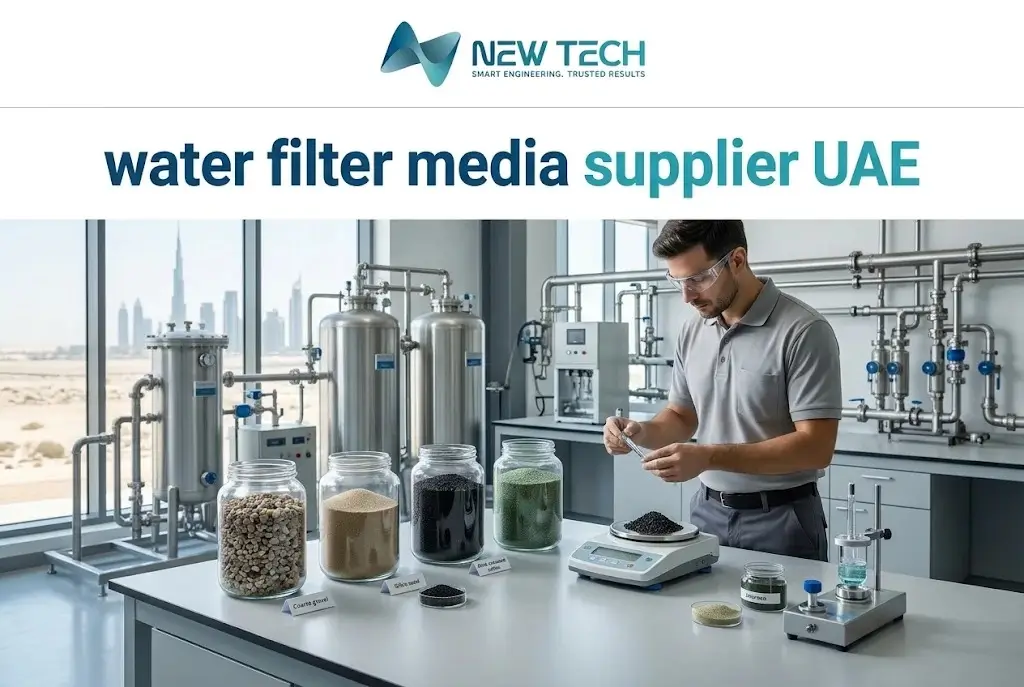
Need a Water Filter Media Supplier UAE for an industrial filtration or RO pretreatment project? Choosing suitable filter media involves more than comparing sand, activated carbon and anthracite prices. Water quality, particle-size distribution, vessel design and backwash capacity all influence performance.
Whether you are developing a new water treatment system or replacing an existing filter bed, this guide helps you compare filtration materials, define technical specifications and prepare a purchasing enquiry for New Tech Water.
Water Filter Media Supplier UAE: What to Know Before Buying
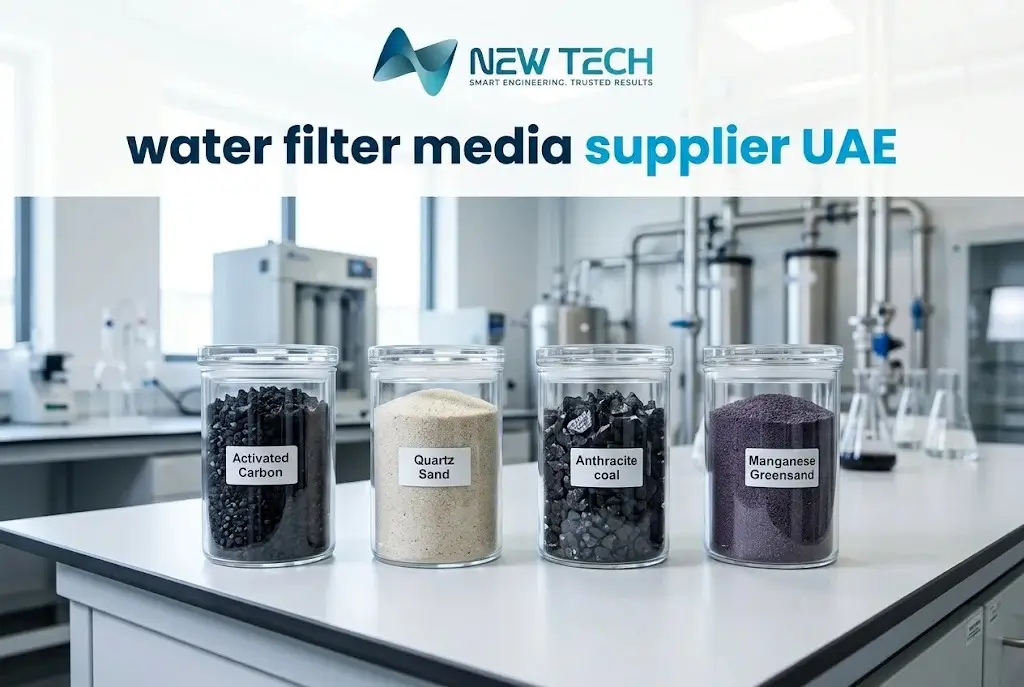
Selecting the correct filtration media begins with identifying the water treatment objective. Silica sand, anthracite, activated carbon and specialty media have different characteristics, so they should not be treated as interchangeable materials. A filter designed to reduce suspended solids may require a different media configuration from a unit intended to remove residual chlorine or selected dissolved organic compounds.
When evaluating a Water Filter Media Supplier UAE for an industrial project, start with a recent feedwater analysis, the required outlet-water quality and the filtration equipment specifications. The vessel diameter, operating flow, existing media depth and available backwash capacity may determine which material grades can be installed safely and effectively.
Buyers should also establish whether the project involves a new filter, partial replenishment or complete media replacement. This distinction affects the required quantity, installation scope and technical documentation. For replacement projects, the original filter design should be reviewed before changing the media type or grading.
Technical Details to Include in Your Filter Media Enquiry
| Required Information | Why It Matters |
|---|---|
| Water Analysis | Identifies relevant contaminants and treatment requirements. |
| Filter Vessel Dimensions | Supports media loading and hydraulic calculations. |
| Operating Flow | Helps determine filtration velocity. |
| Media Type and Grade | Defines the requested material and relevant properties. |
| Particle-Size Specifications | Supports assessment of filtration and backwashing performance. |
| Media Quantity | Clarifies the required supply volume or mass. |
| Backwash Requirements | Helps establish compatibility with cleaning arrangements. |
| Project Location | Clarifies handling and delivery requirements. |
A complete enquiry helps the project team compare materials with equivalent specifications rather than selecting a product solely because it has a lower advertised price.
Select the Right Media for Your Water Quality. Share your filtration specifications and water analysis with New Tech Water to discuss the relevant treatment requirements.
اطلب استشارة مجانية الآن
تواصل مع خبرائنا لمساعدتك في اختيار محطة المياه المناسبة لاحتياجاتك بأفضل كفاءة وأقل تكلفة.
Silica Sand, Activated Carbon, Anthracite and Other Filter Media
Industrial filtration systems use different granular materials depending on the contaminants being treated and the required operating performance. Understanding the purpose of each material helps buyers avoid selecting an unsuitable product for an existing filtration vessel.
| Filter Media | Main Treatment Function | Typical Application |
|---|---|---|
| Silica Sand | Retention of suspended particles. | Pressure sand filters and selected pretreatment systems. |
| Activated Carbon | Adsorption of selected dissolved organics and catalytic reduction of residual chlorine. | Carbon filtration and suitable RO pretreatment applications. |
| Anthracite | Granular particle filtration. | Dual-media and multimedia filters. |
| Garnet | Fine granular filtration in suitable multilayer arrangements. | Selected multimedia filter designs. |
| Support Gravel | Supports media layers and compatible underdrain arrangements. | Filter vessels requiring graded support beds. |
| Specialized Iron and Manganese Media | Treatment of specified iron or manganese contaminants under suitable conditions. | Specialized industrial water treatment systems. |
Silica Sand for Industrial Water Filtration
Silica sand provides granular filtration by retaining suspended particles as water moves through the filter bed. Its performance depends on particle-size distribution, filtration rate, bed depth and the characteristics of the incoming water.
Finer sand may improve particle retention in a correctly designed system, but it can also influence pressure loss and backwashing requirements. Selecting the smallest available particle size is therefore not automatically the best solution.
Anthracite for Dual-Media and Multimedia Filters
Anthracite is used in selected granular filtration systems because its density and particle characteristics allow it to form an upper layer in appropriately designed filter beds.
In a typical downflow dual-media filter, coarser anthracite may be positioned above finer silica sand. This arrangement can support particle retention through different depths of the bed when the media grades and operating conditions are properly selected.
Garnet and Other Dense Filter Media
Garnet is a dense granular material that may be used in lower layers of selected multimedia filters. Its particle size and density must be coordinated with the other media to achieve the intended filtration and backwashing behavior.
Adding garnet to an existing filter without checking the vessel design and available backwash flow can create hydraulic or operational problems.
Support Gravel and Filter Internals
Some pressure filters use graded support gravel to retain the primary filtration media and support water distribution. Other filter designs use compatible underdrains that do not require conventional gravel layers.
The correct arrangement should follow the original equipment specification. Incorrect support media can contribute to media migration or uneven hydraulic distribution.
Compare Filtration Media Before Purchasing. Discuss the required material properties, filter configuration and treatment objective with New Tech Water.
اطلب استشارة مجانية الآن
تواصل مع خبرائنا لمساعدتك في اختيار محطة المياه المناسبة لاحتياجاتك بأفضل كفاءة وأقل تكلفة.
Jacobi Activated Carbon: A Water Treatment Product from New Tech Water
Activated carbon is an important filtration material because it can treat selected dissolved contaminants that conventional granular sand filtration does not effectively remove. Its performance depends on carbon grade, surface characteristics, contact time, water chemistry and contaminant loading.
New Tech Water lists Jacobi activated carbon for water treatment among its published products. For an industrial enquiry, the exact carbon grade, packaging, relevant performance data and availability should be confirmed before ordering.
How Activated Carbon Removes Organic Contaminants
Adsorption is an important mechanism by which activated carbon reduces selected organic compounds. These substances accumulate on accessible carbon surfaces and within suitable pores.
The effective adsorption capacity depends on the target contaminant, its concentration, water characteristics and carbon properties. As the available adsorption capacity becomes depleted, the target contaminant may begin to appear in the treated-water stream.
How Activated Carbon Removes Free Chlorine
Free chlorine removal is different from conventional adsorption of organic compounds. Activated carbon can promote catalytic surface reactions in which free chlorine is chemically reduced, generally producing chloride and associated reaction products.
The effectiveness of dechlorination depends on factors including carbon type, contact time, pH, temperature, chlorine concentration and the operating condition of the carbon bed.
Therefore, chlorine reduction should not be described simply as chlorine being stored inside carbon pores. The relevant treatment mechanism includes chemical reactions at the carbon surface.
Why Chloramine Requires Separate Evaluation
Chloramine removal can behave differently from free chlorine removal. A carbon grade and contact arrangement suitable for free chlorine may not automatically provide adequate chloramine treatment.
Where chloramines are present, engineers should confirm the required carbon performance and treatment conditions for that specific disinfectant.
What Should Buyers Check Before Ordering Activated Carbon?
- Carbon grade and intended application.
- Target contaminants and expected inlet concentrations.
- Particle-size distribution and bulk density.
- Relevant adsorption or dechlorination performance data.
- Empty Bed Contact Time requirements.
- Pressure-loss and backwashing characteristics.
- Available technical documentation and packaging.
Activated carbon does not remove all dissolved salts and cannot replace an RO membrane when dissolved-solids reduction is the treatment objective.
Explore Jacobi Activated Carbon Options. Contact New Tech Water to confirm the appropriate grade and available supply arrangements for your filtration project.
اطلب استشارة مجانية الآن
تواصل مع خبرائنا لمساعدتك في اختيار محطة المياه المناسبة لاحتياجاتك بأفضل كفاءة وأقل تكلفة.
How Multimedia Filter Beds Improve Particle Removal
Multimedia filtration combines selected granular materials with different particle sizes and densities. The purpose is to achieve suitable particle retention through the filter depth while maintaining an acceptable hydraulic resistance.
In a conventional downflow filter, relatively coarse and less dense media may form upper layers, with finer and denser materials positioned below. This arrangement can help distribute particle retention through the bed rather than concentrating all solids at the surface.
Why Media Density and Particle Size Must Work Together
Media layers should be selected so that the filter performs correctly during service and returns to a suitable configuration after backwashing. Density, particle size and the expansion characteristics of each material influence this behavior.
Combining several materials without reviewing their relative properties can lead to unwanted mixing, media loss or ineffective cleaning.
Filter-Bed Depth and Hydraulic Loading
Bed depth influences the available filtration volume, while hydraulic loading affects the movement of water through the media. These parameters must be considered alongside the solids loading and the intended filter operating cycle.
Adding more media is not automatically beneficial. Excessive loading may reduce freeboard needed for backwash expansion or create other operational limitations.
Why Existing Filters Need a Design Review Before Media Changes
Changing from a sand-only filter to a dual-media arrangement may require reviewing the vessel dimensions, support layers, operating flow and backwash system.
Any proposed conversion should follow an appropriate engineering assessment rather than assuming that different materials can simply be added to the existing vessel.
Plan a More Effective Multimedia Filter. Share your vessel dimensions, operating flow and water-quality targets with New Tech Water.
اطلب استشارة مجانية الآن
تواصل مع خبرائنا لمساعدتك في اختيار محطة المياه المناسبة لاحتياجاتك بأفضل كفاءة وأقل تكلفة.
Effective Size and Uniformity Coefficient Explained
Granular filter media are commonly specified using particle-size characteristics that influence filtration behavior and the response of the bed during backwashing.
What Is Effective Size?
Effective Size, commonly expressed as D10, is the particle size at which approximately 10% of the media sample by mass is finer.
This parameter provides useful information about the particle-size distribution, but it should be evaluated together with the media type, bed depth and filtration duty.
What Is the Uniformity Coefficient?
The Uniformity Coefficient describes the spread of particle sizes and is commonly calculated using the following relationship:
Uniformity Coefficient = D60 / D10
D60 represents the particle size at which approximately 60% of the sample by mass is finer. A lower coefficient generally indicates a narrower distribution of particle sizes.
Simple Particle-Size Example
Assume a granular filtration material has an effective size of 0.5 mm and a D60 value of 0.75 mm.
Uniformity Coefficient = 0.75 / 0.5 = 1.5
The calculated uniformity coefficient is 1.5. This example demonstrates the calculation only; it does not establish that the material is suitable for a particular filter.
Actual acceptance limits should be selected from the relevant filter design and applicable technical specifications.
For further engineering guidance, review Veolia’s Water Handbook: Filtration, which explains granular filtration, media grading and backwashing.
Specify Filter Media with Greater Accuracy. Discuss effective size, uniformity coefficient and required media grading with New Tech Water.
اطلب استشارة مجانية الآن
تواصل مع خبرائنا لمساعدتك في اختيار محطة المياه المناسبة لاحتياجاتك بأفضل كفاءة وأقل تكلفة.
Choosing Filtration Media for Industrial RO Pretreatment
Pretreatment is a critical consideration when designing or operating a reverse osmosis plant. It helps address selected feedwater characteristics before water enters the membrane system.
For an industrial RO project, a Water Filter Media Supplier UAE enquiry should reflect the feedwater analysis, membrane requirements and the pretreatment stages already included in the plant design.
Reducing Suspended Solids Before RO
Granular filtration may reduce suspended particles in suitable pretreatment configurations. Depending on the incoming water characteristics, the system may also require clarification, cartridge filtration or other treatment processes.
Sand or multimedia filtration should not be assumed to remove all colloidal substances, dissolved contaminants or membrane-fouling risks.
Managing Residual Chlorine
When chlorine-sensitive RO membranes are used, residual oxidants must be controlled according to the membrane manufacturer’s requirements.
Activated carbon may form part of a suitable dechlorination process, but engineers must confirm its performance under the actual water chemistry and operating conditions.
Monitoring is important because chlorine breakthrough can occur when treatment capacity or contact conditions are inadequate.
Why Pretreatment Performance Must Be Monitored
Filter outlet turbidity, differential pressure, relevant residual disinfectants and other selected parameters can provide useful information about pretreatment performance.
The monitoring requirements should be defined for the actual plant rather than relying on one measurement to represent the condition of every treatment stage.
For more information about overall treatment requirements, explore New Tech Water’s industrial RO plant UAE guide.
Improve Your RO Pretreatment Strategy. Contact New Tech Water with your water analysis and membrane-system requirements to discuss suitable treatment stages.
اطلب استشارة مجانية الآن
تواصل مع خبرائنا لمساعدتك في اختيار محطة المياه المناسبة لاحتياجاتك بأفضل كفاءة وأقل تكلفة.
Backwashing: Keeping Granular Filters Operating Efficiently
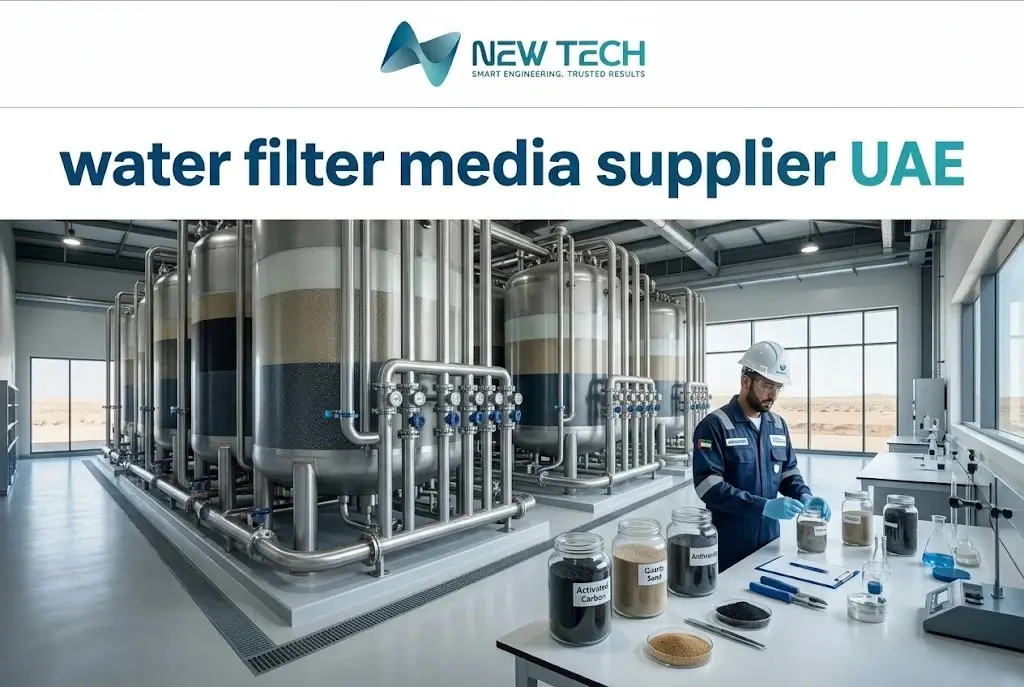
Granular filters accumulate particles during normal operation. Backwashing removes retained material using a cleaning sequence designed for the specific media and vessel arrangement.
The required conditions depend on particle size, density, bed depth, water temperature and the installed filter equipment.
How Backwashing Works
In suitable filter designs, an upward flow of water expands the granular bed and releases retained particles. The contaminated wash water is then discharged through the designated cleaning arrangement.
Some systems use air scour or other approved cleaning stages. The correct sequence should follow the equipment design and manufacturer instructions.
What Happens When Backwash Flow Is Too Low?
Insufficient cleaning may leave accumulated particles inside the bed, contributing to higher resistance, shorter operating cycles or deterioration in filtered-water quality.
Repeated poor cleaning may eventually require additional maintenance or media assessment.
What Happens When Backwash Flow Is Too High?
Excessive backwash flow can cause excessive bed expansion and carry filter media out of the vessel. Continued media loss may reduce the effective filtration depth and affect future performance.
Operators should verify the approved backwash flow and investigate abnormal media loss rather than repeatedly adding more material without resolving the cause.
Backwashing Activated Carbon Filters
Carbon filters may require backwashing to address hydraulic fouling or remove accumulated particles, but backwashing does not automatically restore the original adsorption capacity of exhausted carbon.
The maintenance procedure must distinguish between hydraulic cleaning and the regeneration or replacement of carbon whose relevant treatment performance has declined.
Maintain More Consistent Filter Performance. Share your backwash conditions, media type and operating data with New Tech Water.
اطلب استشارة مجانية الآن
تواصل مع خبرائنا لمساعدتك في اختيار محطة المياه المناسبة لاحتياجاتك بأفضل كفاءة وأقل تكلفة.
Why Is Your Industrial Filter Losing Performance?
Not every filtration problem requires complete media replacement. Symptoms such as rising differential pressure, deteriorating outlet-water quality and media loss can result from different causes.
A structured diagnosis helps identify the appropriate corrective action and may prevent unnecessary replacement costs.
| Observed Problem | Possible Cause | Recommended Investigation |
|---|---|---|
| Rising Differential Pressure | Accumulated particles, inadequate cleaning or hydraulic restriction. | Check flow, backwash performance, instruments and filter condition. |
| High Outlet Turbidity | Media loss, channeling, hydraulic overloading or changes in incoming water quality. | Review media depth, filtration rate and upstream conditions. |
| Media Loss During Backwash | Excessive bed expansion, incorrect grading or damaged internals. | Inspect backwash settings, media distribution and underdrain components. |
| Free Chlorine Breakthrough | Inadequate contact, changing chlorine load or declining dechlorination performance. | Test inlet and outlet chlorine, flow and carbon operating conditions. |
| Organic Contaminant Breakthrough | Reduced available adsorption capacity or unfavorable contact conditions. | Monitor the target contaminant and assess carbon replacement or regeneration. |
High Differential Pressure Does Not Always Mean Exhausted Media
Increasing differential pressure can indicate solids accumulation or another hydraulic restriction. It does not necessarily mean that the media has lost its fundamental filtration properties.
Before ordering replacement media, operators should verify operating flow, pressure instruments, backwash effectiveness and the condition of filter internals.
Chlorine Breakthrough Is Different from Organic Breakthrough
Free chlorine reduction on activated carbon relies significantly on surface chemical reactions. Organic contaminant removal is commonly associated with adsorption onto available carbon surfaces.
For this reason, a carbon filter may show declining performance for one treatment objective without exhibiting identical behavior for another.
Chlorine breakthrough requires evaluation of disinfectant loading, contact time, carbon properties and treatment conditions. Organic breakthrough requires assessing the target contaminant and the available adsorption capacity.
When Is Media Replacement the Correct Solution?
Replacement may be appropriate when the media is physically degraded, severely contaminated, no longer correctly graded or unable to provide the required treatment performance after suitable corrective actions.
For activated carbon, confirmed contaminant breakthrough may justify replacement or regeneration, depending on the material, application and available technical arrangements.
For a related overview of plant maintenance planning, read New Tech Water’s RO plant operation and maintenance UAE guide.
Restore Your Filter’s Performance with the Right Diagnosis. Discuss operating symptoms and media requirements with New Tech Water before planning replacement.
اطلب استشارة مجانية الآن
تواصل مع خبرائنا لمساعدتك في اختيار محطة المياه المناسبة لاحتياجاتك بأفضل كفاءة وأقل تكلفة.
Water Filter Media Price UAE: What Affects the Total Cost?
Industrial filter media prices vary with material type, product grade, particle-size specifications, order quantity and delivery arrangements.
A Water Filter Media Supplier UAE quotation should clearly identify the proposed material and relevant technical properties so that buyers can compare equivalent products.
Why Different Media Grades Have Different Costs
Specialized carbon grades, graded mineral media and products requiring particular quality documentation may have different costs from basic filtration materials.
For activated carbon, procurement teams should review the product’s intended treatment application and available technical specifications instead of comparing products by price per bag alone.
Calculating Required Media Volume
The approximate volume of a cylindrical filter layer can be calculated from its cross-sectional area and required media depth.
Media Volume (m³) = Filter Area (m²) × Media Depth (m)
For example, consider a cylindrical filter with an internal diameter of 1 meter and a specified media depth of 1 meter.
Filter Area = 3.1416 × (0.5)² ≈ 0.785 m²
Media Volume ≈ 0.785 × 1 = 0.785 m³
This is a simplified geometric calculation. The final material mass depends on the appropriate bulk density and loading specifications. Vessel internals, support layers and required backwash freeboard must also be considered.
What Should the Quotation Include?
- Exact media type and product grade.
- Required quantity and unit of supply.
- Particle-size specifications where applicable.
- Relevant technical documentation.
- Packaging and handling arrangements.
- Project delivery location.
- Any agreed loading, inspection or other services.
Commercial comparisons should clearly distinguish media supply from any separate installation or maintenance activities.
Request a Technical Media Quotation. Share your required material grade, filter dimensions and project location with New Tech Water to confirm the available scope.
اطلب استشارة مجانية الآن
تواصل مع خبرائنا لمساعدتك في اختيار محطة المياه المناسبة لاحتياجاتك بأفضل كفاءة وأقل تكلفة.
7 Questions to Ask Before Selecting a Filtration Media Supplier
Technical procurement should begin with product suitability rather than brand names or advertised prices. These questions help buyers evaluate a supplier’s proposed materials against the actual filtration requirements.
- What exact filtration media type and grade are available?
- Are effective size and uniformity coefficient documented where relevant?
- Does the material match the intended treatment objective?
- Is the media compatible with the existing vessel and underdrain arrangement?
- What backwash conditions are required?
- Which technical datasheets, certifications or test documents are available?
- What quantity, packaging, delivery and support arrangements are included?
For activated carbon, buyers should additionally confirm the target contaminant, relevant carbon characteristics and suitable contact conditions. A general claim that carbon removes contaminants is not enough to establish performance for a specific project.
Where the application involves drinking-water production or another regulated use, the applicable material standards and project requirements should be verified before purchase.
Compare Filter Media Using Clear Technical Specifications. Contact New Tech Water to discuss the material and documentation requirements of your project.
اطلب استشارة مجانية الآن
تواصل مع خبرائنا لمساعدتك في اختيار محطة المياه المناسبة لاحتياجاتك بأفضل كفاءة وأقل تكلفة.
Industrial Water Filter Media Applications in UAE
Water filtration requirements vary across industrial facilities in Dubai, Abu Dhabi, Sharjah and other emirates. The relevant media and filter arrangement depend on the water source, operating conditions and required outlet quality.
Filtration Media for Industrial Projects in Dubai
Manufacturing facilities may use sand filtration, activated carbon or other pretreatment stages as part of an industrial water treatment system. The selection depends on the actual feedwater characteristics and downstream equipment.
For replacement projects, the existing vessel and media configuration should be documented before selecting new materials.
Water Treatment Requirements in Abu Dhabi
Industrial water treatment applications may require filtration media selected for specific water sources and production objectives. Where the feedwater contains elevated salts, particular chemicals or challenging suspended solids, an appropriate process assessment is necessary.
Granular filtration should not be assumed to perform desalination or remove all dissolved contaminants.
Industrial Filtration in Sharjah
Facilities may require filtration equipment to support process water treatment, selected reuse applications or RO pretreatment. Media performance should be assessed in relation to the plant’s actual hydraulic and water-quality requirements.
Storage, Handling and Delivery
Procurement teams should consider material packaging, protection from contamination, site access and loading arrangements. Product storage and handling requirements should follow the relevant manufacturer guidance.
Any applicable site procedures, consultant specifications or regulatory requirements should be confirmed for the specific project.
Plan Your UAE Filtration Project with Clear Specifications. Share your water-quality targets, location and equipment requirements with New Tech Water.
اطلب استشارة مجانية الآن
تواصل مع خبرائنا لمساعدتك في اختيار محطة المياه المناسبة لاحتياجاتك بأفضل كفاءة وأقل تكلفة.
Why Consider New Tech Water for Industrial Filtration Requirements?
Successful filtration begins with identifying the actual treatment objective and selecting compatible equipment and materials. New Tech Water works with industrial water treatment solutions, including reverse osmosis systems, and lists Jacobi activated carbon among its published products.
For projects involving filtration or RO pretreatment, a process-focused assessment helps clarify how each stage contributes to the overall treatment requirements.
Technical Considerations That Support Better Decisions
- Reviewing feedwater analysis and treatment objectives.
- Defining the function of each filtration stage.
- Evaluating vessel dimensions and operating flow.
- Identifying appropriate media characteristics.
- Considering backwash capacity and cleaning requirements.
- Reviewing the relationship between pretreatment and RO performance.
- Clarifying maintenance and media replacement requirements.
- Confirming product specifications and the agreed supply scope.
For a Water Filter Media Supplier UAE enquiry, specific availability of silica sand, anthracite, garnet or specialized media grades should be confirmed directly rather than assumed from general treatment capabilities.
Jacobi activated carbon is listed on the company’s website, but the correct grade and available supply arrangements should still be verified for the intended application.
Build a More Reliable Filtration System. Discuss your water analysis, required media and industrial treatment objectives with New Tech Water.
اطلب استشارة مجانية الآن
تواصل مع خبرائنا لمساعدتك في اختيار محطة المياه المناسبة لاحتياجاتك بأفضل كفاءة وأقل تكلفة.
Frequently Asked Questions About Water Filter Media Supplier UAE
What is industrial water filter media?
Industrial water filter media includes materials used in suitable treatment systems to reduce selected contaminants through granular filtration, adsorption or other defined treatment mechanisms.
Which filtration media is best for industrial water treatment?
The suitable media depends on the water analysis, treatment objective, vessel design and operating conditions. No single material is ideal for every application.
What is the difference between silica sand and activated carbon?
Silica sand primarily retains suspended particles, while activated carbon can adsorb selected organic compounds and reduce free chlorine through chemical surface reactions.
What is anthracite filter media used for?
Anthracite is used in suitable granular filtration systems, including selected dual-media and multimedia filters designed to reduce suspended particles.
Can activated carbon remove chlorine before an RO plant?
Activated carbon may be used for free chlorine reduction when properly designed and monitored. The treatment conditions must match the membrane protection requirements.
How often should industrial filter media be replaced?
Replacement depends on media condition, water characteristics, treatment performance and maintenance practices. There is no universal replacement interval.
What is the effective size of filter media?
Effective size, or D10, is the particle size at which approximately 10% of the granular material by mass is finer.
What causes high pressure differential across a filter?
Possible causes include retained particles, inadequate cleaning, hydraulic restrictions or equipment problems. The actual cause should be investigated before replacing media.
How much does water filtration media cost in UAE?
Cost depends on the material type, grade, quantity, particle-size specifications, packaging and agreed supply or delivery conditions.
What information should I provide to a water filter media supplier?
Provide the water analysis, treatment objective, filter dimensions, operating flow, required media specifications, quantity and project location.
Need Help Defining Your Filtration Media Requirements? Contact New Tech Water to discuss your industrial water treatment project.
اطلب استشارة مجانية الآن
تواصل مع خبرائنا لمساعدتك في اختيار محطة المياه المناسبة لاحتياجاتك بأفضل كفاءة وأقل تكلفة.
Choose the Right Filtration Media for Your UAE Project
Finding a Water Filter Media Supplier UAE for your industrial project starts with accurate water analysis and clearly defined treatment requirements. Silica sand, anthracite, activated carbon and specialized media serve different functions, so their selection must match the filter design and operating conditions.
New Tech Water can discuss industrial water treatment requirements and its available filtration products. Share your media specifications, filter dimensions and project details to begin a focused technical consultation.
Contact New Tech Water Today to Discuss Your Filtration Requirements and Take the Next Step Toward More Reliable Water Treatment.
اطلب استشارة مجانية الآن
تواصل مع خبرائنا لمساعدتك في اختيار محطة المياه المناسبة لاحتياجاتك بأفضل كفاءة وأقل تكلفة.

 Arabic
 English