newtech-water.com

مكونات محطة تحلية المياه

مكونات محطة تحلية المياه

Water Treatment Control Valve Supplier UAE | Get a Quote

Need a Water Treatment Control Valve Supplier UAE for an industrial filter or water softener? Choosing the right valve requires more than matching pipe connections. Service flow, backwash capacity, vessel compatibility, regeneration functions and operating pressure all influence performance. Whether you are installing a new filtration system or replacing an existing valve head, this guide explains valve types, sizing, programming, troubleshooting and purchasing requirements to help you discuss suitable equipment with New Tech Water. Water Treatment Control Valve Supplier UAE: What to Check Before Buying A water treatment control valve manages the flow paths and operating cycles of a filtration or softening system. Choosing the correct model begins with understanding the treatment process. A pressure sand filter may require automatic backwashing and rinsing, while a water softener typically needs additional functions to manage resin regeneration and the brine system. When evaluating a water treatment control valve supplier in the UAE, buyers should identify the filter application, vessel dimensions, required flow rates and available operating pressure. These details establish whether a proposed valve can support the system under normal service and cleaning conditions. The purchasing specification should also distinguish between a complete automatic valve, a replacement control head and individual service components. An apparently compatible replacement may require additional fittings, distributor adapters or programming changes. Water Treatment Control Valve Buying Checklist Specification What to Confirm Application Sand filter, carbon filter, multimedia filter or water softener. Service Flow Required water flow during normal treatment. Backwash Flow Required cleaning flow and available pressure. Vessel Dimensions Tank diameter, height and mounting arrangement. Operating Conditions Pressure, temperature and water characteristics. Connection Sizes Inlet, outlet, drain and distributor connections. Control Mode Manual, timer-based, metered or another compatible system. Electrical Requirements Controller supply, adapter and installation conditions. Providing this information helps a supplier evaluate technical compatibility rather than recommending equipment based on nominal pipe size alone. Find the Right Control Valve for Your System. Share your filter application, flow requirements and vessel specifications with New Tech Water to discuss suitable equipment. How Water Treatment Control Valves Work Control valves direct water through the different hydraulic paths required during filtration, softening, backwashing and regeneration. Their internal design determines which operating cycles are available and how water moves between the service, drain and regeneration connections. During normal filtration, water passes through the selected treatment media before leaving the filter. When a backwash cycle begins, a suitable valve changes the flow path to support cleaning of the media bed. The valve may then switch to a rinse cycle before returning to normal service. Water softeners use ion exchange resin to reduce hardness. Their control valves may additionally manage brine draw, slow rinsing and brine refill, depending on the model and regeneration arrangement. Why the Control Valve Matters to System Performance An undersized valve can create excessive hydraulic resistance or fail to deliver the required flow. A valve with insufficient backwash capacity may prevent the filtration media from cleaning properly, even when normal service appears satisfactory. Correct valve selection therefore requires considering the complete system, including the vessel, filter media, resin capacity, piping and available water supply. Improve Your Filtration System’s Operation. Discuss your treatment process and required valve functions with New Tech Water before selecting a control head. Automatic Filter Valves vs Water Softener Control Valves Automatic filter valves and softener valves may look similar, but their required operating cycles are different. Selecting an unsuitable valve can create cleaning problems, incomplete regeneration or unnecessary maintenance. Feature Filter Control Valve Softener Control Valve Main Application Granular filtration. Ion exchange water softening. Normal Operation Directs water through filter media. Directs water through softening resin. Backwash Supports media cleaning where required. May form part of the regeneration cycle. Brine Draw Generally unnecessary for conventional sand or carbon filters. Required for compatible salt-regenerated softeners. Rinsing Removes remaining particles after cleaning. Helps remove residual regenerant. Control Method Manual or automatic, depending on model. Timed or demand-based regeneration, depending on model. Automatic Backwash Control Valves An automatic filter control valve manages cleaning cycles according to the selected controller and valve configuration. This can reduce the need for manual switching in compatible sand, carbon and multimedia filtration systems. However, automation alone does not guarantee effective backwashing. The valve, supply pressure, drain piping and filter media must collectively support the required cleaning flow. Automatic Softener Control Valves A water softener control valve manages the flow paths required for ion exchange service and resin regeneration. Depending on the model, it may initiate regeneration according to time settings or measured water consumption. The correct controller settings depend on the water hardness, resin quantity, operating demand and brine system design. Choose the Right Valve for Your Filter or Softener. Share your application and regeneration requirements with New Tech Water to discuss compatible control options. Manual, Timer-Based and Metered Valves: Which Control Method Is Suitable? The best control method depends on the facility’s operating pattern, water demand, required treatment cycles and maintenance capabilities. Each option has practical advantages and limitations. Manual Multiport Valves Manual valves allow operators to select different hydraulic positions. They may suit selected applications where cleaning is infrequent or regular operator intervention is acceptable. However, manual control requires correct operation at each stage. Switching the valve incorrectly can interrupt service or create unsuitable flow paths. Time-Based Automatic Valves Timer-based controllers initiate backwashing or regeneration according to programmed intervals. They may be appropriate when operating conditions are relatively stable and the cleaning schedule can be established reliably. Fixed schedules do not always reflect actual water demand or solids accumulation, so periodic review of performance remains important. Metered Softener Control Valves Metered controllers use water consumption information and programmed settings to determine when regeneration should occur. Correctly configured systems can align regeneration more closely with demand. Actual benefits depend on meter accuracy, resin capacity, hardness settings and regeneration configuration. An incorrect setup can cause premature regeneration or hardness breakthrough. Motorized Industrial Control Valves Motorized valves use compatible actuators and control signals to switch between positions or regulate a process. Their
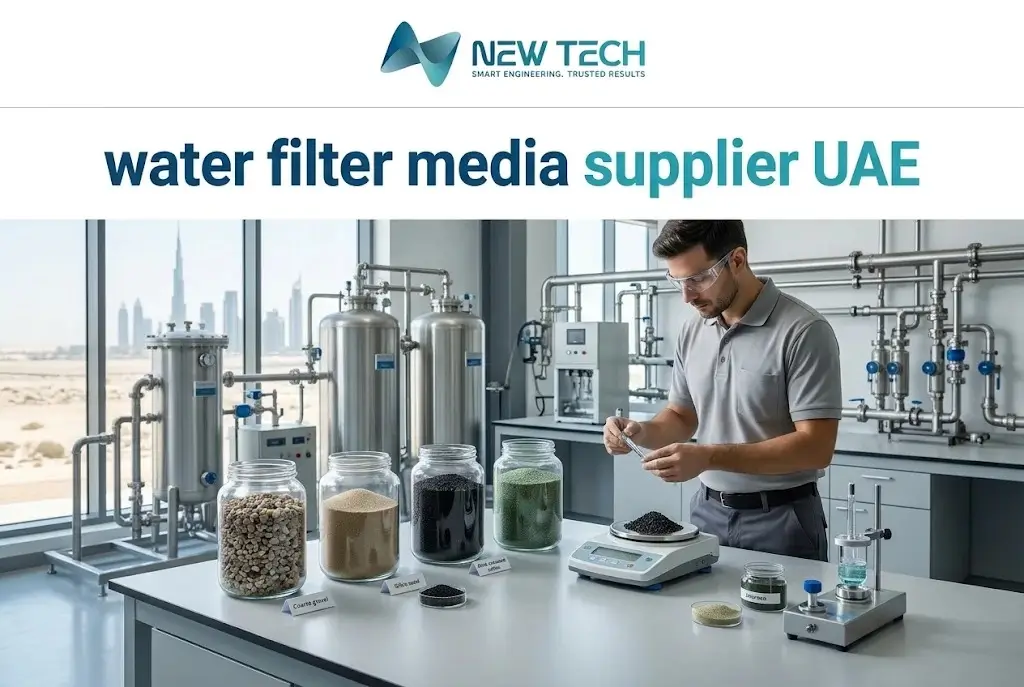
Water Filter Media Supplier UAE
مكونات محطة تحلية المياه

Water Filter Media Supplier UAE | Choose the Right Media

Need a Water Filter Media Supplier UAE for an industrial filtration or RO pretreatment project? Choosing suitable filter media involves more than comparing sand, activated carbon and anthracite prices. Water quality, particle-size distribution, vessel design and backwash capacity all influence performance. Whether you are developing a new water treatment system or replacing an existing filter bed, this guide helps you compare filtration materials, define technical specifications and prepare a purchasing enquiry for New Tech Water. Water Filter Media Supplier UAE: What to Know Before Buying Selecting the correct filtration media begins with identifying the water treatment objective. Silica sand, anthracite, activated carbon and specialty media have different characteristics, so they should not be treated as interchangeable materials. A filter designed to reduce suspended solids may require a different media configuration from a unit intended to remove residual chlorine or selected dissolved organic compounds. When evaluating a Water Filter Media Supplier UAE for an industrial project, start with a recent feedwater analysis, the required outlet-water quality and the filtration equipment specifications. The vessel diameter, operating flow, existing media depth and available backwash capacity may determine which material grades can be installed safely and effectively. Buyers should also establish whether the project involves a new filter, partial replenishment or complete media replacement. This distinction affects the required quantity, installation scope and technical documentation. For replacement projects, the original filter design should be reviewed before changing the media type or grading. Technical Details to Include in Your Filter Media Enquiry Required Information Why It Matters Water Analysis Identifies relevant contaminants and treatment requirements. Filter Vessel Dimensions Supports media loading and hydraulic calculations. Operating Flow Helps determine filtration velocity. Media Type and Grade Defines the requested material and relevant properties. Particle-Size Specifications Supports assessment of filtration and backwashing performance. Media Quantity Clarifies the required supply volume or mass. Backwash Requirements Helps establish compatibility with cleaning arrangements. Project Location Clarifies handling and delivery requirements. A complete enquiry helps the project team compare materials with equivalent specifications rather than selecting a product solely because it has a lower advertised price. Select the Right Media for Your Water Quality. Share your filtration specifications and water analysis with New Tech Water to discuss the relevant treatment requirements. Silica Sand, Activated Carbon, Anthracite and Other Filter Media Industrial filtration systems use different granular materials depending on the contaminants being treated and the required operating performance. Understanding the purpose of each material helps buyers avoid selecting an unsuitable product for an existing filtration vessel. Filter Media Main Treatment Function Typical Application Silica Sand Retention of suspended particles. Pressure sand filters and selected pretreatment systems. Activated Carbon Adsorption of selected dissolved organics and catalytic reduction of residual chlorine. Carbon filtration and suitable RO pretreatment applications. Anthracite Granular particle filtration. Dual-media and multimedia filters. Garnet Fine granular filtration in suitable multilayer arrangements. Selected multimedia filter designs. Support Gravel Supports media layers and compatible underdrain arrangements. Filter vessels requiring graded support beds. Specialized Iron and Manganese Media Treatment of specified iron or manganese contaminants under suitable conditions. Specialized industrial water treatment systems. Silica Sand for Industrial Water Filtration Silica sand provides granular filtration by retaining suspended particles as water moves through the filter bed. Its performance depends on particle-size distribution, filtration rate, bed depth and the characteristics of the incoming water. Finer sand may improve particle retention in a correctly designed system, but it can also influence pressure loss and backwashing requirements. Selecting the smallest available particle size is therefore not automatically the best solution. Anthracite for Dual-Media and Multimedia Filters Anthracite is used in selected granular filtration systems because its density and particle characteristics allow it to form an upper layer in appropriately designed filter beds. In a typical downflow dual-media filter, coarser anthracite may be positioned above finer silica sand. This arrangement can support particle retention through different depths of the bed when the media grades and operating conditions are properly selected. Garnet and Other Dense Filter Media Garnet is a dense granular material that may be used in lower layers of selected multimedia filters. Its particle size and density must be coordinated with the other media to achieve the intended filtration and backwashing behavior. Adding garnet to an existing filter without checking the vessel design and available backwash flow can create hydraulic or operational problems. Support Gravel and Filter Internals Some pressure filters use graded support gravel to retain the primary filtration media and support water distribution. Other filter designs use compatible underdrains that do not require conventional gravel layers. The correct arrangement should follow the original equipment specification. Incorrect support media can contribute to media migration or uneven hydraulic distribution. Compare Filtration Media Before Purchasing. Discuss the required material properties, filter configuration and treatment objective with New Tech Water. Jacobi Activated Carbon: A Water Treatment Product from New Tech Water Activated carbon is an important filtration material because it can treat selected dissolved contaminants that conventional granular sand filtration does not effectively remove. Its performance depends on carbon grade, surface characteristics, contact time, water chemistry and contaminant loading. New Tech Water lists Jacobi activated carbon for water treatment among its published products. For an industrial enquiry, the exact carbon grade, packaging, relevant performance data and availability should be confirmed before ordering. How Activated Carbon Removes Organic Contaminants Adsorption is an important mechanism by which activated carbon reduces selected organic compounds. These substances accumulate on accessible carbon surfaces and within suitable pores. The effective adsorption capacity depends on the target contaminant, its concentration, water characteristics and carbon properties. As the available adsorption capacity becomes depleted, the target contaminant may begin to appear in the treated-water stream. How Activated Carbon Removes Free Chlorine Free chlorine removal is different from conventional adsorption of organic compounds. Activated carbon can promote catalytic surface reactions in which free chlorine is chemically reduced, generally producing chloride and associated reaction products. The effectiveness of dechlorination depends on factors including carbon type, contact time, pH, temperature, chlorine concentration and the operating condition of the carbon bed. Therefore,

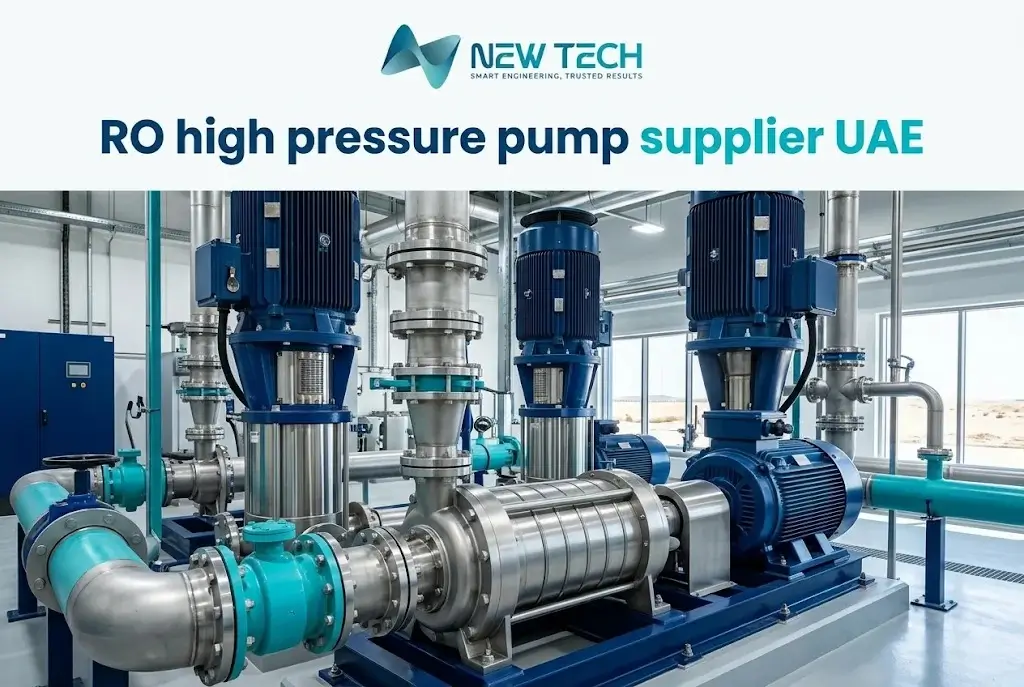
RO High Pressure Pump Supplier UAE
مكونات محطة تحلية المياه

RO High Pressure Pump Supplier UAE | Power Your RO

Looking for an RO High Pressure Pump Supplier UAE to support your industrial reverse osmosis project? Choosing the right pump requires more than selecting the highest available pressure. Feedwater salinity, hydraulic flow, membrane specifications, energy efficiency and material compatibility all affect performance. Whether you are installing a new RO plant or replacing existing equipment, this guide explains pump technologies, selection criteria, operating costs and technical requirements to help you make informed decisions with New Tech Water. RO High Pressure Pump Supplier UAE: What Matters Before Buying? High-pressure pumps are essential components in industrial reverse osmosis systems. They provide the hydraulic energy required to move feedwater through RO membranes under the specified operating conditions. However, pump selection must begin with the overall treatment process rather than an isolated pressure rating. For buyers evaluating an RO High Pressure Pump Supplier UAE, the first step is establishing the required feed flow, suction pressure, discharge pressure and expected operating conditions. Feedwater salinity, temperature, membrane configuration and system recovery also influence the final pumping requirements. Choosing a pump with a higher maximum pressure than necessary does not automatically improve performance. An oversized or incorrectly selected pump may operate inefficiently, create control challenges or place additional stress on the equipment. Essential Pump Selection Requirements Feedwater source, salinity and chemical composition. Required operating flow in m³/h. Suction pressure and discharge pressure. Differential pressure across the pump. Available NPSH and suction-line conditions. Selected membrane system and operating limits. Pump materials and mechanical seal compatibility. Motor efficiency and electrical requirements. Operating hours and maintenance conditions. A technical quotation should identify the proposed pump’s actual performance at the specified operating point, not simply its maximum rated flow and pressure. Find the Right Pump for Your RO System. Share your flow, pressure and feedwater requirements with New Tech Water to discuss the appropriate equipment specifications. How High Pressure Pumps Support Reverse Osmosis Performance Reverse osmosis uses hydraulic pressure to drive water through a semipermeable membrane. Water passes through the membrane as permeate, while much of the dissolved material remains in the concentrate stream. The required feed pressure depends on osmotic pressure, membrane characteristics, feedwater conditions, recovery and hydraulic losses. Pump selection must therefore reflect the complete membrane system design. RO High Pressure Pump vs Feed Pump vs Booster Pump Pump Type Primary Function Key Selection Factor Feed Pump Transfers water to a treatment stage. Flow and required system head. Booster Pump Increases pressure for a specific process duty. Required pressure rise and flow. RO High Pressure Pump Provides the hydraulic duty required for membrane operation. Duty point, efficiency and membrane-system compatibility. Some treatment configurations combine these functions, while others use separate pumps. The correct arrangement depends on the overall system design. Why Higher Pressure Is Not Always Better Increasing pressure may influence permeate production, but excessive pressure can exceed membrane, pressure-vessel or piping limits. It can also increase energy consumption and mechanical loading. When defining an RO high-pressure pumping duty, engineers must consider both pressure and flow at the expected operating conditions. Explore New Tech Water’s industrial RO plant UAE guide for more information about membrane-system design and equipment selection. Match Pump Performance to Your Membrane Requirements. Contact New Tech Water with your RO capacity and feedwater analysis for a technical discussion. Multistage Centrifugal vs Positive Displacement RO Pumps Industrial RO plants may use different high-pressure pumping technologies depending on flow requirements, operating pressure, feedwater conditions and equipment configuration. Two important categories are multistage centrifugal pumps and specialized positive displacement pumps. Their operating principles differ, making it important to evaluate each technology at the intended duty. Multistage Centrifugal Pumps Multistage centrifugal pumps use multiple impeller stages to increase liquid pressure. They can be suitable for industrial water treatment applications when the selected model meets the required flow, pressure and material specifications. Their operating flow and developed head depend on the system resistance and pump performance curve. Proper selection should consider the recommended operating range, best efficiency point and suction conditions. Positive Displacement Pumps Positive displacement pumps move liquid through a defined pumping mechanism. Specialized axial piston designs are used in certain reverse osmosis applications, including high-pressure desalination. Their flow is closely related to operating speed and displacement, subject to internal leakage and operating conditions. Appropriate pressure protection and manufacturer-approved operating arrangements are essential. Comparison of High Pressure Pump Technologies Factor Multistage Centrifugal Positive Displacement Operating Principle Multiple rotating impeller stages. Defined liquid displacement mechanism. Flow Response Depends on the pump and system curves. Strongly related to speed and displacement. Efficiency Varies with the operating duty point. Depends on the design and operating conditions. Control May use compatible speed-control arrangements. Requires appropriate flow and pressure management. Selection Evaluate pump curve, NPSH and materials. Evaluate operating envelope, materials and protective controls. Neither technology should be selected solely on general claims of efficiency. Engineers should compare actual operating performance, maintenance requirements and compatibility with the RO process. Compare Pump Technologies with Confidence. Share your target flow and operating pressure with New Tech Water to discuss the relevant RO equipment requirements. Brackish Water and Seawater RO Pump Requirements Feedwater salinity strongly influences the operating pressure required for reverse osmosis. As salinity increases, osmotic pressure generally increases, affecting the hydraulic duty needed to achieve the required separation. High Pressure Pumps for Brackish Water RO Brackish water RO systems may use suitable multistage pumping arrangements depending on feedwater chemistry, plant capacity and membrane specifications. The required pressure cannot be determined from salinity alone. Temperature, recovery, membrane design and hydraulic losses must also be considered. High Pressure Pumps for Seawater RO Seawater RO generally involves higher operating pressures than typical brackish water applications. The pumping equipment must be suitable for the specified pressure range and the corrosive characteristics of the liquid. Specialized high-pressure pumps and energy recovery equipment may be included in the system design. Material selection should reflect chloride exposure, temperature and other corrosion considerations. Why Pump Materials Matter Not every stainless steel grade is suitable for high-chloride applications. Depending on the project, corrosion-resistant materials such

ion exchange resin supplier UAE
مكونات محطة تحلية المياه

Ion Exchange Resin Supplier UAE | Get a Quote

Looking for an “ion exchange resin supplier UAE” for a water softener, demineralization plant or mixed-bed polisher? Choosing resin requires more than comparing price per litre. Ionic form, exchange capacity, feedwater chemistry, vessel dimensions and regeneration conditions all affect suitability. New Tech Water lists resin as a water treatment product. This guide explains how to prepare a technical purchase request, assess replacement quantities and compare supplier quotations. Need resin for an existing plant? Send New Tech Water your water analysis, vessel details and current resin grade to request a quotation. Ion Exchange Resin Supplier UAE: What to Specify Before Ordering When comparing an ion exchange resin supplier UAE quotation, define the treatment duty before choosing a grade. Sodium-form cation resin for hardness removal is not automatically suitable for demineralization or high-purity polishing. For an ion exchange resin supplier in the UAE, buyers replacing an existing bed should first identify the original product and operating arrangement. For an ion exchange resin supplier UAE enquiry, provide sufficient project data to identify a suitable product, and confirm availability and technical support for the specific requirement. Specify whether the purchase is for a new installation, a partial replacement or a complete resin change. Purchasing Information Checklist Application and treated-water quality target, including hardness or conductivity where relevant. Feedwater analysis, maximum service flow and operating temperature. Existing resin name, ionic form, grade and filling volume, if available. Vessel dimensions, internal distribution design and required freeboard. Regeneration chemicals, control arrangement and operating cycle. Required quantity, packing, delivery location and product documentation. Request manufacturer data sheets showing exchange capacity, particle size, ionic form and operating limitations. Comparing products using only the quoted volume or bag count may hide differences that affect performance. Preparing a resin RFQ? Share the specifications and operating targets with New Tech Water to discuss your requirement. Cation Resin for Water Softening and Hardness Removal Cation exchange resins exchange positively charged ions. Their behaviour depends on the functional group and operating form. Strong acid cation (SAC) and weak acid cation (WAC) resins serve different duties and should not be selected as interchangeable products. Sodium-Form Resin for Softening Conventional softeners use sodium-form SAC resin to exchange calcium and magnesium ions for sodium, reducing hardness. This can support boilers, laundries, commercial hot-water facilities and processes with defined hardness requirements. Softening does not substantially reduce total dissolved solids. When requesting water softener resin UAE, provide measured hardness, daily demand, peak flow, required hardness leakage and regeneration settings. The manufacturer’s usable working capacity, rather than nominal total capacity alone, helps determine the quantity and cycle length. Cation Resin in Demineralization Hydrogen-form cation exchange can form part of a demineralization process alongside anion exchange. WAC resin may be considered in particular arrangements depending on alkalinity and process design. Specify the desired ionic form and regenerant before purchasing from a cation resin supplier UAE. For an ion exchange resin supplier UAE comparison, the technical documentation should identify bead characteristics and hydraulic limits for the existing vessel. A matching product label is not a substitute for evaluating the manufacturer’s full specification. Need cation resin for hardness removal or demineralization? Contact New Tech Water with the original resin specification and plant data. Anion Resin for Demineralization and Specific-Ion Removal Anion resins exchange negatively charged ions and are used in suitable demineralization or selective-removal systems. Strong base anion (SBA) and weak base anion (WBA) products differ in functional chemistry, application range and regeneration behaviour. In an appropriately designed demineralization process, hydroxide-form SBA resin can exchange chloride, sulfate and other anions while releasing hydroxide ions. Product selection can also depend on the requirement to remove weakly ionized species. WBA products have a different operating scope and cannot simply replace SBA resin. Buyers contacting an anion resin supplier UAE should provide feedwater ions, required conductivity or other quality limit, current resin grade and regeneration configuration. An ion exchange resin supplier UAE proposal for selective-ion removal should include evidence for the exact product; a generic anion grade is not necessarily selective for the target contaminant. For demineralization resin UAE enquiries, verify manufacturer recommendations regarding regeneration, resin condition and compatibility with the installed equipment. Do not infer stock availability from a generic category page. Looking for anion resin? Send New Tech Water your target ions, water analysis and existing equipment specifications. Mixed Bed Resin UAE: Applications for High-Purity Water Mixed-bed units combine cation and anion resins so both exchange processes occur within one bed. They are commonly used for polishing pretreated or partially demineralized water when low ionic content is required. When selecting an ion exchange resin supplier in the UAE, the upstream treatment arrangement remains important to service life and product-water quality. Typical uses may include industrial high-purity water, laboratory systems, selected condensate polishing and polishing after reverse osmosis. The specification should state the water-quality target; not every application needs mixed-bed polishing. Choosing a Mixed-Bed Product Resin ratio, ionic form, bead characteristics and whether the unit is regenerable influence selection. Premixed single-use media and regenerable industrial mixed beds can have different design and operating requirements. Do not assume that one blend suits all vessels. New Tech Water explains softening and mixed-bed treatment in its English water treatment plants overview. Buyers asking for mixed bed resin UAE should include the existing cation/anion ratio, original grade and treated-water conductivity target when known. DuPont’s ion exchange technology reference describes the functional differences among resin families and their treatment applications. Need mixed-bed polishing resin? Send New Tech Water the vessel details, original grade and required conductivity. Resin Capacity, Regeneration and Operating-Life Considerations Working exchange capacity is influenced by the resin grade, water chemistry, flow and regeneration conditions. Total exchange capacity from a data sheet should not be treated as the guaranteed usable capacity of an installed vessel. A supplier’s recommendation should be evaluated against the design duty. Regeneration Depends on Resin Type Sodium-form softening resin generally uses salt brine for regeneration, while appropriate demineralization systems can use acid or alkali regenerants. These chemicals present safety hazards and require trained

Water Softener Supplier UAE
مكونات محطة تحلية المياه

Water Softener Supplier UAE | Quality Systems, Better Value

Searching for “water softener supplier UAE” to source equipment for a hotel, factory, laundry, or commercial project? Choosing the right supplier requires more than comparing prices. The proposed system should match your water hardness, daily consumption, peak flow, and operating requirements. New Tech Water provides information about water treatment equipment and welcomes technical enquiries from businesses seeking suitable softening components and project quotations. Need a water softener for your facility? Send New Tech Water your water analysis and equipment requirements to request a quotation. Water Softener Supplier UAE: What to Check Before Requesting a Quote When searching for “water softener supplier UAE,” begin by defining the equipment and service requirements of your project. A competitive price is useful only when the quotation covers a technically suitable system and clearly identifies the items included. Industrial contractors, hotels, and facility managers should compare suppliers using the same operating information. For example, a laundry may need a different service-flow arrangement from a factory that requires softened water throughout its production schedule. Before approaching a water softener supplier in the UAE, confirm the following: Source-water analysis and incoming hardness. Required treated-water quality and intended application. Average daily consumption and maximum hourly flow. Operating hours and acceptable regeneration downtime. Required resin, vessel, and control-valve specifications. Preferred system configuration and automation requirements. Installation, commissioning, and documentation scope. Warranty conditions, delivery terms, and spare-parts requirements. A professional quotation should identify the proposed equipment and the assumptions used in its selection. Buyers should distinguish between equipment-only supply and a wider installation package instead of assuming both offers cover identical services. When comparing a water softener supplier UAE quotation with another offer, check technical equivalence first. Different resin volumes, control functions, and included accessories can explain substantial price differences. Preparing a water softener RFQ? Send New Tech Water your hardness report, required flow, and purchasing specifications. Hardness Analysis and Water Demand Before Selecting a Supplier Accurate water-quality information is essential before a supplier can prepare a meaningful equipment proposal. A softener is intended to reduce calcium and magnesium hardness, but its design must be matched to the source water and the needs of the facility. What Should the Water Analysis Include? Total hardness, commonly expressed as mg/L as CaCO3, is a key selection parameter. Depending on the water source, iron, manganese, suspended solids, and other constituents may also influence equipment or pretreatment requirements. New Tech Water explains the role of resin-based softening in its English water treatment plants overview, including the exchange of calcium and magnesium ions for sodium ions. Daily Consumption Versus Peak Flow Daily water consumption indicates the total volume required, while peak flow identifies the highest demand during operation. Both figures are important when requesting a quotation from an industrial softener supplier in the UAE. A system selected using only daily consumption may be unable to satisfy short periods of high demand. Buyers should therefore provide the operating schedule and maximum expected service flow. Define the Required Treated-Water Quality Different applications may require different hardness limits. Boiler feedwater preparation, laundry operations, and industrial processes should follow the relevant equipment or process specifications. A water softener supplier in the UAE should receive the target hardness value rather than being asked to provide an unspecified level of softening. This makes the proposed equipment easier to evaluate. Unsure which softener capacity to request? Share your laboratory analysis, daily consumption, and peak flow with New Tech Water. Vessel, Resin and Control Valve Selection: Comparing Supplier Offers The resin, pressure vessel, and control valve determine important aspects of softener performance and operation. When comparing a water softener supplier UAE proposal, procurement teams should examine these components separately before approving the complete system. Ion Exchange Resin Conventional softening systems commonly use sodium-cycle cation exchange resin to reduce calcium and magnesium hardness. The resin’s working capacity, operating conditions, and regeneration requirements influence system performance. Buyers should request the resin manufacturer, product specifications, volume, and relevant technical documentation. An offer that specifies only the number of resin bags may not provide enough information for a reliable comparison. For further technical information about ion exchange technology, consult DuPont’s ion exchange resources. Pressure Vessel Specifications The pressure vessel should accommodate the specified resin volume and meet the required hydraulic and operating limits. Vessel material, dimensions, connections, internal distribution components, and applicable pressure rating should be documented. A commercial water softener supplier in the UAE should clarify whether the quotation includes the vessel’s necessary internal components and compatible fittings. Control Valve Specifications Control valves manage service and regeneration functions according to the selected system design. Buyers should verify service-flow capacity, regeneration features, connections, and the exact model offered. The availability of replacement components is also important. A control valve should not be selected solely because it physically fits the vessel. Softener Component Comparison Checklist Component Specifications to Compare Procurement Priority Resin Type, quantity, working capacity Correct hardness treatment duty Pressure vessel Material, dimensions, pressure rating Hydraulic and installation compatibility Control valve Model, flow rating, regeneration functions Reliable system operation Brine tank Capacity and included connections Suitable regeneration arrangement Documentation Datasheets, manuals, warranty Verification and maintenance When sourcing water softening equipment UAE projects require, compare the technical specifications against the same performance criteria. Brand names alone do not prove that two proposals are equivalent. Comparing softener components? Contact New Tech Water with your preferred vessel, resin, and control-valve specifications. Automatic and Duplex Water Softener Configurations Automatic operation and duplex configuration are different design characteristics. An automatic softener uses controls to manage operating cycles, while a duplex arrangement uses two vessels that can be coordinated to meet the facility’s service requirements. Automatic Softener Controls An automatic softener UAE project may use time-based or metered regeneration, depending on the selected control valve. The supplier should specify which functions are supported by the proposed model. Time-based regeneration follows a programmed schedule. Metered regeneration uses treated-water volume and programmed capacity assumptions to help determine when regeneration is required. Duplex Systems for Service Continuity A correctly designed duplex configuration can allow one

Industrial Water Softener UAE
مكونات محطة تحلية المياه

Industrial Water Softener UAE | Get a Quote

Searching for “industrial water softener UAE” solutions for your factory, hotel, or commercial facility? Hardness caused by calcium and magnesium can contribute to scale in boilers, hot-water systems, and industrial equipment. The correct softening system depends on laboratory results, peak flow, daily demand, resin capacity, and regeneration needs. New Tech Water welcomes enquiries from UAE buyers looking to assess their water treatment requirements and request an equipment quotation based on actual operating conditions. Need a softener sized for your facility? Send New Tech Water your hardness analysis, daily consumption, and required flow to request a quotation. Industrial Water Softener UAE: When Does Your Facility Need One? When evaluating an industrial water softener UAE project, begin by confirming that hardness is a measurable problem. Calcium and magnesium can cause scale under certain conditions, but visible deposits do not automatically prove that softening is the correct treatment. Test the feedwater and identify the quality required at the point of use. When comparing an industrial water softener UAE proposal, look at the required treated-water quality before selecting the equipment. Industrial water softeners may be useful for boiler feedwater preparation, commercial laundries, hotel hot-water systems, manufacturing lines, and selected cooling-water applications. The decision depends on the equipment manufacturer’s water specification and the facility’s actual operating conditions. Where Water Hardness Affects Operations Boilers and heat exchangers, where scale can impair heat transfer. Laundries, where hardness can influence detergent consumption and wash performance. Hotels and commercial buildings, where hot-water equipment may be exposed to scaling. Factories with processes requiring controlled water hardness. Selected RO pretreatment arrangements where hardness reduction is specified by the design. For an industrial water softener in the UAE, consider peak demand as well as average consumption. A system that supplies sufficient water over a full day may still be unable to meet a short period of high flow. Facilities needing uninterrupted service must also plan for regeneration downtime. Concerned about scale in your equipment? Share your water report and operating schedule with New Tech Water. Water Hardness Removal UAE: Calcium, Magnesium and Scaling Risk A conventional sodium-cycle water softener uses cation-exchange resin to replace calcium and magnesium ions with sodium ions. The process reduces hardness, helping to manage related scaling risks. It does not, however, significantly lower the overall total dissolved solids (TDS) concentration. How Ion Exchange Works Feedwater passes through a resin bed that exchanges hardness ions for sodium. Over time the resin’s working capacity is consumed, and a controlled brine regeneration restores its ability to soften water. Regeneration also involves rinsing and wastewater discharge according to the equipment design. For background on the mechanism, consult DuPont’s ion exchange technology guidance. Which Water Parameters Matter? For hard water treatment UAE projects, measure total hardness, usually reported in mg/L as CaCO3. Depending on source-water conditions, iron, manganese, suspended solids, temperature, and other parameters may affect resin performance or require pretreatment. A laboratory report helps avoid choosing equipment from an assumed hardness value. New Tech Water explains resin-based softening in its English-language water treatment plants overview. This offers context for discussing whether an industrial water softener UAE installation is relevant to a particular process. Need to confirm a hardness problem? Send New Tech Water your source-water analysis and target water quality. Resin Volume, Vessel Size and Service Flow Rate Sizing an industrial water softener UAE system requires matching the hardness load to the useful resin capacity, while ensuring the vessel can handle the required service flow. A larger vessel is not necessarily a better design, and a smaller system may regenerate too often or allow hardness leakage. Start With Water Demand and Hardness Load Record average daily consumption in cubic metres, the maximum hourly flow, hours of operation, and incoming hardness. The volume of water used between regenerations, multiplied by its hardness concentration, indicates the hardness load that the resin must handle. Use consistent units and a manufacturer’s documented working capacity rather than relying on nominal resin volume alone. Resin Capacity and Vessel Selection Working capacity is affected by resin type, regeneration salt dose, operating conditions, and the acceptable treated-water hardness. Vessel dimensions must also accommodate appropriate bed depth, freeboard, hydraulic distribution, and operating pressure. Specify these requirements before selecting an industrial water softener system UAE configuration. Commercial facilities with variable demand should also establish whether the system needs continuous softening during regeneration. This affects the choice between single-vessel systems, storage arrangements, and duplex configurations. Industrial Softener Sizing Checklist Input What to Provide Why It Matters Raw-water hardness Test result in mg/L as CaCO3 Establishes hardness load Daily demand m3/day and operating hours Determines required throughput Peak flow Maximum m3/hour Checks hydraulic capacity Target hardness Process or equipment limit Defines treatment objective Regeneration Permitted downtime and control preference Guides operating configuration Site conditions Space, drain, electrical supply Checks installation feasibility When selecting an industrial water softener in the UAE, the resin capacity and hydraulic limits must be assessed together. For an industrial water softener UAE quotation, ask for the assumptions behind the proposed resin volume and regeneration interval. This makes competing offers easier to evaluate and reduces the risk of purchasing on vessel dimensions alone. Need accurate softener sizing? Send your water test, peak flow, and daily consumption to New Tech Water. Automatic Water Softener UAE: Controls and Regeneration Strategy The regeneration controller influences how a softener uses resin capacity, salt, and water. The best arrangement depends on operating hours, demand variability, and whether the facility can tolerate a break in softened-water supply. Time-Based Versus Metered Regeneration Time-based controls regenerate on a set schedule. They may suit predictable consumption, although changing water demand can lead to regeneration too early or too late. Metered controls track the volume treated and can trigger a regeneration when the calculated capacity has been consumed. For an automatic water softener UAE project, confirm how the controller accounts for water hardness and the reserve capacity needed to complete an operating cycle. Settings should follow the actual equipment specifications. Single and Duplex Configurations Single-vessel units generally cannot soften water

chemical dosing pump supplier UAE
مكونات محطة تحلية المياه

Chemical Dosing Pump Supplier UAE | Request a Quote

Searching for “chemical dosing pump supplier UAE” to source equipment for an industrial project? Accurate chemical injection is essential for industrial RO plants, water treatment facilities, and wastewater applications. Selecting the right pump requires careful evaluation of chemical compatibility, dosing capacity, operating pressure, and control requirements. New Tech Water provides information about chemical dosing equipment and welcomes technical enquiries from contractors, facility managers, and industrial procurement teams seeking suitable products and quotations. Need reliable chemical dosing equipment? Send New Tech Water your chemical specifications and request a quotation for your application. Chemical Dosing Pump Supplier UAE: How to Select the Right Partner When searching for “chemical dosing pump supplier UAE,” start by identifying the treatment process and the chemical being injected. A pump used for antiscalant dosing in an RO plant may require different materials and operating specifications from one handling sodium hypochlorite, acids, or alkaline solutions. Before comparing products, industrial buyers should determine the required dosing flow, discharge pressure, chemical concentration, and operating conditions. These details help establish whether the proposed pump can provide the intended performance. Before contacting a chemical dosing pump supplier in the UAE, prepare the following information: Exact chemical name, concentration, and Safety Data Sheet. Minimum and maximum injection flow in litres per hour. Required discharge pressure and suction conditions. Pump head, diaphragm, valve, and seal material requirements. Available electrical supply and control signals. Installation environment and operating schedule. Required accessories, quantity, and delivery location. Buyers should also clarify whether they need a replacement pump, a new injection point, or equipment for a larger chemical dosing installation. The technical requirements and quotation scope may differ significantly. A clear enquiry to a chemical dosing pump supplier UAE procurement teams are considering allows offers to be compared on compatibility, actual performance, and included accessories rather than price alone. Preparing a dosing pump enquiry? Share your chemical datasheet, required flow, and operating pressure with New Tech Water. Chemical Compatibility: Pump Head, Diaphragm and Seal Materials Chemical compatibility is a critical consideration when selecting injection equipment. Components exposed to the liquid must be suitable for the exact formulation, concentration, temperature, and operating conditions. For a chemical dosing pump supplier in the UAE, chemical compatibility information should cover all wetted components, including the pump head, diaphragm, valves, seals, and tubing. Each component can use a different material and may have different chemical resistance limits. Pump Head Material Selection Chemical dosing pump heads may be manufactured from materials such as PVC, PVDF, or other engineered materials, depending on the pump design. However, material suitability cannot be established from the product name alone. The selected material must be checked against the chemical manufacturer’s information and the pump manufacturer’s compatibility guidance. Diaphragm and Seal Compatibility A diaphragm separates the pumped chemical from other parts of the pumping mechanism in suitable diaphragm pump designs. The diaphragm, valve components, and seals must withstand chemical exposure and the intended operating duty. For a diaphragm chemical pump UAE application, buyers should confirm material compatibility before approving a specific model or replacement component. Chemical Concentration and Temperature Compatibility may change when chemical concentration or operating temperature changes. A material suitable for a diluted solution may not be appropriate for the same chemical at a higher concentration. A chemical dosing pump supplier in the UAE should review manufacturer material guidance alongside the chemical Safety Data Sheet before a model is selected. For aggressive chemicals, qualified technical assessment is particularly important. Handling corrosive chemicals? Contact New Tech Water with the chemical name, concentration, and required pump specifications. Chemical Dosing Pumps for Antiscalant, Chlorine and Acid Applications Chemical dosing requirements vary according to the treatment objective and the characteristics of the injected liquid. A chemical dosing pump supplier UAE customer approaches should evaluate the application before proposing specifications. Antiscalant Dosing in RO Plants Antiscalant injection is used in suitable reverse osmosis systems to help control mineral scaling on membrane surfaces. The chemical dose depends on feedwater quality, membrane operating conditions, system flow, and the selected antiscalant formulation. For an antiscalant dosing pump UAE application, the required injection rate and discharge pressure should be calculated from the treatment design. The pump’s wetted materials must also be compatible with the antiscalant. New Tech Water features an RO antiscalant product on its English website. This provides an example of a chemical used in membrane treatment, although the required pump model and dose must be verified separately. Chlorine and Sodium Hypochlorite Dosing A chlorine dosing pump for a UAE facility must suit the disinfectant, concentration, and dosing duty. Sodium hypochlorite may introduce particular compatibility and gas-handling considerations. The equipment specification should therefore include chemical storage conditions, required flow, injection pressure, and suitable tubing and valve materials. Acid and Alkali Dosing for pH Adjustment An acid dosing pump selected for a UAE industrial facility must suit the specific acid and its concentration. Alkaline dosing requires the same careful approach to chemical compatibility and operating conditions. The dose should be determined from the treatment process rather than from a general recommended pump setting. Chemical Application Comparison Application Selection Priority Information Required RO antiscalant Accurate injection and suitable wetted materials Water flow, product concentration, required dose Sodium hypochlorite Chemical compatibility and gas-handling considerations Concentration, injection pressure, installation details Acid dosing Resistance to the specific acid formulation Acid type, concentration, temperature Alkaline dosing Material compatibility and controlled injection Required dose, chemical formulation, control method The table is a procurement guide, not proof of compatibility. A chemical dosing pump supplier in the UAE should confirm the proposed wetted materials against approved manufacturer documentation. Need a chemical dosing pump for antiscalant, chlorine, or pH adjustment? Send New Tech Water your application requirements. Required Flow Rate, Back Pressure and Turndown Ratio For a chemical dosing pump supplier in the UAE, the actual flow and pressure range should guide pump sizing. Maximum advertised pump capacity does not necessarily represent the flow available at the intended injection pressure. Determine the Required Injection Flow The required chemical flow depends on process-water flow, treatment dose,

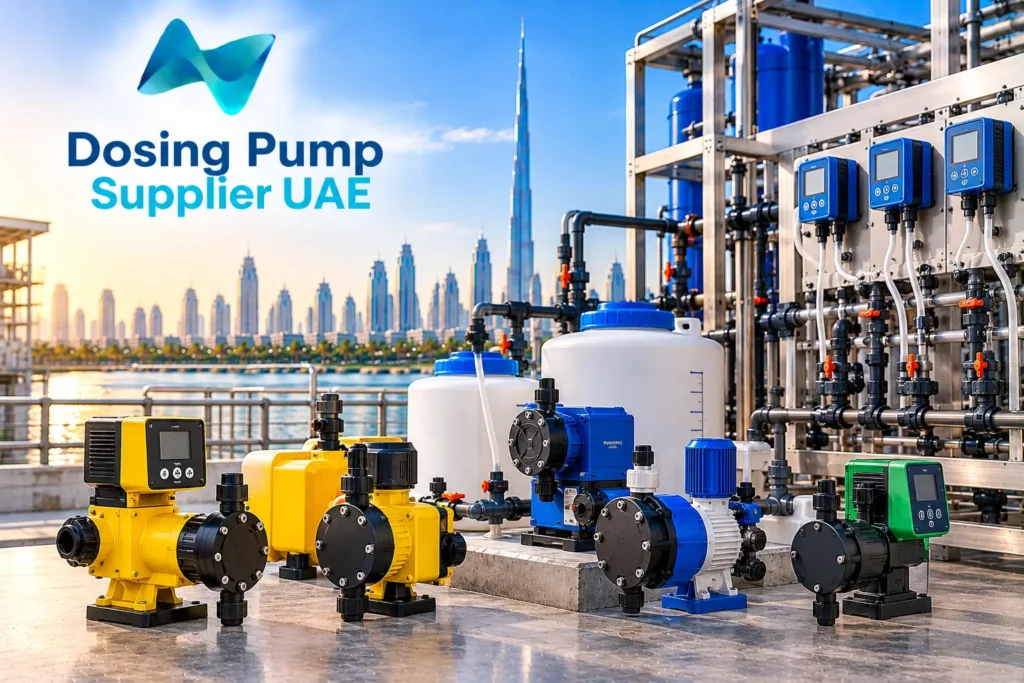
dosing pump supplier UAE
مكونات محطة تحلية المياه

Dosing Pump Supplier UAE | Industrial Solutions

Looking for a dosing pump supplier in the UAE? Selecting the right chemical metering pump is essential for accurate dosing in reverse osmosis plants, industrial water treatment systems, and cooling applications. Flow rate, discharge pressure, chemical compatibility, and control features all influence equipment selection. New Tech Water provides dosing equipment information and welcomes technical enquiries from contractors, plant operators, and procurement teams seeking suitable products and quotations. Need a dosing pump for your facility? Share your chemical specifications and operating requirements with New Tech Water to request a quotation. Dosing Pump Supplier UAE: What to Specify Before Requesting a Quote Choosing a reliable dosing pump supplier in the UAE begins with clearly identifying your chemical injection requirements. A pump must deliver the intended quantity of chemical against the operating pressure while remaining compatible with the fluid and installation conditions. Buyers conducting a dosing pump supplier UAE search should prepare the required technical information before comparing models or requesting prices. Selecting a pump based only on its maximum advertised capacity may result in poor dosing accuracy or unsuitable operating performance. Include the following information in your request for quotation: Chemical type: Exact chemical name, concentration, and Safety Data Sheet. Required capacity: Minimum and maximum dosing flow, usually expressed in litres per hour. Discharge pressure: Operating pressure at the injection point. Suction conditions: Tank position, suction height, and installation arrangement. Wetted materials: Pump head, diaphragm, valves, seals, and tubing compatibility. Control requirements: Manual adjustment, external signal, or automated dosing. Electrical supply: Available voltage and other electrical requirements. Accessories: Chemical tanks, injection fittings, valves, and calibration equipment. Industrial buyers should also clarify whether they need a complete dosing system, a replacement pump, or equipment for a new project. The scope affects technical evaluation and quotation comparison. When comparing offers from a dosing pump supplier UAE buyers should evaluate actual operating performance, product documentation, and included accessories rather than purchase price alone. Preparing a dosing pump RFQ? Send your chemical name, required flow, and operating pressure to New Tech Water. Diaphragm, Solenoid and Metering Pump Applications Understanding dosing pump technologies helps buyers select equipment suited to their application. Terms such as diaphragm, solenoid, and metering describe different aspects of pump operation and should not be treated as completely separate categories. Diaphragm Metering Pumps A diaphragm metering pump uses a moving diaphragm to displace controlled quantities of liquid. Depending on the design, the diaphragm may be actuated electromagnetically, mechanically, or hydraulically. For buyers searching for a diaphragm dosing pump UAE, the important specifications include dosing capacity, discharge pressure, chemical compatibility, and operating requirements. Diaphragm designs are used in many industrial chemical injection applications, provided the selected model meets the required duty. Solenoid-Driven Dosing Pumps A solenoid-driven dosing pump uses an electromagnetic actuator, commonly operating a diaphragm, to deliver measured quantities of chemical. Depending on the model, it may support adjustable stroke frequency, manual control, or external signal inputs. For technical examples of these technologies, consult ProMinent’s solenoid-driven metering pump specifications. Motor-Driven Metering Pumps Motor-driven metering pumps use a motor-powered mechanism and may be considered for applications requiring different capacities or operating characteristics. The correct design should be selected according to the actual operating duty rather than assuming that one actuation method is universally superior. Pump Technology Main Characteristic Key Selection Factors Diaphragm metering pump Diaphragm displaces the chemical Flow, pressure, material compatibility Solenoid-driven pump Electromagnetic actuation Operating range and control options Motor-driven metering pump Motor-powered metering mechanism Duty point and installation requirements New Tech Water features an Aqua chemical dosing pump used in water treatment and chemical injection applications. Its published information discusses manual and digital control options depending on the model. When evaluating a dosing pump supplier UAE product enquiries should identify the required type and operating specifications before choosing a pump. Comparing metering pump technologies? Share your chemical application and duty requirements with New Tech Water. Flow Rate, Discharge Pressure and Chemical Compatibility Flow rate, discharge pressure, and chemical compatibility are the three essential technical factors when selecting a dosing pump. An experienced dosing pump supplier in the UAE should receive the actual operating conditions before a model is chosen. A pump that delivers the required capacity under one pressure condition may perform differently at another operating point. Calculating the Required Dosing Flow The required chemical flow depends on the treatment objective, water flow rate, chemical concentration, and recommended dosage. The correct pump should deliver the required dosing rate across the expected operating range. Selecting a model with excessive capacity may make accurate low-flow dosing more difficult if the required output falls outside its effective adjustment range. Checking Discharge Pressure The pump must overcome the pressure at the chemical injection point and any relevant piping losses. Its performance should therefore be checked at the intended discharge pressure rather than at a nominal reference condition. When comparing equipment from a dosing pump supplier UAE buyers should request manufacturer performance data showing the relationship between flow and pressure. Verifying Wetted Material Compatibility Wetted components must be suitable for the chemical being pumped. This includes the pump head, diaphragm, seals, valves, injection fittings, and tubing. Chemical compatibility depends on the exact formulation, concentration, and operating temperature. A material suitable for diluted chemicals may not necessarily be suitable for more concentrated solutions. Reviewing the Safety Data Sheet and manufacturer’s compatibility guidance is essential before selecting a pump. Need accurate pump sizing? Send your flow requirements, injection pressure, and chemical datasheet to New Tech Water. Dosing Pumps for Antiscalant, Chlorine, Acid and pH Correction Chemical dosing pumps are used across different water treatment applications, but their technical requirements vary according to the chemicals involved. For buyers evaluating a water treatment dosing pump UAE, selecting suitable materials and control features is just as important as choosing the required flow rate. Antiscalant Injection for RO Systems Antiscalants are used in suitable reverse osmosis applications to help control mineral scaling on membrane surfaces. The dosing requirement depends on feedwater chemistry, membrane operating conditions, water flow, and the selected antiscalant formulation.

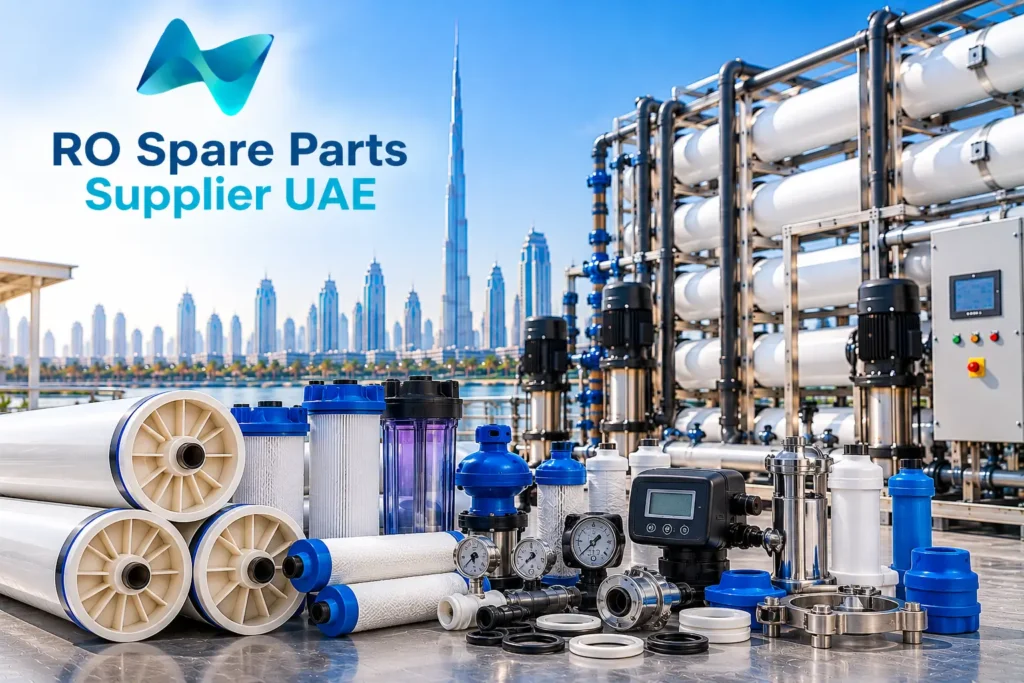
RO spare parts supplier UAE
مكونات محطة تحلية المياه

RO Spare Parts Supplier UAE | Get a Quote Today

Looking for an RO spare parts supplier in the UAE? Keeping industrial reverse osmosis plants operating reliably requires compatible membranes, pressure vessels, pumps, filters, and essential maintenance components. For companies searching for an RO spare parts supplier UAE, accurate equipment specifications can make replacement enquiries faster and more effective. Incorrect replacement parts can cause installation delays, operational problems, and unnecessary downtime. New Tech Water helps customers discuss spare-part specifications, identify their purchasing requirements, and request quotations for equipment used in industrial water treatment systems. Need spare parts for your RO plant? Contact New Tech Water with your equipment details and request a quotation. RO Spare Parts Supplier UAE: What to Confirm Before Ordering Finding the right replacement component starts with identifying the equipment and its operating requirements. A reliable purchasing process should consider the manufacturer’s specifications, installation compatibility, and the actual duties of the component within the reverse osmosis system. When evaluating an RO spare parts supplier UAE, maintenance teams should provide accurate information about the original equipment rather than relying on product appearance or general descriptions. Industrial RO components can vary significantly in operating pressure, flow capacity, materials, dimensions, and connection arrangements. A replacement may fit physically but still be unsuitable for the system. Before requesting a quotation, confirm the following: Original equipment manufacturer and model number. Existing component or spare-part identification number. Operating pressure, temperature, and flow requirements. Dimensions, connection sizes, and mounting arrangements. Material compatibility with water chemistry and treatment chemicals. Electrical specifications where applicable. Manufacturer datasheets and installation instructions. Required quantity and delivery location. Buyers should also distinguish between direct replacements, compatible alternatives, and components purchased for preventive maintenance. Each requirement may involve a different technical evaluation. Providing complete information from the beginning helps suppliers prepare more relevant quotations and reduces the risk of purchasing an unsuitable replacement. Have a part number or equipment datasheet? Share it with New Tech Water to discuss your replacement requirements. Critical RO Plant Spare Parts That Help Reduce Unplanned Downtime Not every component in an industrial RO plant has the same maintenance priority. Some items require regular replacement, while others may operate for extended periods but cause serious disruption if they fail unexpectedly. Maintenance teams planning RO plant spare parts UAE purchases should evaluate the consequences of component failure, the availability of replacements, and the time required to restore operation. Typical component groups that may require spare-part planning include: RO membranes: Replacement elements selected according to membrane specifications and operating performance. Cartridge filters: Consumables replaced according to filtration performance and manufacturer recommendations. Pressure vessel accessories: Approved seals, retaining components, and relevant assemblies. Pump components: Manufacturer-specific mechanical seals, bearings, and repair kits. Dosing equipment: Diaphragms, pump heads, injection components, and compatible tubing. Instrumentation: Pressure transmitters, flow sensors, and conductivity measurement devices. Valves and controls: Selected components whose failure could affect operation. A critical spare does not necessarily have a high purchase price. An inexpensive component with a long delivery lead time may represent a greater operational risk than a more expensive part that is readily available. For this reason, spare inventory decisions should reflect the actual plant configuration and maintenance history rather than a standard list used for every facility. When contacting an RO spare parts supplier UAE, buyers should identify which components are required urgently and which are intended for planned maintenance or future stock. Planning preventive maintenance or critical spare inventory? Send your equipment list to New Tech Water to discuss the required components. RO Membranes, Pressure Vessels, Filters and Pump Spare Parts Membranes, pressure vessels, filtration equipment, and high-pressure pumps perform essential functions in industrial reverse osmosis systems. Their replacement components must be selected according to the operating conditions and manufacturer requirements of the installed equipment. When comparing industrial RO spare parts UAE options, buyers should review each component group separately because the technical requirements differ. When comparing an RO spare parts supplier UAE, buyers should verify membrane performance requirements, pressure vessel compatibility, and manufacturer documentation before ordering. RO Membranes and Pressure Vessel Housings Industrial reverse osmosis membranes are available in different dimensions and performance configurations. Common nominal membrane formats include 4040 and 8040, but matching the nominal size alone does not guarantee compatibility. Membrane selection should also consider feedwater quality, required permeate quality, operating pressure, membrane performance, and the system design. Pressure vessel replacement requires additional checks, including rated pressure, element capacity, vessel dimensions, port arrangements, end-cap components, and installation clearance. New Tech Water features a membrane product on its English website. This page introduces a membrane-related water treatment product and describes residential and commercial applications. It should not be treated as confirmation that a particular industrial 4040 or 8040 membrane model is available. Buyers must verify the exact membrane specification before ordering. For additional technical guidance on membrane characteristics, operating requirements, and maintenance, consult DuPont’s reverse osmosis technical resources. High-Pressure Pump Replacement Components High-pressure pumps provide the hydraulic pressure required for RO membrane separation. Pump maintenance may involve mechanical seals, bearings, gaskets, valves, or manufacturer-approved repair assemblies. Replacement selection should begin with the pump manufacturer’s model and component identification details. Operating pressure, flow requirements, materials, and mechanical specifications must be considered before selecting an alternative. Components that appear similar may differ in material suitability or operating limits. An incorrect replacement can create further maintenance problems. Cartridge Filters and Filter Housings Cartridge filters are commonly used within pretreatment systems to reduce particulate loading before water reaches downstream equipment. When purchasing replacement cartridges, buyers should confirm the required length, diameter, filtration rating, material, and end configuration. Filter housings must also match the pressure rating, connection dimensions, sealing arrangements, and cartridge configuration required by the system. Replacing membranes, filters, housings, or pump components? Share the original equipment specifications with New Tech Water for a quotation enquiry. Chemical Dosing, Instrumentation and Pretreatment Spare Parts Industrial RO systems rely on supporting equipment to maintain operating conditions and monitor treatment performance. Chemical dosing components, measuring instruments, and pretreatment equipment should therefore be included in maintenance planning. An RO spare parts supplier

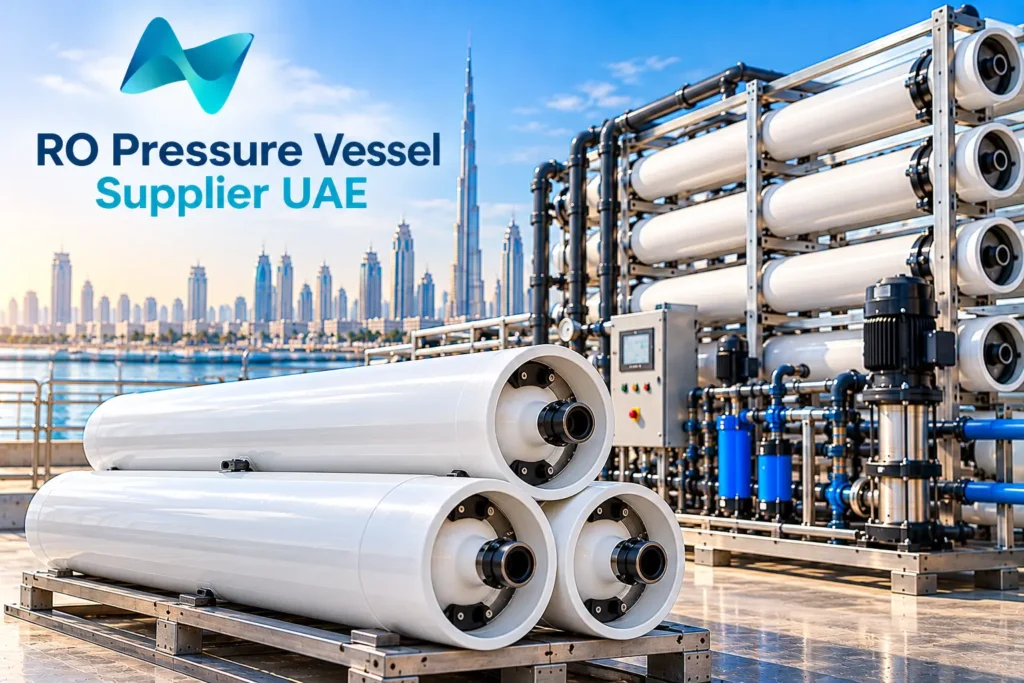
RO pressure vessel supplier UAE
مكونات محطة تحلية المياه

RO Pressure Vessel Supplier UAE | Get a Quote Today

Looking for an RO pressure vessel supplier UAE contractors and industrial buyers can contact for their membrane system requirements? Choosing the correct FRP vessel requires careful evaluation of operating pressure, membrane capacity, connection design, and replacement compatibility. Whether you are upgrading an existing reverse osmosis plant or planning a new installation, selecting suitable components is essential for safe and reliable operation. New Tech Water helps customers discuss their technical requirements and prepare informed purchasing enquiries. Contact New Tech Water today to discuss your RO pressure vessel requirements and request a quotation. RO Pressure Vessel Supplier UAE: How to Choose the Right Supplier Choosing an RO pressure vessel supplier UAE procurement teams can approach with confidence starts with understanding the technical requirements of the project. Industrial pressure vessels must safely accommodate membrane elements while operating within the pressure and temperature limits established by the manufacturer and system designer. When comparing suppliers, buyers should evaluate product specifications, documentation, component compatibility, and quotation details instead of focusing exclusively on price. The vessel must match the operating conditions of the industrial RO plant and its existing equipment configuration. Before selecting an RO pressure vessel supplier UAE project teams should confirm several essential specifications: Maximum allowable operating pressure and temperature Membrane diameter and element capacity FRP construction and material specifications Side-port or end-port connection arrangement Overall vessel dimensions and installation clearance End-cap assemblies, seals, and included accessories Manufacturer datasheets and installation instructions Compatibility with the existing RO skid A technically accurate enquiry helps reduce purchasing mistakes and allows buyers to compare equivalent products. For replacement projects, sharing the original vessel model and equipment drawings is particularly valuable. Share your existing vessel specifications with New Tech Water and request a quotation based on your project requirements. Working Pressure Ratings for Brackish and Seawater RO Vessels Operating pressure is a critical consideration when choosing an industrial membrane vessel. A qualified RO pressure vessel supplier UAE buyers consult should request information about the system’s intended pressure conditions before recommending a particular configuration. Brackish water and seawater reverse osmosis plants operate under different conditions because their feedwater characteristics and membrane requirements vary. Selecting the correct vessel requires an understanding of the approved engineering design rather than relying on general pressure estimates. Brackish Water RO Pressure Vessels Brackish water RO systems generally operate at lower pressures than seawater desalination plants. However, actual operating conditions depend on feedwater salinity, membrane specifications, temperature, and recovery targets. Buyers should confirm the vessel’s pressure rating, allowable temperature, connection dimensions, and compatibility with the required membrane elements before purchasing. High-Pressure Seawater RO Vessels Seawater desalination commonly requires higher operating pressures to overcome the osmotic pressure associated with elevated dissolved-salt concentrations. A high-pressure vessel must therefore be specifically designed and rated for the intended application. When discussing seawater applications with an RO pressure vessel supplier UAE project engineers should provide the system design pressure, membrane configuration, and relevant technical drawings. For additional information about desalination applications, explore New Tech Water’s seawater RO plant UAE guide. Manufacturer documentation provides another essential reference. The Pentair CodeLine pressure vessel specifications illustrate how vessel configurations and operating limits differ between models. Request technical guidance from New Tech Water when selecting pressure vessel specifications for brackish water or seawater RO projects. 8040 Pressure Vessel UAE: Sizes and Membrane Configurations Industrial buyers frequently search for an 8040 pressure vessel UAE when planning large reverse osmosis systems or replacing existing membrane vessels. The designation 8040 refers to membrane elements with a nominal diameter of eight inches and a nominal length of forty inches. However, membrane size does not determine the complete vessel specification. A reliable RO pressure vessel supplier UAE customers approach should also consider element quantity, vessel length, pressure rating, and connection arrangement. Single-Element and Multi-Element Configurations Single-element vessels accommodate one membrane element, while multi-element vessels are designed to hold several membrane elements within the same housing. The appropriate configuration depends on the RO plant design, required membrane area, hydraulic arrangement, and available installation space. Before requesting a quotation, confirm the following: Required number of membrane elements Nominal membrane diameter and length Overall pressure vessel dimensions Manufacturer-rated operating pressure Feed, concentrate, and permeate connection details Available clearance for membrane installation and removal For larger industrial systems, multi-element configurations may reduce the number of separate vessel assemblies required. Nevertheless, the final arrangement must be determined by the system designer. An RO pressure vessel supplier UAE enquiry should therefore include equipment drawings or an existing model reference whenever possible. This helps establish whether the requested configuration matches the actual application. Need an 8040 pressure vessel? Send your membrane configuration and technical specifications to New Tech Water for a quotation enquiry. FRP Construction, Ports, and End-Cap Assemblies FRP pressure vessels are commonly used in industrial reverse osmosis systems because fiberglass-reinforced plastic can provide corrosion resistance and suitable mechanical performance when manufactured for the intended operating conditions. When evaluating an RO pressure vessel supplier UAE industrial buyers should examine the material specifications and manufacturer documentation associated with the proposed vessel. Not all FRP vessels offer identical pressure ratings, chemical compatibility, or construction characteristics. FRP Pressure Vessel Construction Fiberglass-reinforced plastic combines reinforcing fibers with a polymer matrix to create a composite structure. Its suitability for RO applications depends on the vessel design, manufacturing quality, pressure classification, and operating environment. Important considerations include: Manufacturer-approved pressure and temperature limits Corrosion resistance under the intended operating conditions Mechanical design and installation requirements Compatibility with the membrane configuration Inspection and maintenance recommendations End Caps, Seals, and Connections The complete membrane pressure vessel assembly may include end caps, retaining components, sealing elements, membrane adapters, and dedicated fluid connections. These parts are essential to the intended assembly and must meet the manufacturer’s specifications. During replacement, buyers should confirm which accessories are included in the quotation and whether existing components can be reused. Compatibility must not be assumed solely because the nominal membrane size matches. For comparison with another membrane-related component, New Tech Water also provides information about a RO membrane housing product

arArabic
Scroll to Top