
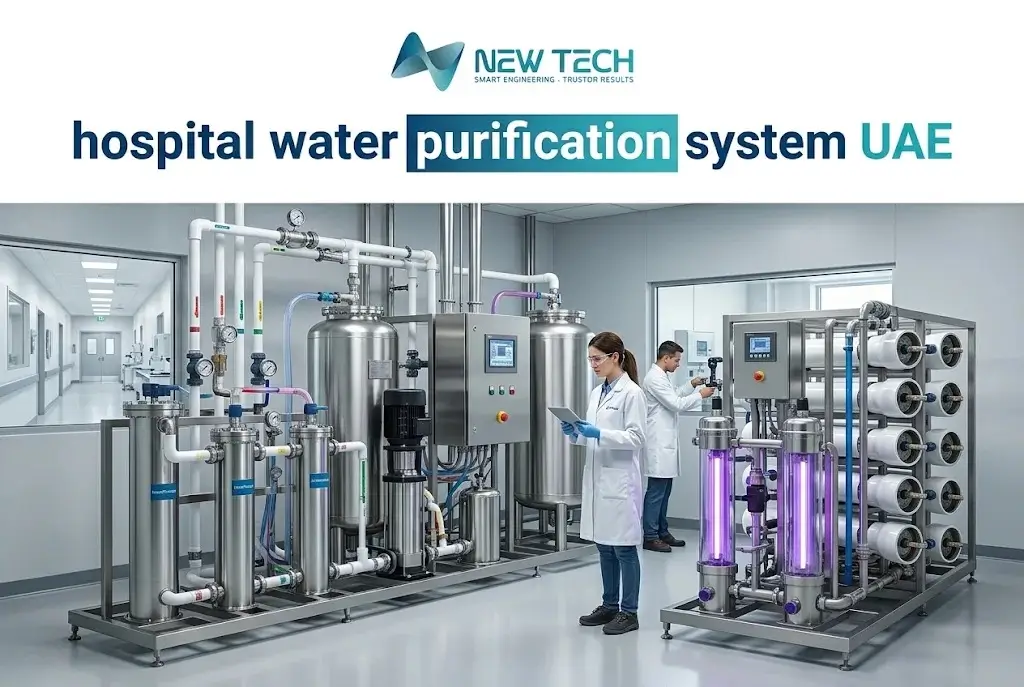
Looking for a reliable hospital water purification system in the UAE? Hospitals need different water quality specifications for drinking, laboratories, medical procedures and building utilities. Choosing suitable treatment equipment involves more than installing RO filters. Healthcare facilities must assess microbial risks, treatment capacity, monitoring and supply continuity.
This hospital water purification system UAE guide helps engineering and procurement teams compare filtration technologies, recognize specialized medical requirements and prepare an accurate technical enquiry with New Tech Water.
Hospital Water Purification System UAE: Start with Water Use and Risk
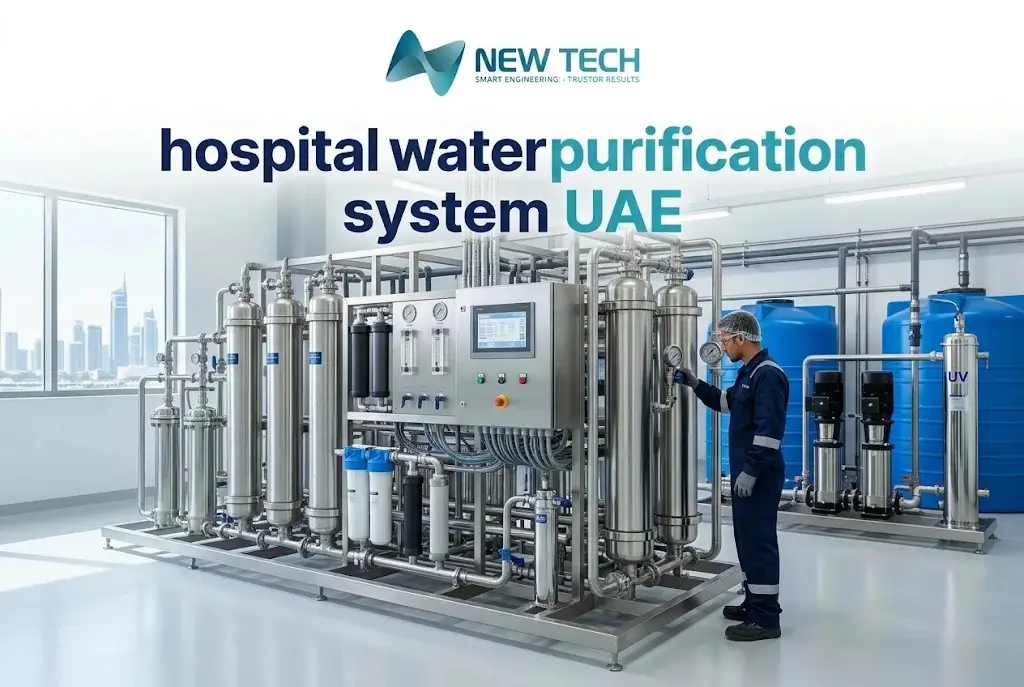
Planning a hospital water purification system UAE begins with understanding where water is used and how its quality affects hospital operations. A single healthcare facility may require potable water for drinking and hygiene, treated water for building utilities and separately specified water for laboratories or certain medical procedures. These applications do not share one universal chemical or microbiological specification. The correct approach is to evaluate each use, define its required water quality and identify which treatment technologies are suitable.
Hospital facility managers must also consider the quality of the incoming supply, storage conditions, distribution infrastructure and operating reliability. A purification unit that performs well at its outlet cannot automatically protect water quality throughout the building. Procurement decisions should therefore reflect the complete treatment and distribution requirements rather than equipment capacity alone.
Hospital Water Treatment Selection by Department
The following comparison provides an initial framework for healthcare engineering and procurement teams. It distinguishes general water treatment applications from those requiring dedicated clinical standards and professional approval.
| Department or Application | Water Quality Considerations | Responsible Team | Information Needed |
|---|---|---|---|
| Drinking and Domestic Water | Applicable potable-water quality and safe distribution. | Facilities and water management team. | Source analysis, usage, storage and plumbing conditions. |
| Medical Laboratories | Instrument-specific conductivity, purity and analytical requirements. | Laboratory and biomedical engineering. | Instrument manuals and required reagent-water grade. |
| Dialysis Department | Specified chemical, microbial and endotoxin quality. | Renal clinical team and qualified technical personnel. | Applicable AAMI/ISO standards and system requirements. |
| Sterile Processing | Water suitable for each relevant medical-device reprocessing stage. | Sterile processing and infection prevention teams. | Device instructions and applicable reprocessing standards. |
| Boilers and Building Utilities | Hardness, scaling, corrosion and equipment protection. | Facilities engineering and maintenance. | Feedwater analysis and equipment specifications. |
| High-Risk Patient Areas | Waterborne pathogen exposure and contamination control. | Infection prevention and clinical teams. | Risk assessment and patient exposure pathways. |
A suitable hospital water treatment plant UAE specification should identify which departments can share a central supply and which require dedicated purification, monitoring or protective controls. This approach supports more accurate equipment selection and avoids treating specialized clinical water as ordinary process water.
Identify the Right Water Treatment for Your Hospital. Send your source-water analysis, required capacity and intended applications to New Tech Water for an equipment enquiry.
Request a Free Consultation Now
Get in touch with our experts to help you choose the right water treatment plant for your needs with maximum efficiency and minimum cost.
Water Quality Requirements for Different Hospital Applications
Healthcare water requirements are determined by intended use, exposure risks and relevant technical standards. A hospital drinking water system must maintain suitable potable-water quality, while an analytical laboratory may require additional purification to meet instrument performance specifications. Meanwhile, certain clinical procedures require dedicated water systems with requirements that general industrial treatment equipment cannot automatically satisfy.
Drinking Water and General Healthcare Use
Hospital drinking water treatment UAE planning should address incoming water quality, storage, internal plumbing and the facility’s approved water management program. Filtration or other treatment may be appropriate where the source-water analysis identifies a specific problem. Nevertheless, installing a central filter is not a substitute for assessing building-water conditions, microbial hazards and the potential effects of stagnant outlets or poorly maintained storage tanks.
Medical Laboratory Purified Water
Laboratory water must meet the needs of the analytical tests and instruments using it. Depending on the application, specifications may include conductivity, organic contamination or other purity parameters. Reverse osmosis may serve as one treatment stage, but additional polishing can be necessary. The laboratory should provide instrument manuals and applicable water quality specifications before any medical laboratory purified water system is selected.
Utility Water and Equipment Protection
Hot-water systems, boilers and other utilities may need treatment to control hardness, deposits and corrosion. These applications can benefit from suitable softening, filtration or RO technologies when justified by feedwater chemistry. However, utility-water equipment should not be presented as suitable for patient-contact or specialized clinical uses without a separate technical and regulatory assessment.
Define Water Specifications for Every Department. Separate general building requirements from laboratory and specialized clinical water before investing.
Request a Free Consultation Now
Get in touch with our experts to help you choose the right water treatment plant for your needs with maximum efficiency and minimum cost.
How Hospital Water Quality Affects Infection Prevention
Water can carry microorganisms capable of causing healthcare-associated infections. Infection risks depend on the organism, water conditions, the pathway of exposure and the vulnerability of the patient. As a result, a hospital water purification system UAE should be considered alongside the facility’s infection prevention and water management responsibilities, rather than as a standalone solution for eliminating microbial hazards.
Legionella and Other Waterborne Pathogens
Legionella is an important concern in healthcare building water systems, particularly when operating conditions support microbial growth and transmission. Other water-associated microorganisms may also create risks in vulnerable patient populations. Water temperature, disinfectant management, plumbing design, stagnation and maintenance practices can all influence those risks. Controls therefore need to be selected through a facility-specific assessment rather than relying on a single disinfection technology.
Why Purification Alone Is Not Enough
Water meeting an approved quality target immediately after treatment may deteriorate in storage tanks, internal distribution lines or rarely used fixtures. Sinks, drains and splashing can also contribute to exposure under certain conditions. Hospital engineering and infection prevention teams should assess these pathways when developing the facility’s water management measures.
The CDC explains these concerns in its Considerations for Reducing Risk: Water in Healthcare Facilities, including water management programs, risk assessments and exposure from plumbing fixtures.
Water Infection Control Risk Assessment
A Water Infection Control Risk Assessment, or WICRA, can help identify water sources, possible transmission routes, patient susceptibility and the readiness of existing control measures. The findings should inform the hospital’s procedures for monitoring, maintenance and corrective action. Treatment equipment can support selected controls, but clinical risk decisions remain the responsibility of qualified healthcare personnel.
Assess Water Quality Risks Before Selecting Equipment. Identify the specific contaminants and treatment objectives relevant to your facility.
Request a Free Consultation Now
Get in touch with our experts to help you choose the right water treatment plant for your needs with maximum efficiency and minimum cost.
Hospital Water Filtration, RO, Softening and Disinfection Options
The appropriate treatment technology depends on the source-water analysis and the required water quality. A healthcare water filtration system Dubai facilities evaluate may include media filters, activated carbon, water softeners, reverse osmosis or suitable disinfection equipment. These technologies perform different functions and should only be combined when the treatment specification justifies their inclusion.
Media and Activated Carbon Filtration
Sand and multimedia filters can reduce selected suspended particles and turbidity, protecting downstream equipment where particle removal is needed. Activated carbon may reduce certain taste, odour and chemical constituents, including free chlorine under appropriate operating conditions. Neither process should be described as a complete medical-grade purification system. Carbon filters also require suitable maintenance and microbial management.
Reverse Osmosis for Selected Hospital Applications
Reverse osmosis reduces many dissolved salts and other constituents through membrane separation. Medical facility RO water treatment may be suitable for selected laboratory or utility applications when the required water quality and equipment conditions support its use. Feedwater analysis, pretreatment, membrane performance, recovery and the required permeate quality should be established before a plant is specified.
New Tech Water explains relevant engineering considerations in its Industrial RO Plant UAE</a guide. These principles can inform industrial equipment selection, but an industrial RO skid must not be assumed to satisfy specialized medical requirements.
Water Softeners and UV Disinfection
Water softeners reduce calcium and magnesium hardness and can support equipment protection where scaling is a concern. They do not substantially reduce all dissolved salts or provide complete microbial treatment. UV systems can inactivate susceptible microorganisms when appropriately designed and operated, but they do not leave a continuing disinfectant residual in distribution pipes or storage tanks.
| Technology | Primary Treatment Function | Key Limitation |
|---|---|---|
| Media Filtration | Reduction of selected suspended solids. | Does not substantially remove dissolved salts. |
| Activated Carbon | Reduction of selected chemicals, tastes and odours. | Requires microbial management and maintenance. |
| Softening | Reduction of water hardness. | Not a complete desalination or disinfection process. |
| Reverse Osmosis | Reduction of many dissolved constituents. | Requires pretreatment and application-specific assessment. |
| UV Disinfection | Inactivation of susceptible microorganisms. | No continuing disinfectant residual. |
For hospital water purification system UAE projects, the equipment configuration should follow measured feedwater conditions, defined treatment targets and the operating requirements of the intended department.
Compare RO, Filtration and Softening Before Investing. Share your feedwater analysis and required treated-water quality with New Tech Water.
Request a Free Consultation Now
Get in touch with our experts to help you choose the right water treatment plant for your needs with maximum efficiency and minimum cost.
Dialysis, Laboratory and Sterile Processing Water: Specialized Requirements
Some medical applications require water treatment standards that go beyond ordinary potable or industrial process water. These applications need separate technical specifications, dedicated operating procedures and appropriate oversight. A hospital should never assume that standard RO permeate, low TDS or a general filtration package is sufficient for a specialized clinical procedure.
Dialysis Water and AAMI/ISO Standards
Hemodialysis can expose patients to substantial volumes of treated water through dialysis treatment. The water used to prepare dialysate and related fluids must therefore meet applicable requirements for chemical contaminants, microbial quality and bacterial endotoxins. The complete system may need specialized treatment, distribution, testing, disinfection and equipment verification.
The CDC’s Water Use in Dialysis guidance explains the importance of AAMI/ISO standards for dialysis water and the associated treatment and distribution requirements. The applicable editions and clinical requirements must be confirmed by the responsible facility team.
Laboratory Water Quality
Clinical laboratory water may require a specified reagent-water grade to support reliable analytical performance. Requirements vary by instrument and procedure, so the laboratory must identify the relevant manufacturer instructions and technical standards. RO, ion exchange or other polishing may be evaluated as appropriate, but the final process must demonstrate the required water quality.
Water Used in Sterile Processing
Medical-device reprocessing may involve different water specifications for cleaning and rinsing. The selection should reflect relevant reprocessing standards, device manufacturer instructions and approved hospital procedures. Purified water is not automatically sterile water, and equipment marketed for general water treatment should not be substituted for a clinically specified process without verification.
Specify Clinical Water Requirements Separately. Confirm the relevant dialysis, laboratory or device-reprocessing standards before purchasing equipment.
Request a Free Consultation Now
Get in touch with our experts to help you choose the right water treatment plant for your needs with maximum efficiency and minimum cost.
Central Water Treatment, Storage and Distribution Design
The performance of a hospital central water filtration UAE project depends on the entire water pathway. Incoming supply, treatment equipment, storage tanks, distribution branches and points of use can all influence delivered water quality. Engineering decisions should also account for maintenance access, operating continuity and the separation of water systems serving different purposes.
Centralized Treatment or Point-of-Use Purification?
Centralized filtration may be suitable for departments with compatible water specifications. Other uses, particularly certain laboratory or clinical applications, may need dedicated point-of-use equipment or separately controlled systems. A water-use inventory can help identify where shared treatment is practical and where it could introduce unsuitable quality or cross-connection risks.
Storage Tanks and Plumbing Conditions
Storage capacity should meet operational requirements while supporting appropriate water turnover, inspection and maintenance. Poorly maintained tanks, stagnant branches or unsuitable operating conditions can affect microbial quality. The distribution design should also include appropriate backflow protection and safeguards where water streams of different quality are present.
Monitoring at Relevant Locations
Testing only at the treatment outlet may not reflect conditions throughout the facility. Sampling locations should be selected according to the water management program, the nature of the risk and the intended application. Specialized water systems may require additional testing at the point of use under their respective standards.
Plan Treatment, Storage and Distribution Together. Define the required capacity, tank arrangements and monitoring points before procurement.
Request a Free Consultation Now
Get in touch with our experts to help you choose the right water treatment plant for your needs with maximum efficiency and minimum cost.
Hospital Water Management Programs and Routine Monitoring
A Water Management Program provides a structured approach to identifying water-related hazards, implementing controls and reviewing performance. The CDC recommends comprehensive water management programs for relevant healthcare facilities to reduce risks associated with Legionella and other waterborne pathogens. Such programs complement treatment equipment but cannot be replaced by the purchase of a purification unit.
What a Water Management Program Should Cover
The program should identify the water source, major equipment, distribution network, vulnerable populations and possible exposure pathways. Responsible teams should establish control measures, monitoring requirements, corrective actions, recordkeeping and periodic review. Appropriate participation may include facilities engineering, maintenance, biomedical engineering, infection prevention and other clinical personnel.
Monitoring and Testing Responsibilities
| Monitoring Activity | Purpose | Responsible Function |
|---|---|---|
| Source-Water Testing | Identify relevant incoming water quality conditions. | Facilities or designated water quality personnel. |
| Filtration and RO Performance | Identify equipment performance changes. | Engineering and treatment operators. |
| Building Water Risk Controls | Monitor relevant microbial risk factors. | Water management and infection prevention teams. |
| Specialized Clinical Water Testing | Verify water against application-specific requirements. | Responsible clinical and technical personnel. |
| Corrective Action Records | Document investigations and response measures. | Assigned facility and quality teams. |
Testing frequency should be determined from the applicable requirements, risk assessment and operating history. No single sampling interval is suitable for all hospital drinking water, laboratory and specialized medical applications.
Build a Measurable Hospital Water Management Plan. Define the equipment performance data and monitoring requirements your facility needs.
Request a Free Consultation Now
Get in touch with our experts to help you choose the right water treatment plant for your needs with maximum efficiency and minimum cost.
Emergency Water Supply and Treatment System Redundancy
Hospital water supply interruptions can affect hygiene, patient services, clinical activities and building operations. Emergency planning should therefore identify which water uses are essential, the quality needed for each function and the procedures for maintaining safe operations when the normal supply is unavailable.
Prioritize Critical Water Applications
The hospital emergency planning team should distinguish between general building needs and water-dependent clinical services. Any alternative supply must be evaluated for suitability before use, particularly where specialized clinical water quality is required. An emergency storage tank cannot automatically substitute for a qualified medical water system.
Backup Equipment and Storage
Depending on facility risks, redundancy may involve standby pumps, appropriately specified treatment capacity, protected storage or alternative approved supplies. The necessary arrangement depends on demand, expected failure scenarios and available infrastructure. Stored water quality and the procedures for switching between supplies are as important as storage volume.
Returning to Normal Operations
After a major supply interruption or contamination incident, the facility may need to inspect, flush, disinfect, sample or otherwise assess affected systems before returning them to service. The response should follow its approved emergency water plan and relevant clinical and regulatory requirements.
Plan Reliable Water Supply for Critical Hospital Operations. Evaluate standby equipment, storage and treatment capacity as part of your procurement specification.
Request a Free Consultation Now
Get in touch with our experts to help you choose the right water treatment plant for your needs with maximum efficiency and minimum cost.
How to Size a Hospital Water Purification System UAE
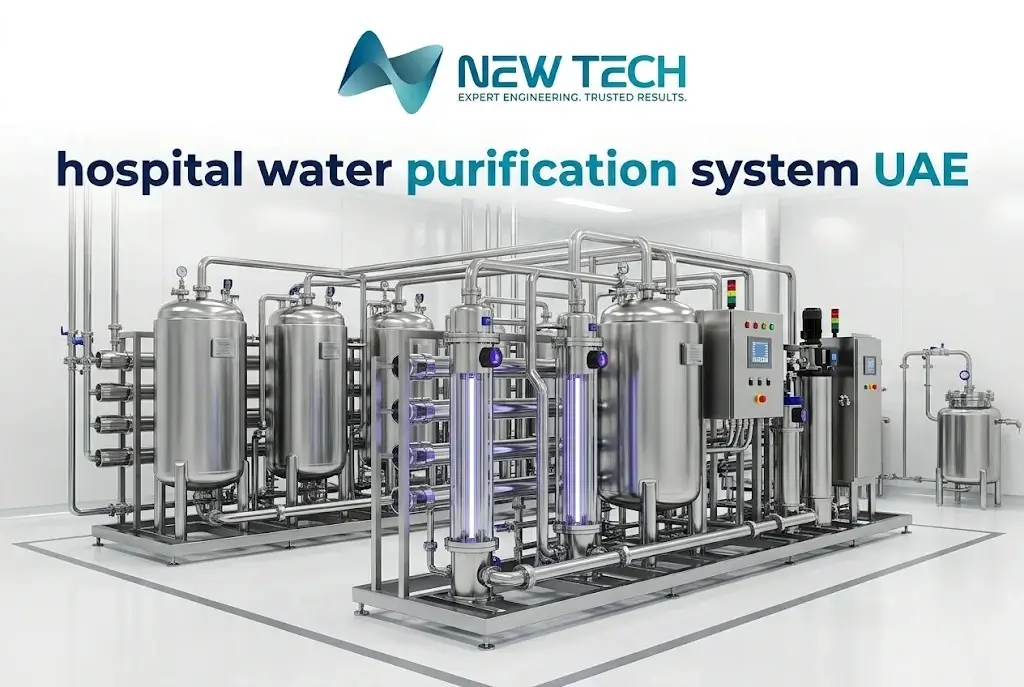
Treatment capacity should be determined using the demand of the applications included in the project scope. Daily water consumption, peak hourly demand, operating hours, storage and maintenance allowances can all influence the selected plant size. Specialized clinical water systems should be sized separately where their standards and duty requirements demand dedicated assessment.
Illustrative Treatment Capacity Calculation
Consider a hypothetical treatment application requiring 120 cubic meters of treated water per day. If the plant is planned to produce this volume over 20 operating hours, the average required output is calculated as follows:
| Parameter | Illustrative Value |
|---|---|
| Daily Treatment Demand | 120 m³/day |
| Available Production Time | 20 hours/day |
| Average Required Output | 6 m³/h |
Average Output = Daily Demand / Production Hours
Average Output = 120 / 20 = 6 m³/h
This example gives an average production requirement of 6 m³/h, not a final equipment rating. Higher instantaneous demand, tank limitations, downtime and design allowances may change the installed capacity. If reverse osmosis is selected, feedwater volume must also account for membrane recovery and concentrate production, which depend on source-water chemistry and operating conditions.
Size Your Treatment Plant Around Actual Hospital Demand. Send New Tech Water your water balance, daily requirements and peak flow conditions.
Request a Free Consultation Now
Get in touch with our experts to help you choose the right water treatment plant for your needs with maximum efficiency and minimum cost.
Water Treatment Maintenance and Operational Reliability
Maintenance should be planned around equipment performance, water quality requirements and the hospital’s approved operating procedures. Common maintenance activities include filter servicing, RO membrane assessment, softener regeneration checks, instrument calibration and review of storage and distribution conditions. Any work involving specialized clinical water must follow the relevant medical equipment standards and responsible department procedures.
| Operational Issue | Possible Cause | Recommended Assessment |
|---|---|---|
| Reduced Filter Flow | Fouling or increased suspended solids. | Check differential pressure and service records. |
| Changed RO Permeate Quality | Feedwater variation or membrane problems. | Review conductivity and normalized operating trends. |
| Unexpected Hardness | Softener regeneration or operating issue. | Verify hardness and equipment settings. |
| Disinfectant Control Problems | Changed demand or distribution conditions. | Follow the facility’s approved control procedures. |
| Microbial Results Above Target | Possible source, treatment or distribution contamination. | Implement the approved water management response. |
| Insufficient Peak Supply | Capacity, storage or hydraulic limitations. | Compare actual demand with system performance. |
Chemical Dosing Equipment for Suitable Utility Applications
Some hospital utility-water or industrial-style treatment processes may use chemical metering equipment for suitable conditioning applications. Pump selection should consider the exact chemical formulation, required injection rate, operating pressure, materials and appropriate controls. New Tech Water discusses these factors in its Chemical Dosing Pump Supplier UAE</a guide.
Any chemical treatment for hospital water must be assessed against the relevant health, safety and application-specific requirements. Chemical dosing equipment should not be assumed suitable for drinking or specialized medical water simply because it is used in industrial treatment.
Reduce Unplanned Water Treatment Problems. Request information on suitable filtration, RO and chemical dosing components for your specified application.
Request a Free Consultation Now
Get in touch with our experts to help you choose the right water treatment plant for your needs with maximum efficiency and minimum cost.
Hospital Water Purification System Cost UAE and Procurement Requirements
The cost of a hospital water purification system UAE depends on the feedwater quality, target water specification, plant capacity and complete equipment scope. A central filtration package, an RO plant for selected utility applications and a specialized medical water system may differ substantially in construction, monitoring, documentation and operating responsibilities. Comparing quotations by flow rate alone is therefore not sufficient.
Major Cost Factors
| Cost Component | What Procurement Should Verify |
|---|---|
| Feedwater Quality | Available analysis and necessary pretreatment. |
| Water Application | Potable, laboratory, utility or specialized clinical use. |
| Treatment Technology | Specified filtration, RO, softening or other stages. |
| Capacity | Normal output, peak demand and operating schedule. |
| Storage and Distribution | Tank, piping and water quality control requirements. |
| Instrumentation | Monitoring, alarms and required records. |
| Reliability Measures | Standby equipment or approved backup provisions. |
| Project Scope | Supply, installation, commissioning and documentation responsibilities. |
Hospital Water Treatment RFQ Checklist
A detailed Request for Quotation helps engineering and procurement teams compare offers based on the same technical requirements. The following information should accompany the enquiry whenever applicable.
| RFQ Item | Information Required |
|---|---|
| Project Location | Emirate, facility type and installation location. |
| Intended Water Use | Specific department and treatment application. |
| Feedwater | Water source and recent laboratory analysis. |
| Required Water Quality | Target chemical and microbial specifications. |
| Capacity | Daily demand, peak hourly flow and operating hours. |
| Treatment Scope | Required stages or acceptable technical alternatives. |
| Storage and Connections | Tank requirements, interfaces and distribution scope. |
| Controls | Instrumentation, alarms and monitoring requirements. |
| Maintenance | Consumables, technical manuals and spare parts. |
| Regulatory Requirements | Applicable facility, clinical or equipment standards. |
| Commercial Scope | Equipment supply, delivery and requested project services. |
Consider Total Lifecycle Costs
Beyond capital cost, buyers should consider electricity, replacement cartridges, RO membranes, chemical consumables, testing, maintenance, water recovery and concentrate handling where relevant. Clinical applications may require additional quality assurance and specialized maintenance costs that are not normally included in a general industrial equipment quotation.
Request a Specification-Based Equipment Quote. Send New Tech Water your water analysis, required capacity and complete technical RFQ.
Request a Free Consultation Now
Get in touch with our experts to help you choose the right water treatment plant for your needs with maximum efficiency and minimum cost.
Hospital Water Treatment in Dubai, Sharjah and Abu Dhabi
Healthcare water treatment requirements across the UAE depend on the facility’s water source, infrastructure, intended applications and applicable regulatory framework. A hospital water purification system UAE proposal should use the actual project location to identify relevant site requirements and delivery conditions, without assuming that identical treatment specifications apply to every hospital or clinic.
Healthcare Water Filtration in Dubai
Hospital engineering teams in Dubai should evaluate the water system design against the requirements applicable to their facility and licensing authority. The Dubai Health Authority has published healthcare facility guidelines addressing water systems design, including relevant engineering and infection control considerations. Project teams should confirm the current applicable edition and any additional authority requirements before procurement.
Hospital Water Treatment in Sharjah
Facilities in Sharjah may evaluate central filtration, RO or utility-water conditioning based on feedwater analysis and equipment needs. Medical departments requiring specialized water quality should be specified separately under the applicable clinical and technical framework. Procurement teams should also clarify the supplier’s delivery and service scope for the project location.
Healthcare Water Systems in Abu Dhabi
Hospitals and clinics in Abu Dhabi should evaluate treatment capacity, storage, continuity planning and the water quality required by each department. Applicable facility regulations and authority requirements must be confirmed for the specific project. The proposed equipment should match the intended application, rather than being selected from a general hospital filtration description.
Discuss Your UAE Healthcare Facility’s Water Requirements. Include your project location, water analysis and equipment scope in the enquiry.
Request a Free Consultation Now
Get in touch with our experts to help you choose the right water treatment plant for your needs with maximum efficiency and minimum cost.
Why Discuss Hospital Water Treatment Equipment with New Tech Water?
New Tech Water publishes information about industrial reverse osmosis, water filtration and chemical dosing equipment. These technologies may support selected hospital building-water, utility-water or non-specialized treatment requirements when their technical performance matches the intended application. Equipment suitability must be confirmed using the actual water quality specification and project scope.
The company’s water treatment plant solutions page outlines filtration and RO technologies used in water purification. This provides a starting point for discussing general treatment options and related equipment requirements.
Seven Questions to Ask Before Selecting Equipment
- Which hospital application will use the treated water?
- What feedwater quality and contaminants have been identified?
- What treated-water specification is required?
- What is the daily demand and maximum operating flow?
- Which equipment materials and control features are necessary?
- What technical documentation and maintenance support are required?
- Does the quotation cover components only or a complete defined installation?
Confirm Specialized Medical Suitability Separately
Industrial RO and filtration capabilities do not independently establish that a supplier provides approved dialysis systems, sterile processing water installations or other medical-grade equipment. Any clinical certification, specialized validation or regulated medical water application must be verified through appropriate documentation and qualified professional assessment.
By clarifying technical requirements early, healthcare procurement teams can distinguish general treatment products from specialized medical systems and avoid requesting unsuitable equipment.
Discuss Your Hospital Water Treatment Project with New Tech Water. Submit your source-water report and technical specifications to confirm suitable available equipment and quotation scope.
Request a Free Consultation Now
Get in touch with our experts to help you choose the right water treatment plant for your needs with maximum efficiency and minimum cost.
Frequently Asked Questions About Hospital Water Purification System UAE
What water purification systems are used in hospitals?
Hospitals may use media filtration, activated carbon, water softening, reverse osmosis and suitable disinfection technologies. Selection depends on the department, intended use and required water quality. Specialized clinical applications may require dedicated systems and standards.
How much does hospital water treatment cost in UAE?
Cost depends on water source, plant capacity, treatment stages, storage, instrumentation and project responsibilities. Specialized clinical systems may involve additional equipment, testing and documentation. A technical RFQ is needed for reliable pricing.
Do hospitals need reverse osmosis systems?
RO can be appropriate for selected laboratory, process or utility applications when dissolved contaminant reduction is required. It is not necessary for every hospital water use, and ordinary industrial RO does not automatically meet clinical standards.
Which water quality is required for medical laboratories?
Laboratory water specifications depend on the analytical instruments and testing methods involved. Procurement teams should consult applicable laboratory standards and instrument manufacturer instructions before selecting a purification system.
How do hospitals control bacteria in water systems?
Hospitals use water management programs, risk assessment, appropriate treatment, plumbing controls, maintenance, sampling and corrective actions. Infection prevention and engineering teams should coordinate the measures needed for the specific facility.
Can UV disinfection protect hospital water supplies?
UV may inactivate susceptible microorganisms under appropriately validated conditions. However, it leaves no continuing disinfectant residual, so downstream storage and distribution still require suitable risk controls.
What is the difference between clinical and potable water treatment?
Potable-water treatment supports safe drinking and general use. Specialized clinical applications may require additional chemical, microbiological or endotoxin specifications, dedicated equipment and application-specific monitoring.
How often should hospital water systems be tested?
Testing frequency depends on the water application, regulatory requirements, risk assessment and operating history. Specialized medical systems may have additional prescribed monitoring and verification requirements.
What should hospitals include in a water purification RFQ?
An RFQ should include the intended use, feedwater analysis, required treated-water quality, daily and peak capacity, treatment scope, controls, storage, relevant standards and requested supplier responsibilities.
Who supplies water treatment equipment for healthcare facilities in Dubai?
Water treatment suppliers may offer filtration, RO and utility-water equipment for suitable healthcare applications. New Tech Water publishes industrial treatment solutions, and buyers should confirm actual equipment availability, application suitability and project scope before ordering.
Need Help Comparing Hospital Water Treatment Equipment? Send your treatment requirements and technical RFQ to New Tech Water.
Request a Free Consultation Now
Get in touch with our experts to help you choose the right water treatment plant for your needs with maximum efficiency and minimum cost.
Request a Hospital Water Treatment Equipment Specification
Choosing a hospital water purification system UAE starts with defining each department’s water quality requirements and assessing the source, treatment, storage and distribution system. Filtration, RO, softening and disinfection can support different applications, while specialized medical water requires separate standards and verification.
New Tech Water publishes industrial water treatment equipment relevant to selected hospital applications. Share your water analysis, required capacity and technical specifications to discuss available products and prepare a focused quotation request.
Contact New Tech Water Today to Discuss Your Hospital Water Treatment Requirements and Request a Technical Equipment Quote.
Request a Free Consultation Now
Get in touch with our experts to help you choose the right water treatment plant for your needs with maximum efficiency and minimum cost.

 English
 Arabic