
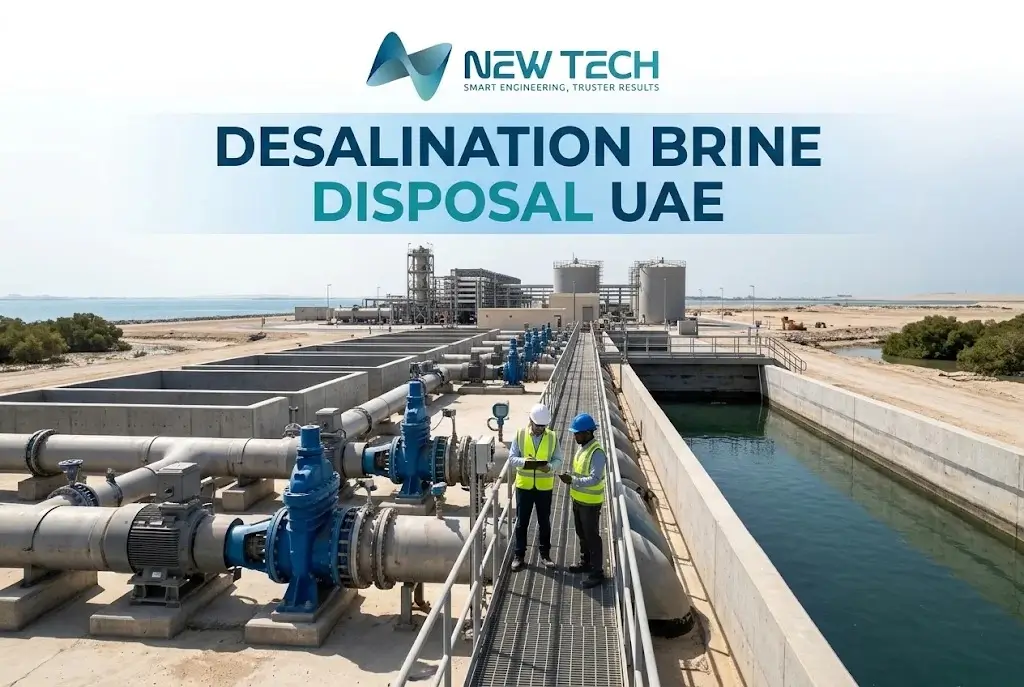
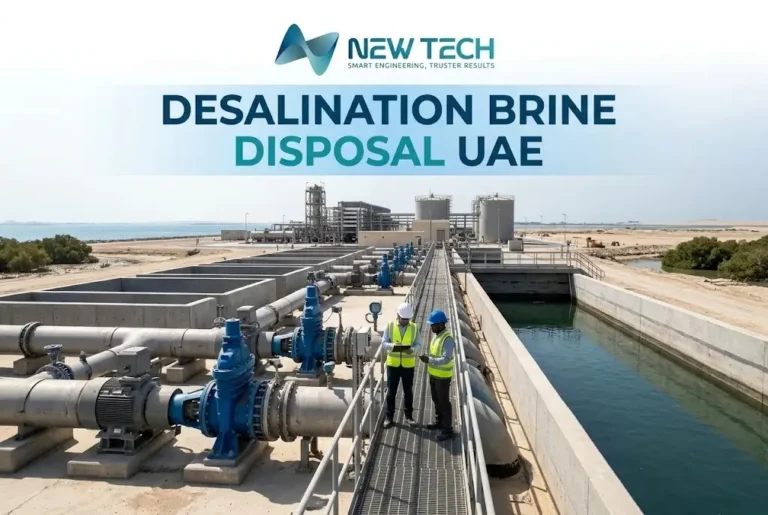
How can UAE desalination plants manage concentrated RO brine without creating environmental or operational problems? Desalination brine disposal UAE projects require careful decisions about concentrate volume, salt loading, environmental permits and lifecycle costs.
This guide compares marine outfalls, engineered evaporation ponds, authorized disposal, brine concentration and Zero Liquid Discharge. Explore practical calculations, coastal versus inland challenges and equipment selection requirements before finalizing your industrial RO system.
Desalination Brine Disposal UAE: Where Can the Concentrate Go?
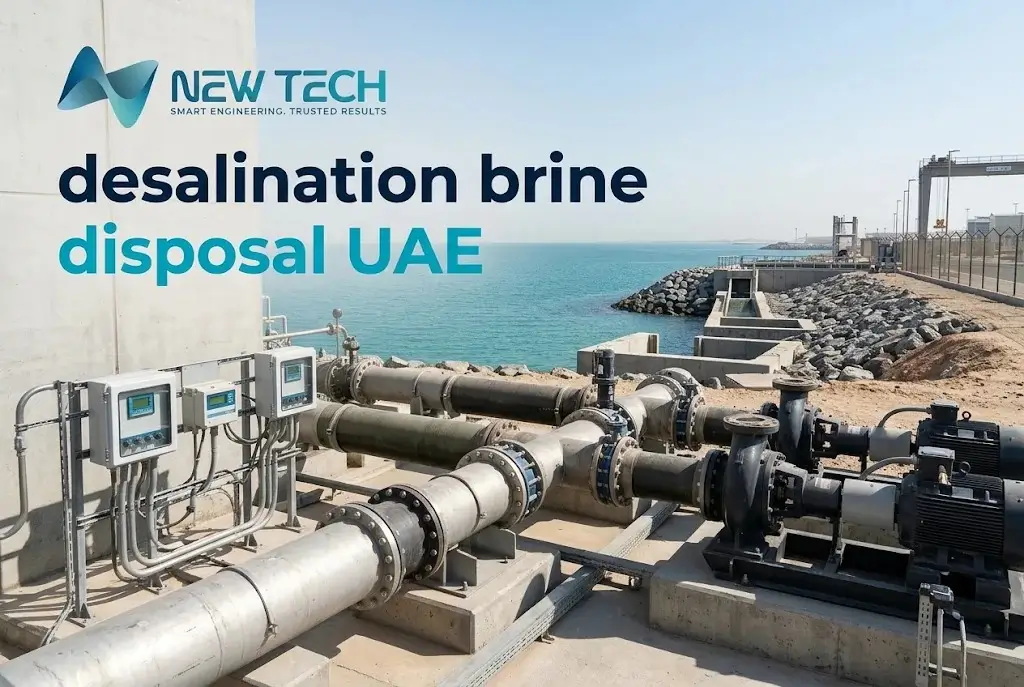
There is no single disposal method suitable for every desalination plant in the UAE. The correct solution depends on whether the facility is coastal or inland, how much concentrate it generates, what substances the brine contains and which management routes are permitted for the specific site.
Desalination brine, also known as RO concentrate or reject water, is the residual liquid produced when a desalination process separates water from dissolved substances. Depending on the feedwater and treatment system, it may contain concentrated salts, scaling constituents and residual process chemicals.
Quick Answer: What Is the Best Brine Disposal Method in the UAE?
Coastal projects may evaluate permitted marine outfalls, while inland facilities may assess authorized off-site handling, engineered evaporation ponds or additional brine concentration. Minimal Liquid Discharge and Zero Liquid Discharge may also be considered when technically and economically justified. None of these options is automatically permitted. Every project requires a suitable environmental and engineering assessment.
For desalination brine disposal UAE facilities, the most important principle is to establish the approved final destination before choosing equipment. A technology that reduces liquid volume still leaves salts or other residual substances that require management.
Five Checks Before Choosing a Brine Disposal Method
| Decision Check | What the Facility Must Confirm |
|---|---|
| 1. Brine Composition | TDS, major ions, chemical constituents and scaling potential. |
| 2. Concentrate Flow | Daily and peak brine volumes under real operating conditions. |
| 3. Regulatory Requirements | Competent authority, applicable permissions and discharge conditions. |
| 4. Final Residual Destination | Approved handling of remaining liquid, salts or treatment waste. |
| 5. Lifecycle Cost | Capital investment, energy, maintenance, monitoring and disposal expenses. |
A preliminary brine strategy should address all five items. Selecting a method based only on its advertised technology or estimated purchase price can lead to unsuitable equipment and additional project costs.
Start with Your Actual RO Concentrate Data. Share the water balance, brine analysis and equipment requirements with New Tech Water.
Request a Free Consultation Now
Get in touch with our experts to help you choose the right water treatment plant for your needs with maximum efficiency and minimum cost.
Decision One: Calculate Your Daily Brine Volume and Salt Load
The first engineering step is to quantify the water and dissolved substances entering and leaving the desalination system. Without a reliable mass balance, it is difficult to estimate storage capacity, residual handling requirements or the feasibility of additional water recovery.
How RO Recovery Determines Concentrate Volume
Recovery (%) = Permeate Flow / Feedwater Flow × 100
Concentrate Flow = Feedwater Flow – Permeate Flow
These relationships apply to a simplified steady-state RO balance. Actual plants may also generate cleaning wastewater, flushing streams and auxiliary treatment losses that require separate accounting.
Worked Example: A Hypothetical Industrial RO Plant
Consider an industrial desalination plant processing 100 m3/day of brackish feedwater at 75% recovery.
| Operating Parameter | Illustrative Value |
|---|---|
| Feedwater Flow | 100 m3/day |
| RO Recovery | 75% |
| Permeate Flow | 75 m3/day |
| Concentrate Flow | 25 m3/day |
| Feedwater TDS | 10,000 mg/L |
| Permeate TDS | 200 mg/L |
Permeate Production = 100 × 0.75 = 75 m3/day
Concentrate Production = 100 – 75 = 25 m3/day
The hypothetical plant therefore produces 25 m3 of concentrate for every 100 m3 of feedwater processed.
Calculate the Approximate Brine Salinity
A simplified dissolved-solids balance can be used to estimate concentrate TDS. This calculation treats TDS as an approximate mass concentration and assumes that no significant salts are added, precipitated or removed through unaccounted streams.
Concentrate TDS = [(Feedwater Flow × Feedwater TDS) – (Permeate Flow × Permeate TDS)] / Concentrate Flow
Concentrate TDS = [(100 × 10,000) – (75 × 200)] / 25
Concentrate TDS = 39,400 mg/L
The resulting concentration is approximately 39.4 g/L under the assumed conditions.
Calculate the Daily Dissolved-Solids Mass
Estimated Dissolved-Solids Load (kg/day) = Flow (m3/day) × TDS (mg/L) / 1,000
Feedwater Load = 100 × 10,000 / 1,000 = 1,000 kg/day
Permeate Load = 75 × 200 / 1,000 = 15 kg/day
Concentrate Load = 25 × 39,400 / 1,000 = 985 kg/day
| Stream | Flow | TDS | Estimated Dissolved-Solids Load |
|---|---|---|---|
| Feedwater | 100 m3/day | 10,000 mg/L | 1,000 kg/day |
| Permeate | 75 m3/day | 200 mg/L | 15 kg/day |
| Concentrate | 25 m3/day | 39,400 mg/L | 985 kg/day |
The simplified balance is internally consistent: 1,000 kg/day entering equals 15 kg/day leaving in permeate plus 985 kg/day leaving in concentrate.
Important Limitation: TDS Is Not a Complete Engineering Model
The calculated concentrate TDS is an educational estimate, not a measured result or a reliable prediction of individual ion concentrations. TDS measurements and estimates have method-dependent limitations, particularly for highly saline mixtures.
Detailed membrane and brine treatment design requires a representative water analysis, including relevant ions such as calcium, magnesium, sodium, chloride, sulfate and silica. Depending on the process, alkalinity, pH, temperature and residual treatment chemicals may also matter.
Predicting mineral precipitation requires appropriate chemical speciation and scaling assessment. A simple TDS mass balance cannot establish whether calcium sulfate, silica or other constituents will exceed their solubility limits.
New Tech Water’s Industrial Water Testing Services UAE guide explains the importance of selecting suitable analytical parameters for industrial water applications.
Define Brine Quantity and Chemistry Before Buying Equipment. Use representative analyses and a complete water balance to establish technical requirements.
Request a Free Consultation Now
Get in touch with our experts to help you choose the right water treatment plant for your needs with maximum efficiency and minimum cost.
Decision Two: Is the Desalination Plant Coastal or Inland?
Plant location influences the practical choices available for concentrate management. A coastal facility may evaluate an engineered marine discharge, while an inland plant can face more demanding transport, containment or concentration requirements.
However, neither location automatically determines which method is acceptable. The actual decision depends on environmental authorization, infrastructure, wastewater chemistry and project economics.
Coastal Desalination Projects
For suitable coastal desalination projects, marine discharge may be considered when the relevant authority permits it and the outfall is appropriately assessed and designed.
Important factors may include ambient seawater salinity, local currents, water depth, diffuser configuration, discharge flow, temperature and the proximity of environmentally sensitive habitats.
The environmental effects of an outfall cannot be reliably predicted from concentrate TDS alone. Receiving-water conditions and near-field mixing can strongly influence local exposure.
Research on desalination brine discharge in the Arabian Gulf has examined how outfall location can affect salinity patterns and regional environmental outcomes.
See the research on brine discharge and Arabian Gulf salinity.
Inland Industrial RO Projects
Inland facilities may lack a suitable marine connection or an authorized liquid waste receiving facility nearby. Concentrate handling can become a significant operating consideration when brine must be stored, transported or further processed.
Uncontrolled discharge to land can present risks to soil and groundwater. These concerns depend on the quantity and chemistry of the brine, local geology, groundwater depth and the effectiveness of containment measures.
What UAE Research Says About Land Disposal
A research publication from the United Arab Emirates University examined potential impacts associated with reject-brine disposal from inland desalination plants in the eastern region of Abu Dhabi.
The study provides useful environmental context for evaluating soil and groundwater risks. However, it is an older scientific investigation from 2005 and must not be presented as evidence of current operating practices or present-day regulatory conditions throughout Abu Dhabi.
Read the UAE University study on inland reject-brine disposal.
Coastal vs Inland Brine Management
| Assessment Factor | Coastal Facility | Inland Facility |
|---|---|---|
| Potential Route | Engineered marine outfall may be considered. | Authorized transport, concentration or engineered containment may be considered. |
| Environmental Focus | Marine salinity, mixing and ecosystem effects. | Soil, groundwater and containment risks. |
| Infrastructure | Outfall systems and marine monitoring. | Storage, transport and residual treatment. |
| Commercial Factors | Marine infrastructure and environmental monitoring costs. | Land, transport and concentrate treatment costs. |
| Approvals | Applicable marine and environmental authorizations. | Applicable waste, land-use and environmental authorizations. |
Evaluate Brine Management Around Your Actual Location. Confirm feasible and authorized routes before selecting a coastal or inland solution.
Request a Free Consultation Now
Get in touch with our experts to help you choose the right water treatment plant for your needs with maximum efficiency and minimum cost.
Decision Three: Compare Brine Disposal and Treatment Options
Brine management technologies can serve different objectives. Some provide a possible disposal route, while others reduce residual volume, recover additional water or produce concentrated solids.
These methods should not be ranked as interchangeable products. The relevant comparison depends on the chemical composition, project location, environmental requirements and ultimate destination of all remaining waste.
Option 1: Engineered Marine Outfall
Marine outfalls may be evaluated for coastal desalination projects where appropriate infrastructure and environmental approvals are available.
Engineering considerations may include diffuser design, ambient seawater conditions, hydraulic capacity, materials, local mixing and monitoring obligations.
The presence of a nearby coastline does not automatically authorize discharge. A project-specific environmental assessment may be necessary, and the competent authority determines the applicable conditions.
Option 2: Engineered Evaporation Ponds
Evaporation ponds reduce liquid volume through evaporation, potentially leaving increasingly concentrated water and salt residues.
Their suitability depends on climate, land availability, evaporation rates, rainfall, pond lining, leak detection, residue handling and environmental permits.
An unlined excavation should never be assumed to be equivalent to an engineered, approved evaporation facility.
Option 3: Authorized Off-Site Handling
Some concentrate streams may be suitable for transport to an approved receiving facility. This route requires confirmation that the waste composition meets the receiving facility’s acceptance conditions and that transport is authorized.
Long transport distances, recurring collection charges and changes in concentrate volume can significantly influence annual operating expenditure.
Option 4: Additional Brine Concentration
Brine concentration processes seek to recover additional water and reduce the quantity of liquid requiring final handling. Depending on the brine composition and required performance, suitable technologies may include specialized membrane processes or thermal concentration.
Water recovery generally increases the concentration of remaining dissolved substances, making scaling control, material selection and residual management important.
Option 5: Minimal Liquid Discharge
Minimal Liquid Discharge, or MLD, aims to substantially reduce the amount of liquid waste remaining after treatment. It does not necessarily eliminate the final liquid concentrate stream.
MLD may be evaluated when substantial water recovery is desirable but a technically suitable and authorized route remains available for the reduced residual volume.
Option 6: Zero Liquid Discharge
Zero Liquid Discharge, or ZLD, is a treatment approach intended to eliminate liquid discharge from a defined process boundary. It commonly involves extensive water recovery and the production of residual solids.
Possible equipment may include specialized concentration processes, thermal evaporators or crystallizers, depending on the brine chemistry and required final condition.
ZLD can reduce the need to discharge a liquid stream, but it is not waste-free. Residual salts and other solids still require appropriate classification, management and disposal or beneficial use.
A 2025 scientific review in Nature Reviews Clean Technology discusses the advantages and limitations of ZLD and MLD, including the relatively high energy demand and cost of many concentration and crystallization systems.
See Brine Management with Zero and Minimal Liquid Discharge.
Option 7: Resource Recovery
Some brine streams may offer opportunities to recover salts or other materials. However, potential recovery should be evaluated against the actual chemistry, separation efficiency, required product purity, energy consumption and market demand.
Recovering a material technically does not necessarily mean it can be sold profitably or used without further treatment.
Compare Brine Management Methods
| Method | Potential Advantage | Primary Challenge |
|---|---|---|
| Marine Outfall | Possible management route for approved coastal projects. | Environmental approval, dispersion and marine monitoring. |
| Engineered Evaporation Pond | Reduces liquid volume through evaporation. | Land, containment, rainfall and salt residue handling. |
| Authorized Off-Site Handling | May avoid on-site concentration equipment. | Receiving approval, transport and recurring charges. |
| Brine Concentration | Reduces residual liquid volume. | Energy, scaling and remaining concentrated waste. |
| MLD | Substantial water recovery with some liquid residual. | Final concentrate still requires management. |
| ZLD | Eliminates liquid discharge within a defined process boundary. | High complexity, capital cost, energy and solid waste. |
| Resource Recovery | Potential useful material recovery. | Purity, process economics and market demand. |
No method should be recommended solely because it has the lowest initial equipment cost or the highest theoretical water recovery. It must also be technically feasible and compatible with applicable environmental conditions.
Compare Brine Management Technologies by Project Requirements. Evaluate residual volume, operating demand and final waste handling before purchasing equipment.
Request a Free Consultation Now
Get in touch with our experts to help you choose the right water treatment plant for your needs with maximum efficiency and minimum cost.
Decision Four: What Environmental Requirements Matter in the UAE?
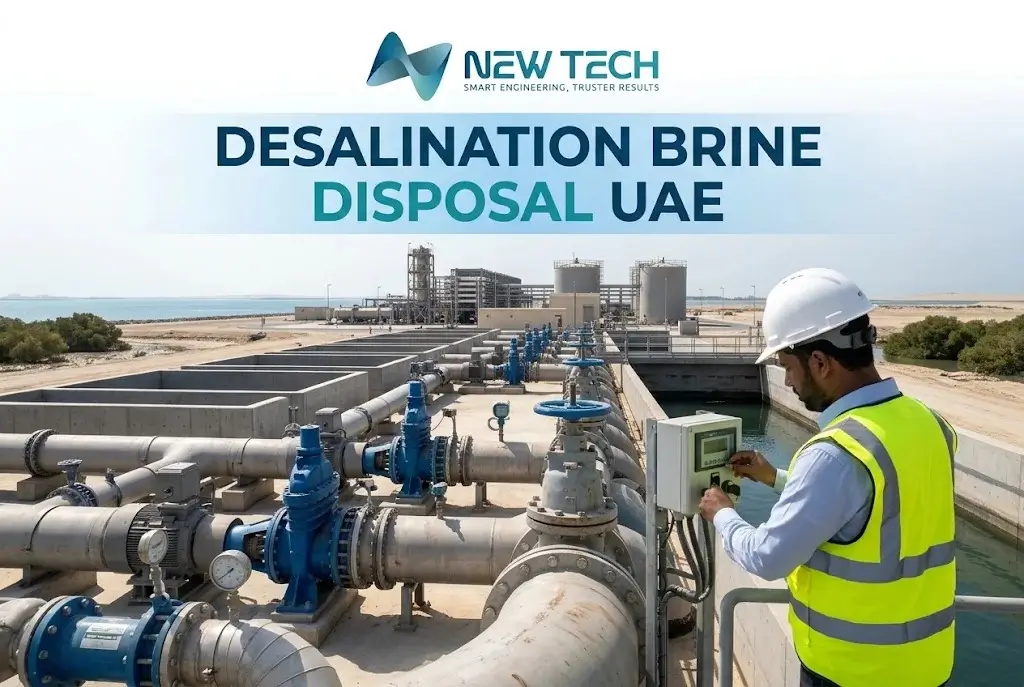
Desalination brine disposal UAE projects require an environmental assessment appropriate to the proposed route and site. Requirements can vary by emirate, receiving environment, industrial zone, facility size and project activity.
There is no single universal brine salinity threshold that should be assumed to authorize every type of disposal across the UAE.
Marine Environmental Protection in Abu Dhabi
Environment Agency – Abu Dhabi has published policies and initiatives addressing marine water quality and pressures from wastewater and desalination-related discharge.
These initiatives highlight the importance of managing marine pollution, assessing environmental effects and protecting sensitive receiving waters.
Consult the Environment Agency – Abu Dhabi marine water quality policy information for environmental context.
A marine policy announcement is not a project-specific discharge permit. Actual permission and conditions must be established through the applicable authorities.
Potential Marine Impacts
Concentrated discharge may alter salinity and density near a marine outlet. Depending on receiving-water conditions, local currents, temperature and outlet configuration, the effects may vary significantly between projects.
Residual treatment chemicals can also be relevant. Appropriate assessment should therefore consider more than a single salinity measurement.
Research published in Frontiers in Marine Science discusses desalination brine characteristics, marine chemistry and potential ecological effects.
See Characteristics of Desalination Brine and Its Impacts on Marine Chemistry and Health.
Potential Inland Environmental Impacts
Inland brine management should address risks to soil and groundwater. Relevant considerations can include site geology, groundwater conditions, storage integrity, seepage control, salt accumulation and residual waste transport.
Engineered containment and monitoring may be necessary depending on the selected route and regulatory requirements.
Practical UAE Project Scenarios
| Illustrative Scenario | Questions the Project Team Must Answer |
|---|---|
| Coastal Desalination Project in Abu Dhabi | Which authority applies, what marine assessment is required and can the intended outfall be authorized? |
| Inland Industrial RO Plant in Dubai | What is the brine composition, and is there an authorized receiving route or suitable concentration alternative? |
| Industrial Facility in Sharjah | Which authority governs the site, and what approved handling or treatment arrangements are available? |
| Facility in a Special Industrial Zone | Do the zone authority and other competent regulators impose additional environmental or technical requirements? |
These examples are planning scenarios, not statements that any particular disposal method is automatically permitted in the named location.
Environmental Assessment Information
- Normal and peak brine flow.
- Representative major-ion and contaminant analysis.
- Proposed receiving environment or residual destination.
- Potential impacts on water, soil and sensitive habitats.
- Temperature and relevant treatment chemicals.
- Containment and leakage controls where applicable.
- Monitoring and reporting requirements.
- Emergency and abnormal-operation procedures.
The competent authority and qualified project specialists should determine the final assessment scope and required permissions.
Verify Environmental Requirements Before Finalizing Disposal. Confirm the correct authority, approved destination and site-specific technical conditions.
Request a Free Consultation Now
Get in touch with our experts to help you choose the right water treatment plant for your needs with maximum efficiency and minimum cost.
Decision Five: Should You Reduce Brine Volume Before Disposal?
Increasing water recovery may reduce concentrate volume, but it also changes the chemical conditions in the residual stream. Lower volume is not automatically equivalent to lower overall operating cost or better membrane performance.
Compare 75% and 85% RO Recovery
Return to our hypothetical plant with 100 m3/day of feedwater. Consider two mathematical recovery scenarios, assuming the same feedwater TDS and a constant permeate TDS for illustration.
| Parameter | 75% Recovery | 85% Recovery |
|---|---|---|
| Feedwater Flow | 100 m3/day | 100 m3/day |
| Permeate Flow | 75 m3/day | 85 m3/day |
| Concentrate Flow | 25 m3/day | 15 m3/day |
| Feedwater TDS | 10,000 mg/L | 10,000 mg/L |
| Assumed Permeate TDS | 200 mg/L | 200 mg/L |
At 75% recovery, concentrate production is 25 m3/day.
At 85% recovery, concentrate production falls to 15 m3/day.
Concentrate Volume Reduction = [(25 – 15) / 25] × 100 = 40%
What Happens to Concentrate TDS?
Using the same simplified dissolved-solids balance:
At 75% Recovery:
Concentrate TDS = [(100 × 10,000) – (75 × 200)] / 25 = 39,400 mg/L
At 85% Recovery:
Concentrate TDS = [(100 × 10,000) – (85 × 200)] / 15 = approximately 65,533 mg/L
| Result | 75% Recovery | 85% Recovery |
|---|---|---|
| Concentrate Volume | 25 m3/day | 15 m3/day |
| Calculated TDS | 39,400 mg/L | 65,533 mg/L |
| Estimated Concentrate Salt Load | 985 kg/day | 983 kg/day |
The higher-recovery case produces less liquid concentrate, but the remaining brine contains a higher estimated dissolved-solids concentration.
Why 85% Recovery Is Not a Design Recommendation
The 85% recovery case is a mathematical scenario, not evidence that this particular RO system can safely achieve such recovery with the assumed feedwater chemistry.
At elevated salinity, osmotic pressure, scaling potential and membrane operating constraints become increasingly important. The actual permeate quality may also change with operating conditions.
Before increasing recovery, a qualified evaluation should assess major-ion chemistry, saturation limits, membrane pressure requirements, pretreatment, concentrate composition and manufacturer operating guidance.
The simplified TDS values cannot determine the feasible maximum recovery or predict the formation of specific mineral scales.
Lower Brine Volume Does Not Mean the Salts Disappear
Under the stated assumptions, approximately 985 kg/day of dissolved solids remain in concentrate at 75% recovery, compared with approximately 983 kg/day at 85% recovery.
The small difference reflects the assumed additional dissolved solids leaving with the higher permeate volume. It is not evidence of significant salt destruction or removal.
Most of the original dissolved-solids load remains to be managed, even when concentrate volume is substantially reduced.
For related RO equipment selection considerations, see New Tech Water’s Industrial RO Plant UAE guide.
Assess RO Recovery Using Water Chemistry, Not Volume Alone. Confirm membrane limits and concentrate characteristics before changing operation or equipment.
Request a Free Consultation Now
Get in touch with our experts to help you choose the right water treatment plant for your needs with maximum efficiency and minimum cost.
Decision Six: What Does Desalination Brine Management Actually Cost?
Brine management cost should be evaluated using consistent production and financial assumptions. The lowest equipment purchase price may not represent the lowest lifecycle expense.
Brine storage, pumping, transportation, concentration, energy use, environmental monitoring and residual waste handling can all affect the total cost.
Separate CAPEX from OPEX
Capital expenditure may include tanks, pumps, instrumentation, piping, civil works, concentration equipment and other assets within the defined project scope.
Operating expenditure may include electricity, chemicals, maintenance, consumables, labour, waste transport, authorized disposal and monitoring.
Do Not Confuse Cost per m3 of Brine with Cost per m3 of Product Water
Brine Management OPEX per m3 Brine = Annual Brine Management OPEX / Annual Brine Volume
Brine Management OPEX per m3 Permeate = Annual Brine Management OPEX / Annual Usable Permeate Production
Both indicators may be useful, but they answer different questions.
Hypothetical Cost Example
Assume a plant produces 25 m3/day of concentrate and 75 m3/day of permeate over 300 operating days annually. Suppose annual expenditure for an authorized brine management arrangement is AED 150,000.
Annual Brine Volume = 25 × 300 = 7,500 m3/year
Annual Permeate Volume = 75 × 300 = 22,500 m3/year
OPEX per m3 Brine = 150,000 / 7,500 = AED 20.00/m3
OPEX per m3 Permeate = 150,000 / 22,500 = approximately AED 6.67/m3
| Cost Indicator | Illustrative Value |
|---|---|
| Annual Brine Managed | 7,500 m3 |
| Annual Permeate Produced | 22,500 m3 |
| Annual Brine Management OPEX | AED 150,000 |
| OPEX per m3 Brine | AED 20.00 |
| OPEX per m3 Permeate | AED 6.67 |
Every amount in this example is hypothetical. These figures are not verified UAE disposal prices, typical tariffs, New Tech Water quotations or guaranteed cost benchmarks.
The calculation excludes capital recovery and any expense not included in the assumed operating total.
Why Lifecycle Cost Matters
A concentration system may reduce transport volume but require more electricity and maintenance. An off-site disposal arrangement may involve limited treatment equipment but substantial recurring transport expenses.
Where alternatives involve different capital investments and operating costs, a discounted lifecycle assessment may provide a stronger comparison than annual OPEX alone.
Expenses That Are Often Overlooked
- Brine storage capacity and secondary containment.
- Corrosion-resistant piping, pumps and materials.
- Transport and approved receiving charges.
- Additional water recovery and evaporation energy.
- Scaling control chemicals and consumables.
- Sampling, laboratory tests and environmental monitoring.
- Salt and sludge handling.
- Replacement equipment and planned maintenance.
- Site-specific engineering and permit-related expenditure.
Cost comparisons should proceed only after the proposed routes are confirmed to be technically feasible and compatible with applicable environmental requirements.
Compare Total Brine Management Costs Before Investing. Request clear operating assumptions, equipment specifications and residual disposal responsibilities.
Request a Free Consultation Now
Get in touch with our experts to help you choose the right water treatment plant for your needs with maximum efficiency and minimum cost.
Decision Seven: Build a Technical RFQ for Brine Management Equipment
A brine management Request for Quotation should provide the supplier with enough technical information to evaluate relevant equipment. Concentrate volume alone is insufficient because brine chemistry and operating conditions can strongly influence suitability.
Brine Management Equipment RFQ
| RFQ Requirement | Information to Provide |
|---|---|
| Facility Location | Emirate, industrial zone and site constraints. |
| Desalination Technology | Seawater RO, brackish-water RO or other process. |
| Feedwater Analysis | Relevant physical and chemical parameters. |
| Brine Analysis | TDS, major ions, scaling constituents and process chemicals. |
| Feedwater Flow | Normal and maximum operating volumes. |
| Permeate Flow | Actual product-water volume and required quality. |
| Concentrate Flow | Daily and peak reject-water generation. |
| Current RO Recovery | Actual operating recovery and relevant constraints. |
| Operating Schedule | Hours per day and operating days per year. |
| Water Temperature | Normal and maximum temperatures. |
| Chemical Dosing | Antiscalants, cleaning chemicals and other relevant additions. |
| Management Objective | Authorized disposal, concentrate reduction or water recovery. |
| Final Residual Destination | Approved liquid or solid waste management arrangements. |
| Environmental Conditions | Applicable permissions and documented site restrictions. |
| Equipment Scope | Required components, instrumentation and accessories. |
| Utilities | Available power, water, space and infrastructure. |
| Commercial Conditions | Delivery requirements, documentation and supply exclusions. |
Why Brine Analysis Matters More Than Capacity Alone
Two RO systems can produce the same concentrate volume but have very different chemical compositions. One stream may create more severe scaling conditions, while another may contain different contaminants requiring separate handling considerations.
Equipment selection should therefore reflect chemical compatibility, pressure, flow, operating temperature and the intended management objective.
Where Chemical Dosing Equipment May Be Relevant
Some membrane and pretreatment applications require controlled chemical dosing. Pump selection should be based on chemical compatibility, dosing rate, discharge pressure and control requirements.
New Tech Water publishes relevant guidance in its Chemical Dosing Pump Supplier UAE article.
Confirm the Available Equipment and Service Scope
New Tech Water provides information about industrial RO systems, industrial water analysis and related treatment equipment. These areas may support assessment of selected components and technical requirements.
However, the availability of complete ZLD plants, crystallizers, engineered evaporation ponds, marine outfall construction or specialized brine disposal services must not be assumed without direct confirmation.
Any proposed quotation should state the available products, specifications, included equipment and service responsibilities.
Request Relevant RO and Treatment Equipment Information from New Tech Water. Send your brine analysis, flow data and required component specifications.
Request a Free Consultation Now
Get in touch with our experts to help you choose the right water treatment plant for your needs with maximum efficiency and minimum cost.
Eight Brine Disposal Mistakes That Increase Environmental and Financial Risks
Brine management problems often begin before the equipment is installed. Unverified assumptions about the final disposal route, concentrate composition or operating costs can lead to expensive project changes.
1. Designing an RO Plant Without a Concentrate Plan
Increasing freshwater production may also increase the quantity of brine requiring management. The residual stream should be included in the initial project assessment.
2. Assuming Coastal Discharge Is Automatically Permitted
Marine discharge depends on environmental authorization, engineering conditions and the receiving environment. Proximity to the sea does not establish permission.
3. Using Uncontrolled Land Disposal
Unlined pits or unapproved soil disposal may create environmental risks. Inland brine management should use appropriately assessed and authorized arrangements.
4. Depending on TDS Alone
Two streams with equal TDS can have different ion compositions, scaling tendencies and contaminants. Major-ion analysis is important when evaluating concentration or disposal processes.
5. Raising RO Recovery Without Engineering Assessment
Higher recovery may increase scaling potential and required operating pressure. A calculated reduction in concentrate volume does not establish that a proposed recovery rate is feasible or safe.
6. Treating ZLD as Having No Waste
ZLD seeks to avoid liquid discharge within a defined treatment boundary, but solids and other residual materials still require suitable management.
7. Comparing Costs with Different Denominators
Cost per cubic meter of concentrate is not the same as cost per cubic meter of usable permeate. Supplier proposals should use consistent definitions and accounting boundaries.
8. Ignoring the Ultimate Residual Destination
Volume reduction concentrates remaining substances. Every treatment strategy should identify where the final liquid or solid residues will be handled.
Reduce Brine Management Project Risks. Confirm concentrate chemistry, authorized handling and equipment limitations before finalizing your investment.
Request a Free Consultation Now
Get in touch with our experts to help you choose the right water treatment plant for your needs with maximum efficiency and minimum cost.
Frequently Asked Questions About Desalination Brine Disposal UAE
What is desalination brine and why does it require management?
Desalination brine is the concentrated residual water left after desalination. It contains dissolved substances separated from the product water and may include relevant process chemicals. Management depends on volume, composition and the applicable environmental conditions.
How is RO brine volume calculated?
For a simplified steady-state water balance, subtract permeate flow from feedwater flow. A plant treating 100 m3/day at 75% recovery would produce approximately 75 m3/day of permeate and 25 m3/day of concentrate.
Can desalination brine be discharged into the sea in the UAE?
Marine discharge may be considered for suitable coastal projects, but it requires verification of applicable environmental approvals and technical conditions. Discharge should not be assumed lawful simply because the plant is near the coast.
Are brine disposal requirements the same across UAE emirates?
No. Applicable requirements can vary by emirate, industrial zone, discharge route, competent authority and project conditions. Facilities must verify the requirements relevant to their own site.
What are the environmental risks of inland brine disposal?
Potential risks include soil salinization and groundwater contamination if concentrated water is inadequately contained. Actual impacts depend on brine chemistry, geology, groundwater conditions and disposal arrangements.
Can an evaporation pond be used for RO concentrate?
An engineered evaporation pond may be considered where the site, climate, containment design and environmental approvals make it feasible. Remaining salts and residual liquids also require an acceptable management plan.
What is Zero Liquid Discharge in desalination?
ZLD is an approach intended to eliminate liquid discharge within a defined treatment system through extensive water recovery and residual concentration. It can require substantial energy and equipment investment, and resulting solids still need appropriate management.
Does increasing RO recovery always reduce brine disposal cost?
No. Increasing recovery may reduce liquid volume but also raise concentrate salinity, scaling risk and equipment demands. A complete cost assessment should consider energy, maintenance and final residual management.
Can useful minerals be recovered from desalination brine?
Selected brine compositions may provide opportunities for recovering salts or other materials. Commercial feasibility depends on composition, separation technology, product purity, energy costs and market demand.
What information should a factory provide for brine management equipment selection?
Provide feedwater and concentrate analyses, normal and peak flows, RO recovery, operating schedule, project location, management objective, relevant permissions and the required equipment scope.
Need Industrial RO Equipment Information? Share Your Brine Analysis and Technical Requirements with New Tech Water.
Request a Free Consultation Now
Get in touch with our experts to help you choose the right water treatment plant for your needs with maximum efficiency and minimum cost.
Choose a Brine Management Route Before Finalizing Your RO System
Desalination brine disposal UAE decisions require accurate water balances, representative chemistry, approved management routes and realistic lifecycle costs. Coastal outfalls, engineered evaporation, additional concentration and ZLD each involve different constraints. The correct approach begins by confirming the final residual destination and the technical requirements.
New Tech Water publishes information about industrial RO and related treatment equipment. Share your project specifications to discuss suitable available components and request a quotation.
Contact New Tech Water Today to Discuss Industrial RO Equipment and Request a Specification-Based Quote.
Request a Free Consultation Now
Get in touch with our experts to help you choose the right water treatment plant for your needs with maximum efficiency and minimum cost.

 English
 Arabic