
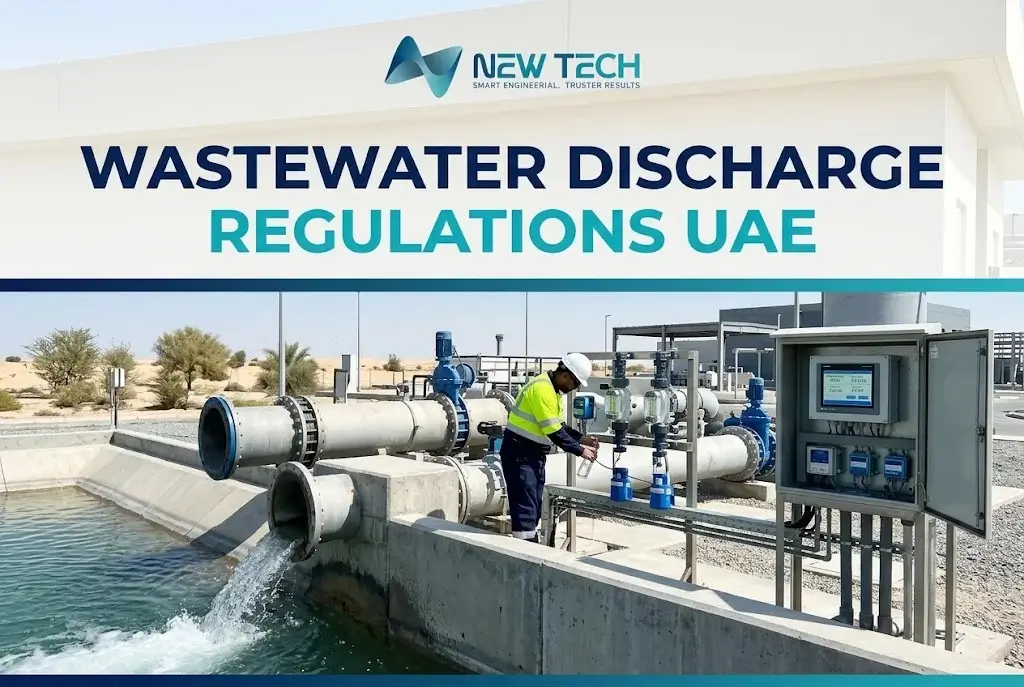
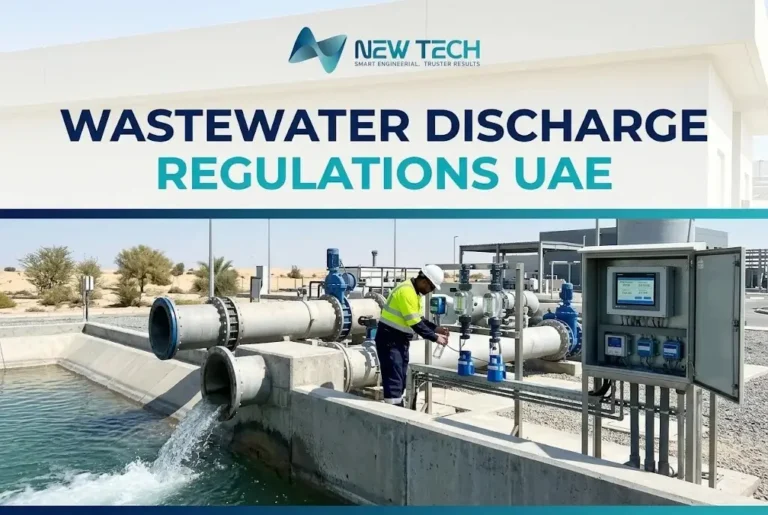
Can your factory discharge industrial wastewater legally in Dubai, Abu Dhabi or Sharjah? Understanding wastewater discharge regulations UAE starts with identifying the discharge destination, responsible authority and applicable permit conditions. Public sewers, marine outlets and wastewater reuse follow different requirements.
This practical guide explains trade effluent consent, testing parameters, COD calculations and pretreatment decisions so industrial facilities can prepare for compliance and select suitable wastewater treatment equipment.
Wastewater Discharge Regulations UAE: Can Your Facility Discharge Legally?
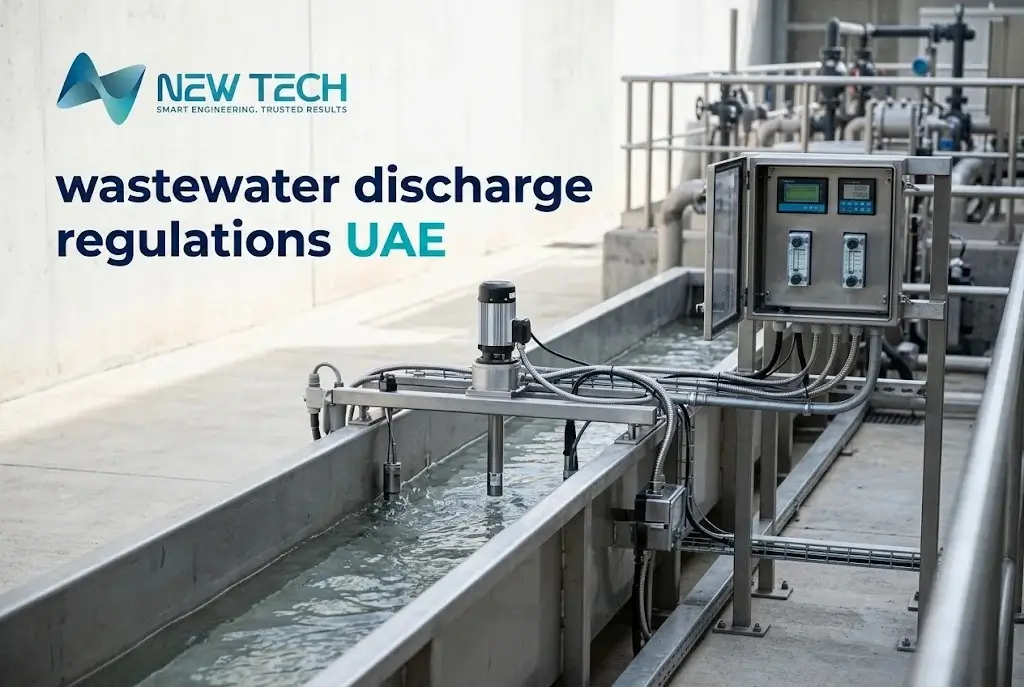
The first question an industrial facility should ask is not which treatment plant to buy. It is whether the proposed wastewater discharge route is permitted and what conditions apply. Wastewater discharge regulations UAE businesses must consider can differ by emirate, industrial zone, receiving network and type of wastewater.
Industrial wastewater may contain chemicals, suspended solids, oils, organic pollutants, dissolved salts or other substances generated during manufacturing, equipment cleaning and production activities. The relevant requirements depend on the wastewater composition and where it will be discharged.
A laboratory result showing that water meets a particular concentration target does not automatically provide legal authorization to discharge it. Facilities must also verify the applicable approvals, permitted connection points, monitoring obligations and conditions established by the competent authority.
Three Questions That Determine Your Next Step
- Where will the wastewater be discharged, transported or reused?
- Which authority or licensed operator controls that destination?
- What consent, testing, monitoring and treatment conditions apply?
These questions establish the foundation for selecting pretreatment equipment and preparing an appropriate technical quotation.
Check Your Wastewater Discharge Requirements. Define the receiving system and applicable conditions before choosing treatment equipment.
Request a Free Consultation Now
Get in touch with our experts to help you choose the right water treatment plant for your needs with maximum efficiency and minimum cost.
Start with the Discharge Destination, Not the Treatment Technology
A common mistake is choosing a treatment process before identifying the approved wastewater destination. Public sewer networks, tanker collection facilities, industrial reuse applications and marine outlets can have different acceptance conditions.
A treatment system suitable for one destination may not satisfy another destination’s requirements, even when the wastewater comes from the same factory.
Wastewater Discharge Decision Table
| Discharge Destination | First Requirement to Verify | Important Technical Consideration |
|---|---|---|
| Public Sewer Network | Applicable consent and sewer acceptance conditions. | Pollutant concentration, flow and network compatibility. |
| Approved Tanker Collection | Authorized transporter and receiving facility. | Waste characterization, containment and tracking. |
| Industrial Water Reuse | Approval and water quality specification for the intended reuse. | Application-specific chemical and microbial quality. |
| Marine Discharge | Applicable environmental permits and discharge conditions. | Receiving environment, effluent quality and discharge design. |
| Stormwater Drainage | Whether the proposed discharge is legally authorized. | Separation of industrial effluent from stormwater systems. |
| Sludge or Concentrate Disposal | Waste classification and approved disposal route. | Residual composition, storage and transport. |
Discharging to a Public Sewer
Public sewerage systems may impose restrictions on industrial pollutants, discharge flow and substances that could damage the network or interfere with downstream treatment. Approval conditions must be confirmed with the relevant authority or licensed collection operator.
Using an Authorized Wastewater Tanker
Off-site tanker collection may be considered where the relevant authority permits this route and the receiving facility is authorized to accept the waste. The factory should confirm the waste classification, transporter authorization and disposal documentation.
Using a tanker does not automatically eliminate wastewater compliance obligations.
Reusing Treated Industrial Wastewater
Wastewater reuse requires a defined application, appropriate treatment and any applicable approvals. Water suitable for one non-potable industrial application may not be suitable for product contact, drinking or other sensitive uses.
Discharging to the Marine Environment
Marine discharge requires evaluation under the relevant environmental framework and project-specific permits. Public sewer acceptance conditions should not be substituted for marine discharge requirements.
Stormwater Drainage Is Not an Alternative Sewer
Dubai Local Order No. 8 of 2002, Article 26, prohibits wastewater discharge into the rainwater drainage network within its scope. Facilities should never assume that industrial wastewater can be directed into a stormwater connection without the appropriate legal basis.
See the official Dubai sewerage and drainage legislation.
Confirm Your Approved Wastewater Discharge Route. Match the treatment objective to the receiving network and its acceptance requirements.
Request a Free Consultation Now
Get in touch with our experts to help you choose the right water treatment plant for your needs with maximum efficiency and minimum cost.
Dubai, Abu Dhabi and Sharjah: Which Wastewater Rules Apply?
Wastewater discharge regulations UAE industrial operators encounter should be evaluated according to the facility’s specific location. Published legal frameworks in Dubai and Abu Dhabi provide important guidance, while sites in other emirates or special industrial zones may be subject to different competent authorities.
Dubai: Industrial Effluent and Public Sewerage
Dubai Local Order No. 8 of 2002 addresses sewerage, irrigation and water drainage. Article 8 states that industrial wastewater may not be discharged into the public sewerage network unless the competent department verifies compliance with the requirements and standards prescribed for that purpose.
Article 6 also addresses written approval for establishing wastewater treatment plants, together with testing and approval requirements for the use of treated water or sludge.
The legislation includes provisions addressing grease traps and oil separation for specified activities, which can be relevant to selected food-related, oil-processing and vehicle-washing operations.
Important: Dubai’s 2002 Order Has Later Amendments
The original order should not be treated as the entire current regulatory framework. Dubai Municipality also lists Local Order No. 3 of 2005 and Order No. 2 of 2006 as amendments to Local Order No. 8 of 2002.
The 2006 amendment addresses a charge relating to treated sewage water used for private irrigation. It should not be interpreted as replacing the original industrial wastewater discharge requirements.
Additional administrative resolutions and later legislation may also be relevant to particular wastewater, waste management or reuse activities.
For the published instruments, consult the Dubai Municipality Waste and Sewerage Agency legislation directory.
Industrial operators should verify current implementing requirements, relevant amendments and site-specific approvals before designing a wastewater discharge arrangement.
Abu Dhabi: Trade Effluent Control Regulations 2022
The Abu Dhabi Department of Energy issued the Trade Effluent Control Regulations 2022, effective from 1 January 2022. The framework addresses trade effluent entering regulated sewerage systems.
Under Section 5.1, entities subject to the regulations must obtain the relevant consent before discharging trade effluent into a sewerage system. Consent is handled through the applicable Collection Licensee.
The regulations also address restricted parameters, consent conditions, monitoring, sampling, inspections and related responsibilities.
See the Abu Dhabi Trade Effluent Control Regulations 2022.
Sharjah: Confirm the Relevant Local Authority
Factories operating in Sharjah should identify the authority or network operator responsible for their site and receiving system. Applicable acceptance conditions, approvals and testing requirements should be obtained directly for the proposed discharge activity.
Limits published for Dubai or Abu Dhabi must not automatically be applied to industrial facilities in Sharjah.
Special Industrial Zones
Certain industrial zones can operate under additional environmental and technical requirements administered by their responsible authorities. Facilities should confirm the rules applicable to their exact location, including any additional monitoring, connection or discharge controls.
| Location | Relevant Framework | Action for the Facility |
|---|---|---|
| Dubai | Local Order No. 8 of 2002 and applicable amendments. | Confirm the competent authority and current discharge conditions. |
| Abu Dhabi | Trade Effluent Control Regulations 2022. | Verify consent requirements with the Collection Licensee. |
| Sharjah | Applicable local and site-specific requirements. | Confirm the receiving operator and permit conditions. |
| Special Zones | Relevant zone authority requirements. | Verify any additional approvals and technical conditions. |
Identify the Authority Responsible for Your Facility. Verify the current wastewater discharge framework before specifying equipment.
Request a Free Consultation Now
Get in touch with our experts to help you choose the right water treatment plant for your needs with maximum efficiency and minimum cost.
Trade Effluent Consent: What Documents Should You Prepare?
Obtaining wastewater discharge approval may require documents describing the industrial activity, wastewater composition, drainage arrangement and any existing or proposed treatment system.
The exact requirements depend on the authority. However, TAQA Water Solutions provides a practical example through its published service for approval of non-domestic wastewater discharge in its service area.
TAQA Water Solutions Trade Effluent Approval
The published service addresses non-domestic wastewater discharge from facilities including factories, commercial entities, hospitals and laboratories, subject to the scope and exceptions described by the provider.
Documents identified on the service page include:
- A completed application for trade effluent discharge consent.
- A valid industrial or commercial licence.
- Recent water bills covering the period specified by the service.
- Drainage layout drawings and connection points.
- A process flow diagram describing industrial operations.
- A process flow diagram for an existing pretreatment unit, where applicable.
- Safety Data Sheets for relevant liquid chemicals.
- A trade effluent analysis report meeting the service requirements.
Applications are described as being submitted through the TAMM platform, with inspection where required and an electronic consent decision.
See the TAQA Water Solutions Trade Effluent Approval Service.
What About Low-Risk Activities?
TAQA Water Solutions identifies certain predefined low-risk categories, such as restaurants, cafes, laundries and car wash centers, as exceptions to the scope of this particular approval service.
This must not be interpreted as a blanket exemption from wastewater management, drainage, environmental or other applicable obligations. Such facilities should confirm the correct approval route and requirements for their activities with the responsible authority.
Similarly, the service’s published document list should not be presented as a mandatory application checklist for every industrial facility across the UAE.
Why Process and Drainage Diagrams Matter
A process diagram identifies where wastewater originates, while a drainage layout shows how it moves through the facility and where it reaches the proposed receiving network.
These documents help clarify whether different wastewater streams should be managed separately and which treatment equipment may be needed before discharge.
Why Wastewater Analysis Is Required
Wastewater testing identifies relevant pollutants and helps determine whether the stream meets the applicable discharge conditions. Results must be interpreted using the correct sampling point, analytical method and specification.
For technical background on industrial testing, read New Tech Water’s Industrial Water Testing Services UAE guide.
Prepare Your Trade Effluent Application. Organize the required diagrams, wastewater analysis and facility documents for the appropriate authority.
Request a Free Consultation Now
Get in touch with our experts to help you choose the right water treatment plant for your needs with maximum efficiency and minimum cost.
Which Wastewater Parameters Should Industrial Facilities Test?
Industrial wastewater testing should reflect the contaminants generated by the factory and the requirements of the receiving authority. A general testing panel may provide useful initial information, but the final analytical scope should be selected according to the actual process.
Common Industrial Wastewater Parameters
| Parameter | Why It Matters | Common Consideration |
|---|---|---|
| pH | Corrosion and chemical compatibility. | Acidic or alkaline wastewater. |
| COD | Oxidizable pollutant loading. | Organic and other oxidizable substances. |
| BOD | Biochemical oxygen demand. | Selected biodegradable pollutants. |
| TSS | Suspended solids loading. | Manufacturing and washing residues. |
| Oil and Grease | Blockage and treatment interference. | Food, mechanical and oily processes. |
| Temperature | Network and treatment compatibility. | Hot process streams. |
| Conductivity and TDS | Dissolved mineral content. | Saline wastewater and concentrates. |
| Selected Metals | Potential toxicity and treatment effects. | Metal processing and chemical operations. |
| Ammonia and Nutrients | Biological and nutrient loading. | Selected industrial waste streams. |
| Process-Specific Chemicals | Additional discharge and safety concerns. | Specialized industrial production. |
COD and BOD Are Not the Same Measurement
COD represents the oxygen equivalent associated with substances oxidized by the specified chemical method. BOD represents oxygen consumption during a defined biological laboratory test.
Both can support wastewater characterization, but neither alone determines whether a particular biological treatment system will perform reliably.
Why Specific Metals May Need Testing
Conductivity or TDS cannot identify the amount of each potentially regulated metal. Where industrial processes involve metals or specific chemical substances, targeted laboratory analysis may be required.
Are Discharge Limits Identical Across the UAE?
No single wastewater concentration table should be assumed to apply across all emirates and discharge destinations. Required limits can be established by relevant legislation, consent conditions and receiving-network specifications.
Before relying on a numerical value, confirm its source, jurisdiction, parameter definition, testing method and application.
Identify the Tests Required for Your Effluent. Use representative wastewater analysis and the correct acceptance conditions to plan treatment.
Request a Free Consultation Now
Get in touch with our experts to help you choose the right water treatment plant for your needs with maximum efficiency and minimum cost.
Failed Wastewater Test: A Practical COD Compliance Example
A failed wastewater test can indicate that a factory needs to investigate the cause of contamination, assess treatment performance or review its discharge arrangements. The required response depends on the applicable consent and regulatory conditions.
The following case study demonstrates how pollutant concentration and mass loading can support a preliminary treatment assessment. All values are hypothetical and do not represent general UAE legal discharge limits.
Case Study: Industrial Wastewater with Elevated COD
| Parameter | Illustrative Value |
|---|---|
| Daily Wastewater Flow | 50 m3/day |
| Measured Influent COD | 1,200 mg/L |
| Hypothetical Acceptance Criterion | 500 mg/L |
| Required Concentration Reduction | 58.3% |
Step 1: Calculate the Required COD Reduction
Required COD Reduction (%) = [(Influent COD – Target COD) / Influent COD] × 100
Required COD Reduction = [(1,200 – 500) / 1,200] × 100
Required COD Reduction = 58.3% approximately
Step 2: Calculate the Incoming COD Mass Load
COD Load (kg/day) = Wastewater Flow (m3/day) × COD Concentration (mg/L) / 1,000
Influent COD Load = 50 × 1,200 / 1,000 = 60 kg COD/day
Step 3: Calculate the Target Effluent COD Mass Load
For this simplified example, assume treated-water flow remains 50 m3/day.
Target Effluent COD Load = 50 × 500 / 1,000 = 25 kg COD/day
Required COD Mass Reduction = 60 – 25 = 35 kg COD/day
Summary of the COD Calculation
| Calculation | Illustrative Result |
|---|---|
| Incoming COD Concentration | 1,200 mg/L |
| Target COD Concentration | 500 mg/L |
| Incoming COD Load | 60 kg/day |
| Target COD Load | 25 kg/day |
| Required Mass Reduction | 35 kg/day |
| Required Concentration Reduction | 58.3% |
Why the Flow Assumption Matters
The calculated target COD load of 25 kg/day assumes the treated effluent flow remains at 50 m3/day. Actual treatment may involve sludge removal, evaporation, additional streams or other changes in water balance.
Where the final effluent flow differs, the mass loading must be recalculated using the actual flow and concentration. Concentration reduction and mass-load reduction are related but should not automatically be treated as identical under changing hydraulic conditions.
Why COD Alone Cannot Determine the Treatment Technology
The calculations establish a preliminary removal objective, not the design of a complete treatment plant.
Further evaluation may require BOD, suspended solids, pH, salinity, nutrient availability, possible inhibitory substances, peak hydraulic flow and wastewater treatability.
A high COD value does not automatically demonstrate that the wastewater can be treated biologically. Treatment feasibility depends on the pollutant composition and actual operating conditions.
What Should a Factory Do After a Failed Test?
- Confirm the sample identity, method and laboratory result.
- Compare the result with the correct current permit or consent condition.
- Follow applicable notification and operational response requirements.
- Investigate possible changes in wastewater generation.
- Assess whether process adjustment or additional treatment is necessary.
- Verify corrective measures through suitable testing.
- Keep records and obtain any required approval before changing discharge arrangements.
If the discharge is unauthorized or outside the applicable conditions, the facility should follow its approved containment and compliance procedures. Treatment equipment should not be selected or operated as a substitute for regulatory authorization.
Assess Your Wastewater Pretreatment Needs. Share flow, pollutant concentrations and the required outlet specification with New Tech Water.
Request a Free Consultation Now
Get in touch with our experts to help you choose the right water treatment plant for your needs with maximum efficiency and minimum cost.
Match Wastewater Pollutants to the Appropriate Treatment Process
Industrial wastewater treatment should be selected by the actual pollutants present. A single process may address a particular contaminant but remain ineffective for other substances in the same water stream.
The objective is to evaluate a treatment process that can reliably meet the applicable outlet specification under realistic operating conditions.
Pollutant-to-Treatment Comparison
| Wastewater Problem | Technology to Evaluate | Important Limitation |
|---|---|---|
| High Suspended Solids | Screening, settling or suitable filtration. | Does not necessarily remove dissolved pollutants. |
| Oil and Grease | Appropriate separation or flotation. | Performance depends on oil characteristics. |
| Biodegradable Organic Loading | Suitable biological treatment. | Requires compatible wastewater and operating conditions. |
| Selected Dissolved Metals | Appropriate physicochemical treatment. | Depends on metal form, pH and residual management. |
| Acidic or Alkaline Wastewater | Engineered neutralization. | Requires chemical control and safe handling. |
| Selected Dissolved Salts | Suitable membrane or specialized treatment. | May create concentrated residual waste. |
| Variable Flow and Loading | Equalization and suitable process control. | Requires actual flow and storage data. |
| Multiple Pollutants | Combined treatment processes. | Requires an integrated technical design. |
When Does Biological Treatment Make Sense?
Biological treatment may be appropriate for certain biodegradable wastewater streams. However, salinity, toxic chemicals, nutrient limitations or extreme operating conditions may inhibit microorganisms.
Treatability testing and qualified process design may be required before selecting biological equipment.
Why Equalization Can Be Important
Batch manufacturing and cleaning operations may generate short periods of high wastewater flow or contaminant loading. Equalization can help manage these variations where appropriate, but its size and operation must be based on actual flow and wastewater characteristics.
Chemical Treatment and Dosing Equipment
Certain treatment processes require controlled chemical injection for pH adjustment, coagulation or other defined applications. Chemical dosing equipment should be selected according to the required injection rate, chemical compatibility, operating pressure and controls.
New Tech Water provides equipment selection information in its Chemical Dosing Pump Supplier UAE guide.
Industrial Wastewater Treatment Equipment
New Tech Water also publishes an overview of treatment equipment considerations in its Wastewater Treatment Plant Supplier UAE guide.
The correct treatment arrangement should be evaluated against the wastewater characteristics and required outlet quality. Product availability, installation, engineering services and full project scope should be confirmed directly rather than assumed.
Compare Wastewater Treatment Equipment by Pollutant Type. Request technical information based on your actual wastewater analysis.
Request a Free Consultation Now
Get in touch with our experts to help you choose the right water treatment plant for your needs with maximum efficiency and minimum cost.
Sampling, Monitoring and Wastewater Discharge Documentation
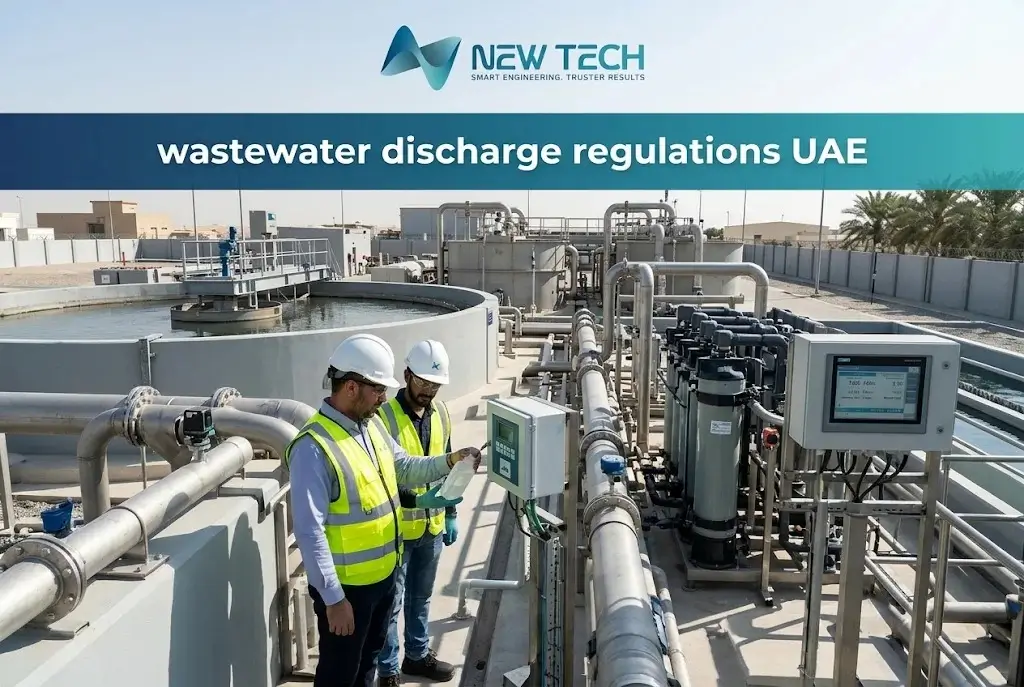
Wastewater compliance requires representative sampling and reliable records. The correct monitoring approach depends on the wastewater source, variability of the process and requirements established by the responsible authority.
Select the Correct Sampling Location
Samples should be taken at the point required by the relevant permit or monitoring program. This may be upstream of treatment, downstream of treatment or at the approved final discharge point.
A sample collected from a temporary tank does not necessarily represent the water discharged into the receiving network.
Grab Samples and Composite Samples
A grab sample represents the water collected at a particular time. A composite sample can represent conditions over a defined sampling period when collected and prepared using an appropriate method.
The suitable sampling method depends on the parameter, wastewater variability and applicable requirements. Some parameters require immediate or specialized measurement.
Laboratory Quality and Testing Methods
Accurate analysis depends on sample preservation, timing, analytical methods and laboratory competence. Facilities should verify any required laboratory accreditation, testing scope or reporting format specified by the responsible authority.
Records to Maintain
| Record | Purpose |
|---|---|
| Wastewater Source | Identifies the process generating the wastewater. |
| Sampling Location | Establishes where the sample was collected. |
| Sampling Date and Conditions | Provides operational context. |
| Laboratory Results | Documents measured pollutant concentrations. |
| Acceptance Requirements | Identifies applicable limits and conditions. |
| Discharge Flow | Supports hydraulic and mass-loading assessment. |
| Treatment Records | Supports equipment performance evaluation. |
| Corrective Actions | Documents responses to deviations. |
| Consent and Permit Documents | Provides evidence of relevant authorizations. |
| Waste Transfer Documentation | Supports traceability of off-site waste handling. |
How Frequently Should Wastewater Be Tested?
Testing frequency depends on the applicable discharge conditions, industrial activities, wastewater variability and any monitoring requirements in the facility’s permit or consent.
Some parameters may require online monitoring, while others can be analyzed at defined intervals. A single laboratory report should not automatically be considered sufficient for all wastewater compliance responsibilities.
Improve Wastewater Monitoring Records. Define the correct sampling points, analytical methods and documentation requirements.
Request a Free Consultation Now
Get in touch with our experts to help you choose the right water treatment plant for your needs with maximum efficiency and minimum cost.
Common Wastewater Compliance Mistakes to Avoid
Factories can encounter compliance problems even after installing treatment equipment. Many issues arise from misunderstanding the approved discharge route, relying on incomplete testing or assuming technical treatment performance replaces regulatory authorization.
Mistake 1: Using the Wrong Discharge Destination
Public sewers, stormwater drains, tanker collection and marine outlets are not interchangeable. The facility must confirm its permitted destination and relevant conditions.
Mistake 2: Treating a Laboratory Result as Authorization
A water analysis report describes measured characteristics. It does not grant permission to discharge wastewater.
Mistake 3: Diluting Wastewater Instead of Addressing Pollution
Dilution solely to reduce measured pollutant concentrations may conceal the actual contaminant load and may conflict with applicable rules or permit conditions.
Facilities should not assume that mixing contaminated wastewater with cleaner water is an acceptable substitute for authorized treatment or process control. Applicable restrictions should be verified with the competent authority.
Mistake 4: Ignoring Peak Wastewater Loads
Daily average flow may conceal short periods of high discharge from batch production, equipment cleaning or plant shutdown. Treatment equipment should be assessed using the relevant hydraulic and pollutant-loading patterns.
Mistake 5: Relying on Outdated Regulations
Legal frameworks, technical requirements and consent conditions may change. The current applicable rules and amendments should be confirmed before finalizing the treatment design.
Mistake 6: Forgetting Sludge and Concentrate
Wastewater treatment may produce residual sludge, concentrate, spent media or chemical waste. These streams can require separate handling, classification and approved disposal arrangements.
Mistake 7: Assuming Installed Equipment Guarantees Compliance
Real compliance depends on operating performance, sampling, maintenance, approvals and meeting the relevant discharge conditions. Equipment installation alone does not satisfy every legal or technical obligation.
Avoid Wastewater Compliance Mistakes. Evaluate the permitted discharge route, actual pollutant loading and treatment requirements before investing.
Request a Free Consultation Now
Get in touch with our experts to help you choose the right water treatment plant for your needs with maximum efficiency and minimum cost.
Technical RFQ for Wastewater Treatment Equipment
After identifying the discharge requirements and wastewater characteristics, the facility can prepare a technical Request for Quotation. A well-defined RFQ helps suppliers evaluate appropriate equipment without assuming that a particular technology will solve every wastewater problem.
Wastewater Treatment RFQ Checklist
| RFQ Item | Information Required |
|---|---|
| Facility Location | Emirate, industrial zone and site details. |
| Industrial Activity | Processes generating the wastewater. |
| Receiving Destination | Approved sewer, collection, reuse or other discharge route. |
| Permit or Consent | Applicable acceptance requirements and conditions. |
| Average Flow | Expected m3/day. |
| Peak Flow | Maximum hourly or batch discharge. |
| Operating Schedule | Production and wastewater generation periods. |
| Wastewater Analysis | Representative laboratory results. |
| Pollutant Loading | Relevant mass loads and concentration data. |
| Target Effluent Quality | Required outlet parameters and conditions. |
| Existing Treatment | Installed equipment and available performance data. |
| Utilities | Power, pressure, drainage and space. |
| Residual Waste | Sludge, concentrate and disposal requirements. |
| Monitoring | Instruments, sampling and recordkeeping needs. |
| Supply Scope | Equipment, accessories and requested services. |
| Commercial Terms | Delivery location, documentation and quotation conditions. |
What Should Be Included in a Technical Proposal?
A suitable proposal should describe the assumed wastewater conditions, proposed equipment, hydraulic capacity, expected treatment performance, utilities and required maintenance.
Any exclusions, consumables, residual handling responsibilities or site work should be identified clearly.
Equipment Supply Is Not Regulatory Approval
Suppliers may provide technical documentation and equipment quotations, but official discharge authorization remains the responsibility of the competent regulatory or collection authority.
New Tech Water provides information about industrial treatment technologies and related equipment. Buyers should confirm actual available products and project scope directly.
Request a Technical Wastewater Treatment Quotation. Share your analysis, flow requirements and target effluent quality with New Tech Water.
Request a Free Consultation Now
Get in touch with our experts to help you choose the right water treatment plant for your needs with maximum efficiency and minimum cost.
Frequently Asked Questions About Wastewater Discharge Regulations UAE
What are the wastewater discharge regulations in the UAE?
Wastewater discharge regulations UAE facilities must consider depend on the emirate, receiving destination, industrial activity and applicable permit conditions. Operators should verify the relevant authority, required approvals, analytical limits and monitoring obligations.
Do factories need a wastewater discharge permit in Dubai?
Industrial discharge to Dubai’s public sewerage network is subject to the applicable requirements of the competent department under the relevant legal framework. Facilities should confirm the current consent or approval conditions for their location and discharge activity.
What is a Trade Effluent Consent in Abu Dhabi?
A Trade Effluent Consent is an authorization required under the applicable Abu Dhabi framework for relevant trade effluent entering a sewerage system. The consent is administered through the responsible Collection Licensee.
Are wastewater discharge limits identical across the UAE?
No. Conditions can differ between emirates, receiving systems, industrial activities and individual consents. A numerical limit published for one location should not be treated as a universal UAE requirement.
Which parameters should industrial facilities test?
Depending on the wastewater source, testing may include pH, COD, BOD, TSS, oil and grease, temperature, metals, nutrients and process-specific chemicals. The final scope should match the applicable discharge conditions.
Can industrial wastewater be discharged into stormwater drains?
Industrial operators should not assume stormwater drains are authorized wastewater outlets. Dubai Local Order No. 8 of 2002 prohibits wastewater discharge into the rainwater drainage network within its scope. Site-specific requirements must be checked elsewhere.
Can a factory dilute wastewater to meet discharge limits?
Dilution should not be assumed to be an acceptable substitute for pollution control or appropriate treatment. The facility must follow its applicable permit conditions and any relevant restrictions on dilution.
What happens if wastewater fails a compliance test?
The facility should verify the result, follow applicable notification and response requirements, investigate the cause and implement authorized corrective measures. Continued discharge must comply with the relevant consent and conditions.
Does installing a wastewater treatment plant guarantee compliance?
No. Compliance also depends on actual effluent quality, operating conditions, approved discharge arrangements, testing, documentation and any required official authorization.
What information is needed for a wastewater treatment equipment quotation?
Provide the wastewater analysis, average and peak flows, industrial process description, receiving destination, target outlet quality, site utilities and required equipment scope.
Need Industrial Wastewater Treatment Equipment? Send Your Technical Requirements to New Tech Water and Request Product Information.
Request a Free Consultation Now
Get in touch with our experts to help you choose the right water treatment plant for your needs with maximum efficiency and minimum cost.
Before You Discharge: Final Compliance Checklist
Understanding wastewater discharge regulations UAE means verifying more than pollutant concentrations. Before releasing industrial wastewater, confirm the competent authority, approved destination, applicable consent, current analysis and monitoring requirements.
Five Final Checks Before Industrial Wastewater Discharge
- Confirm the authority and approved wastewater destination.
- Verify the applicable consent, permit and conditions.
- Review representative wastewater analysis against the correct requirements.
- Confirm the approved discharge connection and treatment performance.
- Maintain the required sampling, monitoring and compliance records.
New Tech Water publishes industrial water treatment equipment information relevant to selected applications. Share your wastewater characteristics, required treatment capacity and outlet specification to discuss suitable available products and request a technical quotation.
Contact New Tech Water Today to Discuss Wastewater Treatment Equipment and Request a Specification-Based Quote.
Request a Free Consultation Now
Get in touch with our experts to help you choose the right water treatment plant for your needs with maximum efficiency and minimum cost.

 English
 Arabic