
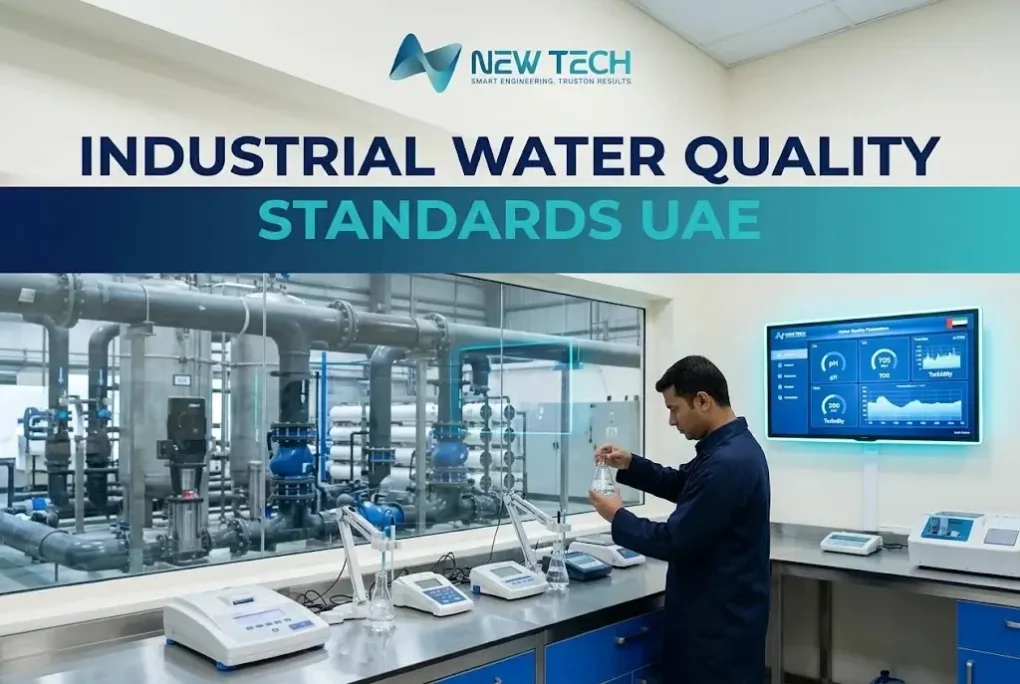
What are the industrial water quality standards UAE factories must consider? The answer depends on the water’s application, equipment specifications and whether it will be used, discharged or recycled. Boiler feedwater, cooling water, reverse osmosis and manufacturing processes do not share one universal quality limit.
This guide explains testing parameters, UAE regulatory frameworks and treatment technologies, helping industrial operators identify the correct requirements and prepare informed equipment enquiries with New Tech Water.
Industrial Water Quality Standards UAE: Which Requirements Apply?
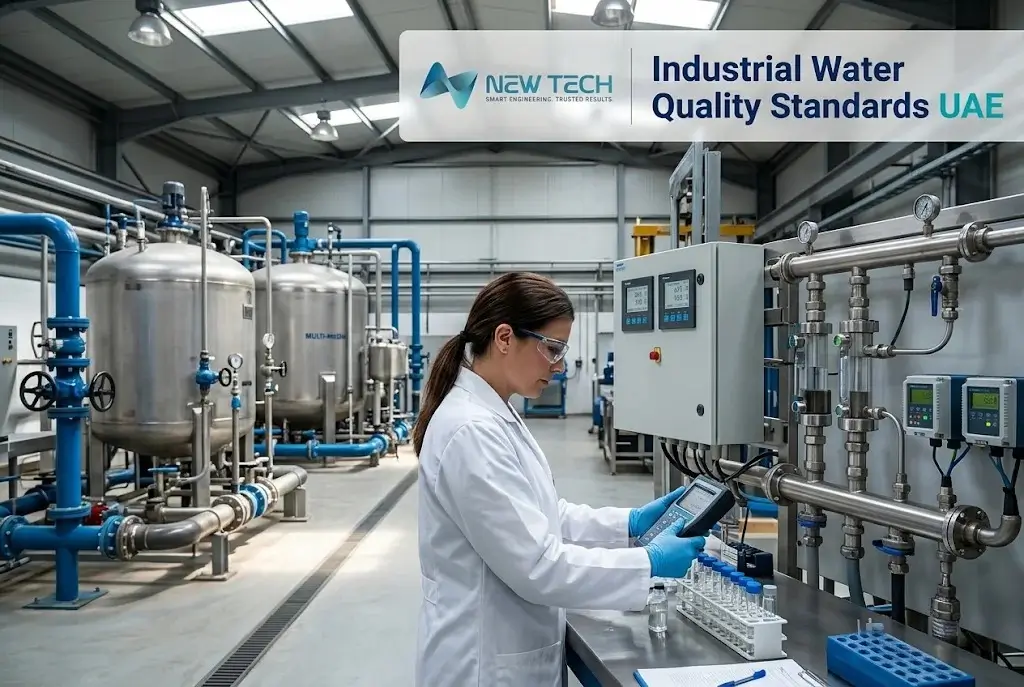
Understanding industrial water quality standards UAE starts with identifying the intended water application. Water used in manufacturing, steam generation, cooling, cleaning and wastewater treatment can require different chemical, physical and microbiological characteristics. Selecting an inappropriate specification may result in scaling, corrosion, membrane fouling, unreliable production or non-compliance with discharge requirements.
There is no single nationwide TDS, hardness or pH value suitable for every industrial operation. The applicable requirement may come from a regulatory instrument, environmental permit, process specification, product-quality standard or equipment manufacturer’s instructions.
A factory should therefore identify both the water stream being assessed and the authority or document that defines acceptable quality before purchasing treatment equipment.
Four Categories of Industrial Water Quality Requirements
| Water Category | Primary Purpose | Specification Source |
|---|---|---|
| Potable Water | Protect human health where drinking-water requirements apply. | Applicable potable-water legislation and standards. |
| Industrial Process Water | Support product quality and manufacturing processes. | Process, customer and applicable industry specifications. |
| Boiler and Cooling Water | Maintain equipment reliability and operating efficiency. | Manufacturer requirements and applicable technical guidance. |
| Wastewater and Recycled Water | Meet discharge or approved reuse requirements. | Competent authority, permits and reuse specifications. |
The same industrial facility may need separate specifications for raw water, softened water, RO permeate, boiler feedwater and final wastewater discharge. Each specification must be assessed independently.
Identify the Water Quality Requirements for Your Factory. Share your application, water analysis and equipment specifications with New Tech Water.
Request a Free Consultation Now
Get in touch with our experts to help you choose the right water treatment plant for your needs with maximum efficiency and minimum cost.
Regulatory Limits vs Industrial Process Specifications
One of the most important steps in industrial water assessment is distinguishing legally binding requirements from technical operating targets. A manufacturer’s recommended water quality range is not automatically a UAE legal limit, while an environmental discharge permit does not necessarily define the quality required by production machinery.
Regulatory and Permit Requirements
Regulations can control potable water, industrial wastewater, environmental protection or specific recycled-water applications. The relevant provisions depend on the emirate, industrial activity, receiving water system and approval conditions.
Where permits apply, the facility should verify the parameters, limits, sampling points, testing methods and reporting requirements stated by the competent authority.
Manufacturer Requirements
Industrial boilers, heat exchangers, cooling towers, RO membranes and other equipment may have specific requirements for hardness, dissolved oxygen, chloride, silica, suspended solids or chemical compatibility.
Equipment limitations should be taken from current manufacturer documentation for the actual model and operating conditions, rather than from an unrelated generic water quality table.
Process and Product Specifications
Food and beverage, pharmaceutical, electronics and other industries may establish additional quality targets for water that contacts products or supports sensitive manufacturing processes.
These requirements may be stricter than general utility-water specifications and can include specialized chemical, microbial or validation criteria.
How to Classify a Water Quality Requirement
| Requirement Type | Example | How to Verify It |
|---|---|---|
| Regulatory Limit | Permitted wastewater discharge parameter. | Current regulation, consent or applicable permit. |
| Manufacturer Requirement | Maximum feedwater hardness for specific equipment. | Model-specific technical documentation. |
| Process Specification | Required TDS for a manufacturing operation. | Approved production or customer specification. |
| Illustrative Design Target | Hypothetical water quality value used in a calculation. | Clearly identified engineering assumption. |
Before approving a treatment proposal, procurement teams should record the origin and status of every required water quality parameter.
Separate Legal Compliance from Equipment Performance. Build a clear specification before requesting industrial treatment equipment.
Request a Free Consultation Now
Get in touch with our experts to help you choose the right water treatment plant for your needs with maximum efficiency and minimum cost.
Industrial Water Quality Parameters and Testing Requirements
Industrial water testing provides the basis for choosing appropriate treatment equipment. However, no single parameter describes every relevant property of water. Conductivity, TDS, hardness, suspended solids and microbiological quality measure different characteristics and must be interpreted according to their intended applications.
Important Water Quality Parameters
| Parameter | Typical Unit | Industrial Significance |
|---|---|---|
| pH | pH units | Corrosion, precipitation and process chemistry. |
| Total Dissolved Solids | mg/L | Overall dissolved constituent concentration. |
| Electrical Conductivity | µS/cm | Dissolved ionic content and process monitoring. |
| Total Hardness | mg/L as CaCO3 | Calcium and magnesium scaling potential. |
| Alkalinity | mg/L as CaCO3 | Buffering and water chemistry control. |
| Silica | mg/L | Membrane and steam-system deposits. |
| Iron and Manganese | mg/L | Fouling, deposits and discoloration. |
| Chloride | mg/L | Corrosion and material compatibility. |
| Turbidity | NTU | Light scattering associated with suspended material. |
| Total Suspended Solids | mg/L | Suspended particulate loading. |
| COD | mg/L as O2 | Chemical oxygen demand associated with oxidizable substances. |
| BOD | mg/L as O2 | Biochemical oxygen demand under defined test conditions. |
| Microbiological Indicators | Method-dependent | Hygiene and biological contamination concerns. |
What Is the Difference Between TDS and Conductivity?
TDS describes the concentration of dissolved constituents, while conductivity measures a solution’s ability to conduct electricity. Conductivity may be used to estimate TDS, but the conversion factor varies with ionic composition and measurement conditions.
A conductivity-derived TDS estimate should therefore not automatically replace a laboratory determination when a process specification requires a particular testing method.
Why Hardness and TDS Are Not Interchangeable
Total hardness mainly reflects calcium and magnesium ions, whereas TDS includes a wider range of dissolved substances. A conventional sodium-cycle softener reduces hardness through ion exchange but does not provide general desalination.
If the objective is to reduce dissolved mineral content significantly, RO or another suitable treatment process may be evaluated using the full water analysis.
Sampling and Laboratory Quality
The reliability of a test result depends on representative sampling, suitable sample preservation, correct methods and competent laboratory procedures. Water should be sampled at locations relevant to the decision, such as an RO feed line, treated-water outlet or designated wastewater discharge point.
New Tech Water discusses testing parameters and procurement considerations in its Industrial Water Testing Services UAE guide.
Identify the Right Industrial Water Tests. Prepare a representative analysis before comparing treatment technologies.
Request a Free Consultation Now
Get in touch with our experts to help you choose the right water treatment plant for your needs with maximum efficiency and minimum cost.
Industrial Process Water Requirements by Industry
Factories need water quality appropriate to their products, equipment and operating conditions. A treatment system suitable for general equipment cleaning may be insufficient for sensitive manufacturing or product-contact applications.
Food and Beverage Manufacturing
Where water contacts food or becomes part of a product, applicable food safety and water quality requirements must be satisfied. Process water used in cleaning, steam generation or utilities may have additional requirements based on exposure risks and plant procedures.
Treatment options can include filtration, RO or other processes where justified by the required quality. The final design should align with the facility’s food safety management system.
Pharmaceutical Manufacturing
Pharmaceutical production may require defined grades of purified water governed by applicable pharmacopoeial and quality system requirements. Conductivity, organic carbon and microbiological quality can be relevant depending on the water grade.
Industrial RO equipment alone should not be represented as a validated pharmaceutical purified-water system without the necessary design, qualification and monitoring arrangements.
Textile and Laundry Operations
Laundry and textile facilities may require hardness reduction to support equipment operation and washing performance. Iron, manganese and other source-water constituents may also influence fabric appearance or process consistency.
The correct treatment target depends on washing equipment, textile type and chemical specifications.
Electronics and Precision Manufacturing
Selected electronics processes may require highly purified or ultrapure water with strict control of ions, particles and trace contaminants. These applications can need multiple treatment and polishing stages beyond conventional industrial RO.
General Industrial Utilities
Water used for cooling, boilers, washing and other plant utilities should be evaluated against the operating requirements of each system. One facility can require several distinct water quality specifications.
| Application | Main Water Quality Concern | Specification Basis |
|---|---|---|
| Food and Beverage | Product safety and process suitability. | Applicable food safety and production requirements. |
| Pharmaceutical | Defined purity and microbial quality. | Pharmacopoeial and validated quality requirements. |
| Textiles and Laundry | Hardness and mineral contamination. | Machine and washing-process specifications. |
| Electronics | Very low ionic and particulate contamination. | Application-specific ultrapure-water specifications. |
| Industrial Utilities | Scaling, corrosion and equipment performance. | Equipment manufacturer and engineering requirements. |
Match Water Treatment Equipment to Your Industry. Confirm the process-water specification before choosing filtration, softening or RO.
Request a Free Consultation Now
Get in touch with our experts to help you choose the right water treatment plant for your needs with maximum efficiency and minimum cost.
Boiler Feedwater Quality Requirements
Boiler feedwater quality affects scaling, corrosion, steam quality and operating reliability. The correct specification depends on boiler type, pressure, materials, condensate return and manufacturer recommendations. There is no reliable universal hardness or conductivity limit applicable to every industrial boiler.
Hardness and Scale Control
Calcium and magnesium can form mineral deposits under suitable conditions. Scale on heating surfaces may reduce heat-transfer efficiency and create operating risks. Water softening may be appropriate where hardness reduction is required.
Dissolved Oxygen and Corrosion
Dissolved oxygen can contribute to corrosion. Depending on the steam system, suitable deaeration, chemical treatment and monitoring may be necessary.
Silica, Conductivity and Alkalinity
Silica, dissolved salts and alkalinity can influence boiler-water chemistry and deposit formation. Their acceptable levels depend on the actual boiler and steam requirements.
Boiler Feedwater Assessment Checklist
- Boiler manufacturer and model.
- Operating pressure and steam demand.
- Feedwater and condensate chemistry.
- Hardness, silica and conductivity requirements.
- Dissolved oxygen and corrosion control.
- Existing pretreatment and chemical conditioning.
- Blowdown and residual wastewater arrangements.
A softener may form part of an appropriate treatment system, but it should not be assumed to satisfy every boiler-water requirement without a specialist design assessment.
Compare Your Feedwater with Boiler Requirements. Establish the necessary quality targets before specifying treatment equipment.
Request a Free Consultation Now
Get in touch with our experts to help you choose the right water treatment plant for your needs with maximum efficiency and minimum cost.
Cooling Tower Water Quality Standards and Monitoring
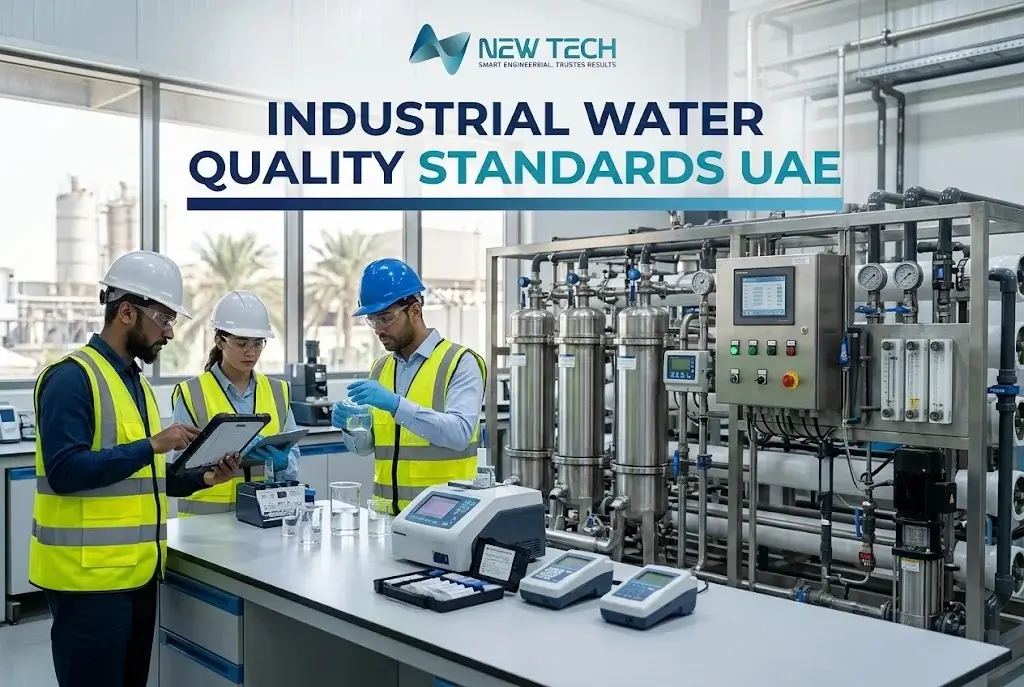
Cooling towers require water quality management to control scaling, corrosion, sediment and microbial growth. Evaporation concentrates dissolved minerals in the circulating water, making makeup-water chemistry and blowdown management important design and operating considerations.
Scaling and Corrosion
Hardness, alkalinity, pH, chloride, temperature and material compatibility influence scaling and corrosion risks. The operating program should reflect the tower design, cooling load and selected treatment approach.
Cycles of Concentration
Cycles of concentration compare the concentration of a suitable dissolved constituent in recirculating water with that in the makeup water. Higher cycles can reduce blowdown in some circumstances, but excessive concentration may create scaling, corrosion or other operating problems.
The allowable range must be established using actual water chemistry and the equipment’s operating requirements, rather than a universal target.
Microbial Control and Legionella
Cooling towers can support Legionella growth when conditions allow. A suitable water management program should address sediment, biofilm, water temperature, disinfectant management, equipment cleaning and monitoring.
The CDC guidance on controlling Legionella in cooling towers provides useful technical recommendations. It should not be confused with a legally binding UAE-wide cooling-water standard.
Cooling Tower Monitoring Parameters
| Parameter Group | Examples | Purpose |
|---|---|---|
| Mineral Concentration | Conductivity, hardness and alkalinity. | Support scaling and concentration control. |
| Corrosion | pH, chloride and relevant treatment indicators. | Evaluate material compatibility and corrosion risk. |
| Suspended Matter | Turbidity and solids measurements. | Assess filtration and sediment management. |
| Microbial Control | Appropriate microbial and disinfectant indicators. | Support water management and hygiene. |
| Blowdown | Conductivity and relevant flow data. | Manage concentration and water demand. |
Evaluate Cooling Tower Water Quality. Review corrosion, scaling and microbial control requirements before selecting equipment.
Request a Free Consultation Now
Get in touch with our experts to help you choose the right water treatment plant for your needs with maximum efficiency and minimum cost.
RO Feedwater and Permeate Quality Requirements
Reverse osmosis requires separate specifications for incoming feedwater and produced permeate. Feedwater chemistry affects membrane performance and reliability, while permeate requirements depend on the industrial application.
RO Feedwater Testing
Important feedwater parameters can include TDS, hardness, calcium, sulfate, silica, turbidity, iron, manganese, fouling potential and residual oxidants. The testing scope depends on the source water and membrane design.
SDI and Fouling Potential
The Silt Density Index is used as a screening measure for certain particulate fouling tendencies. Appropriate SDI requirements must be established from the selected membrane manufacturer and treatment design.
SDI is not a substitute for complete feedwater chemistry or a guarantee that membranes will remain free of biological and chemical fouling.
Oxidants and Membrane Compatibility
Certain polyamide RO membranes are sensitive to oxidizing agents such as free chlorine. Pretreatment should follow the membrane manufacturer’s technical requirements, including any necessary oxidant removal.
For technical guidance, consult the DuPont FilmTec RO and NF Technical Manual.
RO Permeate Specifications
Permeate quality may be assessed using conductivity, TDS or specific ions. Some applications also require microbial, organic or other quality parameters.
Where the application requires specialized purified water, further treatment and validation may be necessary beyond conventional RO.
| Water Stream | Main Question | Design Priority |
|---|---|---|
| RO Feedwater | Can the membranes operate reliably? | Pretreatment, scaling and fouling control. |
| RO Permeate | Does the product meet the required quality? | Target TDS, conductivity and other specifications. |
| RO Concentrate | How will rejected constituents be managed? | Recovery and approved concentrate handling. |
For information about industrial membrane systems, read New Tech Water’s Industrial RO Plant UAE guide.
Compare RO Feedwater and Product-Water Specifications. Provide a full analysis and required permeate quality before requesting equipment.
Request a Free Consultation Now
Get in touch with our experts to help you choose the right water treatment plant for your needs with maximum efficiency and minimum cost.
Potable Water, Process Water and Recycled Water: Key Differences
Water that meets drinking-water requirements is not necessarily suitable for a high-pressure boiler or sensitive manufacturing process. Similarly, water treated for a non-potable industrial utility should not automatically be considered safe for drinking or product-contact use.
Potable Water
Potable water must comply with applicable drinking-water safety requirements. Additional treatment may still be necessary when industrial equipment requires lower hardness or dissolved-mineral content.
Industrial Process Water
Process water must meet the specific conditions of the equipment or manufacturing operation. Depending on the application, the required quality may focus on mineral content, chemical compatibility, particles or microbiological characteristics.
Recycled Industrial Water
Recycled water must satisfy the quality requirements for its intended reuse application and any applicable approvals. Water suitable for cooling or another selected utility may not be appropriate for direct product contact.
Operators should also consider storage, monitoring and prevention of cross-connections between different water systems.
Select the Correct Water Quality Grade. Confirm whether your application requires potable, process, utility or recycled water.
Request a Free Consultation Now
Get in touch with our experts to help you choose the right water treatment plant for your needs with maximum efficiency and minimum cost.
Industrial Wastewater Discharge Standards in the UAE
Industrial wastewater discharge requirements are distinct from the quality specifications used for production. Wastewater may contain oils, organic contaminants, metals, suspended solids, chemicals or other pollutants requiring treatment or monitoring.
Applicable rules depend on the emirate, industrial activity, receiving system and approval conditions. A single discharge limit table should not be assumed to govern all UAE industrial facilities.
Dubai Industrial Wastewater Requirements
Dubai Local Order No. 8 of 2002 addresses sewerage, irrigation and drainage. Article 8 requires that industrial wastewater meet the requirements prescribed by the competent department before discharge to the public sewerage network.
Article 6 addresses prior written approval for establishing wastewater treatment plants, and relevant testing and approval for the use of treated water or sludge.
See the official Dubai Local Order No. 8 of 2002.
Facilities should verify current amendments, permits and implementation requirements with the competent authority.
Abu Dhabi Trade Effluent Requirements
The Abu Dhabi Department of Energy published the Trade Effluent Control Regulations 2022, establishing a framework for the management of trade effluent in the emirate.
The framework addresses trade effluent control and relevant consent, monitoring and compliance responsibilities. The actual requirements for a facility depend on its category, wastewater characteristics and applicable consent conditions.
Consult the official Abu Dhabi Trade Effluent Control Regulations 2022.
Recycled Water Requirements in Abu Dhabi
Abu Dhabi also has a published regulatory framework for recycled water and biosolids, including provisions related to their management and monitoring.
See the Recycled Water and Biosolids Regulations 2021.
The scope of these regulations should be checked before applying them to a particular private industrial water reuse project.
Sharjah and Other Emirates
Industrial operators in Sharjah and other emirates should identify the responsible authority, approved discharge route and applicable permit requirements. Dubai and Abu Dhabi regulations should not be treated as automatically applicable throughout the country.
Industrial Wastewater Compliance Checklist
- Identify the competent wastewater authority.
- Confirm the permitted discharge route.
- Determine whether consent or another approval is required.
- Identify the relevant testing parameters and limits.
- Confirm approved sampling points and methods.
- Evaluate any required pretreatment.
- Manage brine, sludge and other residual streams appropriately.
- Maintain permits, analytical reports and monitoring records.
Check Your Industrial Wastewater Obligations. Verify the relevant authority and discharge requirements before specifying treatment equipment.
Request a Free Consultation Now
Get in touch with our experts to help you choose the right water treatment plant for your needs with maximum efficiency and minimum cost.
How to Read an Industrial Water Analysis Report
A laboratory result becomes useful when it is compared with the correct quality requirement. Before choosing equipment, the plant should confirm the sampled water stream, the reported units and the applicable acceptance criteria.
Step 1: Identify the Water Stream
Determine whether the sample represents raw feedwater, softened water, RO feed, permeate, boiler feedwater, cooling water or wastewater. Each location has a different monitoring purpose.
Step 2: Check the Units
Review whether results are reported in mg/L, µS/cm, NTU or another unit. Hardness reported as CaCO3 equivalent is not directly interchangeable with the mass concentration of an individual ion.
Step 3: Confirm the Required Specification
Determine whether the target originates from a legal limit, equipment requirement or approved process specification. Avoid judging results against arbitrary numerical values from unrelated applications.
Step 4: Identify the Treatment Gap
Compare the feedwater result with the required final quality and determine which constituents need removal or control. A high TDS result does not necessarily mean RO is required unless the process demands lower dissolved-mineral content.
Step 5: Review the Full Design Conditions
The final equipment assessment should consider water temperature, flow, pressure, treatment recovery, hydraulic peaks, chemical compatibility and residual waste.
Step 6: Define the Response to Failed Results
A complete monitoring plan should specify what happens when results exceed the relevant acceptance limit. Depending on the application, actions may include verifying the test, investigating treatment performance, diverting unsuitable water or following the approved operational procedure.
Turn Water Analysis into a Practical Equipment Specification. Identify the treatment gap before requesting quotations.
Request a Free Consultation Now
Get in touch with our experts to help you choose the right water treatment plant for your needs with maximum efficiency and minimum cost.
Practical Example: Calculating the Required TDS Reduction
Consider a hypothetical factory using source water with a TDS concentration of 1,200 mg/L. The industrial process requires product water with a contractual target of 100 mg/L TDS. The feedwater also has hardness of 300 mg/L as CaCO3 and pH 7.5.
These values are illustrative engineering inputs, not UAE regulatory limits or guaranteed equipment performance figures.
| Parameter | Illustrative Value |
|---|---|
| Feedwater TDS | 1,200 mg/L |
| Feedwater Hardness | 300 mg/L as CaCO3 |
| Feedwater pH | 7.5 |
| Required Product TDS | 100 mg/L |
Step 1: Calculate the Required Reduction
Required TDS Reduction (%) = [(Feedwater TDS – Product TDS Target) / Feedwater TDS] × 100
Required TDS Reduction = [(1,200 – 100) / 1,200] × 100 = 91.67%
The required product-water target therefore represents an overall TDS concentration reduction of approximately 91.7% relative to the feedwater.
Step 2: Evaluate Water Softening
Ion-exchange softening may reduce calcium and magnesium hardness, but conventional sodium-cycle softening does not normally provide the dissolved-mineral reduction required to move from 1,200 mg/L TDS to 100 mg/L.
Step 3: Evaluate Reverse Osmosis
RO may be a suitable technology to investigate because it reduces many dissolved salts. However, the calculated 91.7% is a required overall concentration reduction, not a membrane guarantee or a substitute for a detailed design calculation.
Step 4: Assess Pretreatment and Concentrate
The engineer must review the full feedwater analysis, membrane fouling and scaling risks, recovery, pressure, permeate requirements and concentrate disposal.
Step 5: Confirm All Other Specifications
Meeting the hypothetical TDS target does not establish compliance with every process requirement. Additional quality parameters may be relevant, including specific ions, silica, microbial quality or organic constituents.
Evaluate Treatment Options Using Your Actual Water Analysis. Share the source-water report and required product-water specification with New Tech Water.
Request a Free Consultation Now
Get in touch with our experts to help you choose the right water treatment plant for your needs with maximum efficiency and minimum cost.
Which Treatment Technology Meets Your Water Quality Requirements?
Industrial water treatment technologies address different contaminants. Equipment should be selected using the measured feedwater characteristics, the required product quality and the actual operating duty.
| Water Quality Problem | Technology to Evaluate | Important Limitation |
|---|---|---|
| Suspended Solids | Media or cartridge filtration. | Does not generally remove dissolved salts. |
| Calcium and Magnesium Hardness | Ion-exchange softening. | Not equivalent to RO desalination. |
| High Dissolved Mineral Content | Reverse osmosis. | Requires pretreatment and concentrate management. |
| Iron and Manganese | Source-specific pretreatment. | Depends on concentration and chemical form. |
| Selected Organic Pollutants | Activated carbon or another suitable process. | Removal depends on the contaminant. |
| Specified pH Adjustment | Controlled chemical dosing. | Requires appropriate chemical and equipment design. |
| Microbiological Quality | Suitable treatment and validation. | Must match exposure and process requirements. |
| Complex Wastewater | Combined treatment processes. | Requires detailed wastewater characterization. |
When Are Multiple Treatment Stages Necessary?
Water may contain solids, hardness, dissolved salts and other contaminants at the same time. A treatment process can therefore require several coordinated stages, but each stage should be justified by the water analysis and the required outlet quality.
Chemical Dosing Equipment
Some treatment systems use chemical injection for pH control, antiscalant application or another defined treatment duty. The selected pump must match the chemical formulation, required dosing capacity, operating pressure and materials of construction.
New Tech Water provides procurement guidance in its Chemical Dosing Pump Supplier UAE page.
Compare Equipment by Treatment Performance. Match filtration, softening, RO or dosing technology to your actual water quality requirements.
Request a Free Consultation Now
Get in touch with our experts to help you choose the right water treatment plant for your needs with maximum efficiency and minimum cost.
Industrial Water Quality Monitoring and Compliance Records
Routine testing helps identify changes in feedwater quality and treatment performance. The monitoring program should reflect equipment sensitivity, process criticality and any applicable regulatory or permit conditions.
Online Monitoring
Online conductivity, pH, flow, temperature and other suitable instruments may support continuous process control. The selected instruments should be properly installed, calibrated and maintained.
Laboratory Testing
Laboratory analysis may be needed for hardness, individual ions, silica, metals, organic parameters and microbiological indicators. Online instrumentation does not eliminate the need for laboratory tests where these are required.
Sampling and Reporting
Sampling locations should be defined for raw water, treated process water and wastewater as appropriate. The facility should document results, acceptance criteria, test methods and corrective actions.
| Monitoring Record | Why It Matters |
|---|---|
| Sampling Location | Identifies the tested water stream. |
| Sampling Date | Provides operational context. |
| Test Method and Unit | Supports valid comparison. |
| Measured Result | Documents actual water quality. |
| Applicable Specification | Shows the required acceptance criterion. |
| Corrective Action | Records the response to an unacceptable result. |
| Calibration and Maintenance | Supports monitoring reliability. |
Build a Consistent Water Quality Monitoring Program. Define test parameters, sampling points and corrective-action procedures.
Request a Free Consultation Now
Get in touch with our experts to help you choose the right water treatment plant for your needs with maximum efficiency and minimum cost.
Technical RFQ for Industrial Water Treatment Equipment
A clear Request for Quotation allows suppliers to compare equipment using the same design basis. Procurement teams should include the water analysis, required outlet quality and operating conditions, while distinguishing equipment supply from installation or other project services.
| RFQ Item | Required Information |
|---|---|
| Project Location | Dubai, Sharjah, Abu Dhabi or another UAE site. |
| Industrial Application | Process water, boiler, cooling, RO or wastewater. |
| Water Source | Municipal, groundwater or another approved source. |
| Feedwater Analysis | Representative laboratory report. |
| Target Water Quality | Required parameters, limits and specification source. |
| Daily Water Demand | Required m3/day. |
| Peak and Normal Flow | Design flow and operating variations. |
| Operating Conditions | Temperature, pressure and operating hours. |
| Required Technology | Filtration, softening, RO or another process. |
| Residual Streams | Brine, sludge, backwash or wastewater arrangements. |
| Utilities | Power, space, drainage and controls. |
| Monitoring | Instruments, signals and reporting requirements. |
| Commercial Scope | Products, accessories, documentation and requested services. |
How to Compare Supplier Proposals
Compare the required feedwater quality, guaranteed or proposed outlet performance, operating assumptions, consumables, maintenance and exact scope of supply. Two systems with similar nominal capacity may not deliver equivalent results under the same conditions.
Any performance guarantee should be supported by written supplier documentation and applicable terms rather than assumed from a general product description.
Send Your Industrial Water Treatment RFQ. Provide the water analysis, target quality and equipment specifications to request a focused quotation.
Request a Free Consultation Now
Get in touch with our experts to help you choose the right water treatment plant for your needs with maximum efficiency and minimum cost.
Industrial Water Quality Requirements in Dubai, Sharjah and Abu Dhabi
Industrial facilities across the UAE can have different source-water conditions, operating requirements and wastewater obligations. Location matters for regulatory compliance and project logistics, but the treatment design must still reflect the actual industrial application.
Dubai Industrial Water Quality
Dubai facilities should distinguish process-water requirements from wastewater discharge conditions. Boiler, cooling and RO specifications depend on equipment and production requirements, while wastewater discharge is subject to the relevant authority’s applicable rules.
Sharjah Industrial Water Quality
Industrial operators in Sharjah should assess source-water hardness, dissolved salts and equipment compatibility. Wastewater obligations must be verified with the responsible local authority and the approved discharge route.
Abu Dhabi Industrial Water Quality
Abu Dhabi factories should identify any applicable trade effluent and recycled-water requirements alongside process-specific water quality specifications. The existence of wastewater regulations does not create a single TDS or hardness target for every industrial application.
Assess the Requirements of Your UAE Facility. Confirm the relevant process specification, water source and competent authority.
Request a Free Consultation Now
Get in touch with our experts to help you choose the right water treatment plant for your needs with maximum efficiency and minimum cost.
Why Discuss Industrial Water Treatment Equipment with New Tech Water?
New Tech Water publishes technical information about industrial water treatment, water analysis, reverse osmosis and chemical dosing equipment. These resources can help buyers prepare treatment specifications and identify relevant products for selected industrial applications.
Water Treatment Selection
Technical equipment selection begins with source-water analysis, the required treated-water quality and the operating conditions. Suitable technologies may include filtration, softening or RO, depending on the defined treatment objective.
Industrial RO and Dosing Components
Membrane and chemical dosing equipment should be assessed using the actual feedwater conditions, treatment duty and manufacturer documentation. Availability, models and project scope should be confirmed through a direct technical enquiry.
What to Send New Tech Water
- Industrial application and project location.
- Water source and laboratory analysis.
- Required treatment capacity.
- Target product-water quality.
- Available pressure, electricity and operating conditions.
- Required equipment and technical documentation.
- Requested delivery and commercial scope.
Discuss Your Industrial Water Treatment Requirements with New Tech Water. Share your specifications to confirm available products and request an equipment quotation.
Request a Free Consultation Now
Get in touch with our experts to help you choose the right water treatment plant for your needs with maximum efficiency and minimum cost.
Frequently Asked Questions About Industrial Water Quality Standards UAE
What are industrial water quality standards in the UAE?
They are the applicable regulatory, technical and contractual requirements for water used, discharged or reused by industrial facilities. The correct specification depends on the application and the relevant authority or equipment requirements.
Is there one TDS limit for all industrial water applications?
No. Boilers, cooling towers, RO systems and manufacturing processes have different water quality needs. A TDS target should be established from the actual process specification rather than treated as a universal UAE limit.
What parameters should factories test in industrial water?
Common parameters include pH, conductivity, TDS, hardness, alkalinity, silica, iron, chloride and turbidity. Wastewater and specialized processes may require additional chemical and microbiological analysis.
What is the difference between potable and process water?
Potable water must meet applicable drinking-water safety requirements. Process water must satisfy the requirements of a particular industrial operation, which may involve different or more restrictive parameters.
What water quality is required for industrial boilers?
The required quality depends on boiler pressure, design, operating conditions and manufacturer guidance. Hardness, dissolved oxygen, silica and conductivity are among the parameters that may require control.
Which water quality parameters matter for cooling towers?
Relevant parameters include conductivity, hardness, pH, alkalinity, chloride and microbial control indicators. Actual targets depend on source-water chemistry, equipment and the water management program.
What are important RO feedwater quality requirements?
RO feedwater should be assessed for dissolved salts, hardness, silica, particles, fouling potential, iron and residual oxidants. The exact limits must follow the selected membrane and system design.
How do wastewater discharge requirements differ by emirate?
Dubai and Abu Dhabi have distinct published frameworks, while facilities in Sharjah and other emirates must verify local conditions. Requirements depend on the industrial activity, wastewater composition and discharge route.
How often should industrial water quality be tested?
Testing frequency depends on process risk, source-water variability, equipment guidance and any permit conditions. Critical parameters may require continuous monitoring, while others can be tested at defined intervals.
How can a factory choose suitable water treatment equipment?
Start with representative water analysis and an approved target specification. Compare treatment technologies using expected performance, flow, pretreatment needs, operating conditions and residual waste management.
Need Industrial Water Treatment Equipment? Share your water analysis and project requirements with New Tech Water to discuss suitable available products.
Request a Free Consultation Now
Get in touch with our experts to help you choose the right water treatment plant for your needs with maximum efficiency and minimum cost.
Request Industrial Water Treatment Equipment Information
Understanding industrial water quality standards UAE requires separating process-water specifications from regulatory discharge requirements. Boilers, cooling towers, RO plants and manufacturing operations each require appropriate testing and treatment targets. A representative water analysis and clear equipment specification provide the foundation for reliable procurement.
New Tech Water publishes industrial treatment equipment information relevant to selected applications. Share your water analysis, required capacity and target quality to discuss available products and request a technical quotation.
Contact New Tech Water Today to Discuss Your Industrial Water Quality Requirements and Request an Equipment Quote.
Request a Free Consultation Now
Get in touch with our experts to help you choose the right water treatment plant for your needs with maximum efficiency and minimum cost.

 English
 Arabic