
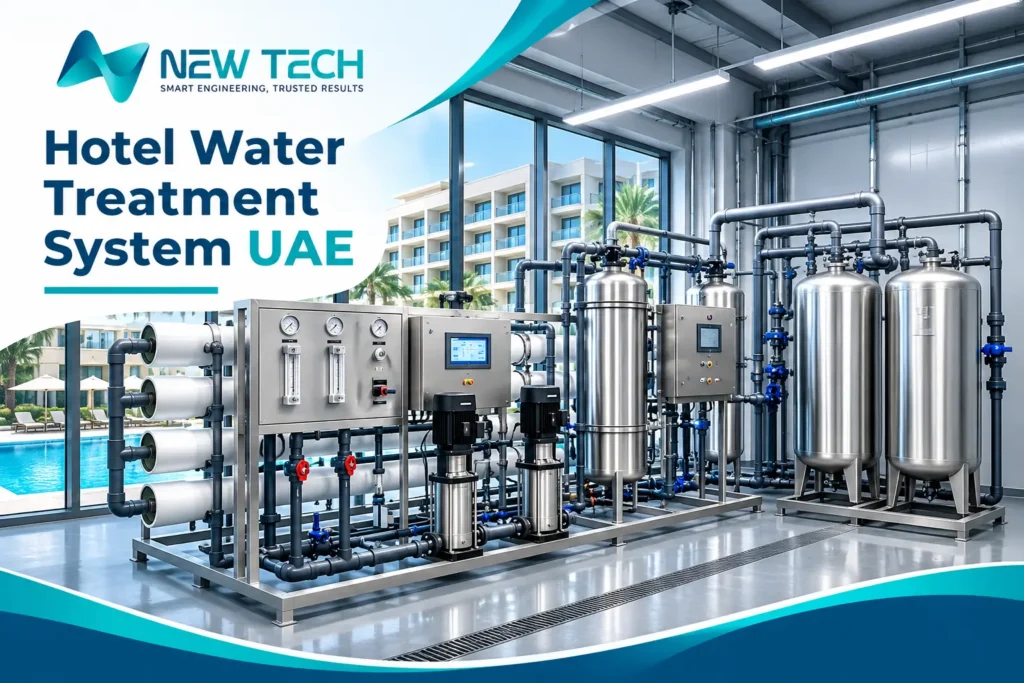
Hotel Water Treatment System UAE | Request a Quote
Looking for a reliable hotel water treatment system in the UAE? From guest rooms and kitchens to laundry and hot-water equipment, hotels need different water quality solutions to maintain comfort and protect their facilities. Choosing the right hotel water treatment system UAE starts with source-water analysis, actual consumption and equipment specifications. This guide explains filtration, RO, water softening, water safety management and operating costs to help hospitality engineering teams select suitable treatment equipment and prepare a technical enquiry with New Tech Water. Hotel Water Treatment System UAE: Choosing the Right Solution for Your Property A successful hotel water treatment system UAE project begins with understanding how water is used throughout the property. Hotels depend on consistent water quality for guest bathrooms, food preparation, commercial laundry, heating systems and building utilities. Although several departments may receive water from the same supply, they do not necessarily need identical treatment. A kitchen may require specific mineral control, while laundry equipment may benefit from hardness reduction and central building systems may require suitable filtration. The hotel engineering team should evaluate incoming water quality, existing equipment, operating schedules and peak demand before selecting a treatment technology. This approach helps avoid installing unnecessary RO capacity or relying on a filter that cannot solve the identified problem. The objective is to achieve suitable water quality, protect equipment and manage long-term operating costs without compromising the hotel’s water safety responsibilities. Hotel Water Treatment Requirements by Application Application Main Concern Potential Treatment Guest Rooms Potability, scale and water quality consistency Suitable filtration or hardness reduction where needed Restaurants and Kitchens Taste, minerals and equipment specifications Activated carbon or RO when justified Commercial Laundry Hardness, deposits and detergent performance Water softening or appropriate conditioning Boilers and Hot-Water Equipment Scaling, corrosion and feedwater chemistry Equipment-specific conditioning Cooling Systems Scale, corrosion and microbial risks Specialized treatment and monitoring Storage and Distribution Stagnation and microbial quality Water management and suitable operating controls The correct treatment configuration should follow the intended use and applicable quality requirements. A central softener, for example, does not automatically replace dedicated kitchen purification or a comprehensive building-water safety program. Identify the Right Treatment Equipment for Your Hotel. Share your source-water analysis, required capacity and property specifications with New Tech Water. How Hard Water Affects Guest Comfort and Hotel Operating Costs Hardness is an important consideration in hospitality water management because calcium and magnesium can contribute to mineral deposits under suitable operating conditions. Scale may accumulate on shower fittings, taps, heat exchangers and selected heating equipment. The resulting cleaning and maintenance burden can affect operational efficiency and the appearance of guest facilities, although visible limescale does not automatically mean the water is unsafe. Bathrooms, Guest Experience and Maintenance Mineral deposits on bathroom fixtures can increase housekeeping effort and make surfaces appear poorly maintained. Hotels experiencing persistent scaling should measure total hardness and investigate related water chemistry before selecting treatment. Water softening may be useful when hardness is responsible, but surface deposits can have different causes and should not be attributed to hardness without assessment. Hot-Water Systems and Heat Transfer Scale in suitable heating equipment may reduce heat-transfer efficiency and increase maintenance requirements. Boiler and hot-water equipment specifications should guide any softening or additional conditioning. The appropriate solution depends on hardness, alkalinity, operating temperature and equipment design rather than a generic hotel water quality target. Water Hardness and Laundry Performance Commercial laundries often depend on consistent water conditions for detergent performance and cleaning processes. Excessive hardness can interfere with some detergent formulations and contribute to equipment deposits. A hotel water softening system UAE should be evaluated using measured hardness, laundry consumption, regeneration requirements and the specifications supplied by detergent and equipment manufacturers. Protect Your Hotel Equipment from Scale-Related Problems. Request a technical review of your hardness results and treatment requirements. Filtration, Reverse Osmosis and Water Softening: Technology Comparison The selection of a hotel water treatment system UAE should be driven by water analysis and the intended application. Different technologies remove or control different contaminants, and installing additional treatment stages without a defined purpose may increase capital costs, energy consumption and maintenance requirements. Media Filtration for Suspended Particles Sand and multimedia filters can reduce selected suspended solids and turbidity. They may protect downstream equipment or support other treatment stages. Filter design should account for solids loading, required flow, pressure loss and cleaning or backwashing. Conventional media filtration should not be expected to remove significant quantities of dissolved salts. Activated Carbon for Taste and Odour Control Activated carbon may reduce selected organic compounds, unwanted taste and odour substances, and free chlorine under suitable conditions. This can be relevant to certain kitchen or beverage applications and membrane pretreatment arrangements. Carbon systems require appropriate maintenance because microbial growth and loss of disinfectant residual may create downstream water quality concerns. Water Softening for Hardness Reduction Ion-exchange softeners reduce calcium and magnesium hardness. They may be appropriate for selected laundry, heating and utility applications when scaling is the primary concern. A softener should be specified using actual hardness loading, service flow, regeneration frequency and operating conditions. Softening is not equivalent to desalination or complete disinfection. Reverse Osmosis for Selected Kitchen and Utility Applications Reverse osmosis reduces many dissolved salts and other constituents using membrane separation. A hotel RO water treatment system may be useful where kitchen equipment, beverage preparation or a selected utility process requires additional dissolved-mineral reduction. The preferred permeate quality should be determined from the intended application because very low-mineral water is not automatically suitable for every connected appliance. New Tech Water discusses feedwater analysis, treatment capacity, pretreatment and permeate specifications in its Industrial RO Plant UAE</a guide. UV Disinfection and Its Limitations UV treatment can inactivate susceptible microorganisms when appropriately designed and operated. Performance depends on water UV transmission, reactor characteristics, flow and the intended microbial target. However, UV does not create a lasting disinfectant residual, so it cannot independently control microbial hazards in hotel storage tanks and distribution networks. Technology Primary Function Key Limitation Media Filtration Suspended-solids reduction Does not substantially remove
 English
 Arabic